Is it possible for you to feel OK by interacting with someone you feels is NOT OK? Is it possible to increase one’s sense of worth through dealings with someone who has low self worth?
Yet another thought-provoking and relatable question from our Transactional Analysis course. This is one of the easier ones to answer.
Yes: someone you think who has low esteem can build you up. And I do not answer this merely from the point of view of feeling.
Low self esteem is not a disease. Although there are people we know who are continuously in this mode, I think it’s something that affects everyone sometimes. It is, yes, a feeling, but also the result of beliefs that can be highly dependent on context. Low self esteem is found in the highly talented as well the most mediocre, in rich and in poor. It can be found in people who are professionally highly successful, and whose stories inspire.
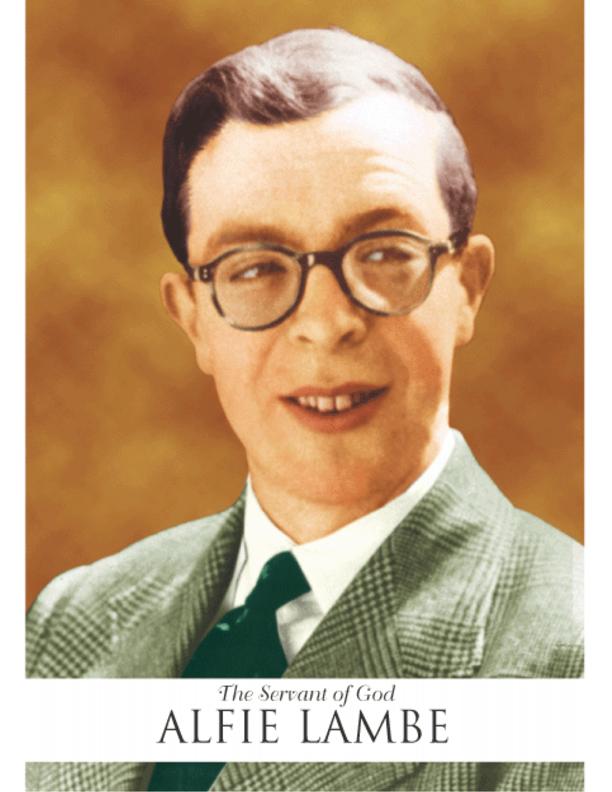
This phenomenon is very clear in the saints. And few are more illustrative than the life of Alphonsus ‘Alfie’ Lambe (1932-1959). Although he is not a canonized saint of the Catholic Church, having reached the first stage which is to be called “Servant of God”, he is considered by many to be the patron of people with low self esteem. A patron saint is often someone associated with a need. In his case we find frustration and poor health, perhaps few friends, but mixed with a great love for God and for men.

This is how the site https://www.thecatholicprofessional.com/patron-saints-series/ describes him:
Servant of God Alfie Lambe was also a member of the Legion of Mary and was an Envoy to South America. He was very disappointed when his ill health prevented him from joining the Irish Congregation of Christian Brothers. However, he found a new calling through the Legion of Mary, serving homeless men at the Morning Star Hostel in Dublin. Despite his health challenges, he became an Envoy of the Legion of Mary and visited schools, leper colonies and prisons in Columbia, Ecuador, Chile, Bolivia, Peru, Uruguay, Brazil and Argentina. He was good with languages and learned Portuguese, Spanish, Quechua (a native language), and even Russian in hopes of traveling there. The ‘el corderito,’ or ‘little lamb’ as he was known, didn’t make it to Russia, dying at the young age of 26 in 1959 after establishing numerous branches of the Legion in multiple countries. Although he didn’t join the order, he is buried in the Christian Brothers Vault, Recoleta Cemetery, Buenos Aires, Argentina. His cause for beatification began in 1978. If you are in a situation where you don’t know what to say or how to say it, ask ‘el corderito’ for help!
Quite average in human talents but extraordinary in achievement, Alfie Lambe reflects the words of St. John the Baptist
“He must increase, and I must decrease.”
John 3: 30
Many saints were failures by our standards: St. John Cupertino, denied entry to three monasteries because of extreme neuroticism, St. Francis Xavier, failed miserably in his dream to catechize East Asia. Some saints were quite loud: like St. Jerome, the second most voluminous writer in Church history after St. Augustine. This is how https://www.wordonfire.org/articles/the-cantankerous-st-jerome/ describes him:
“Jerome was known for being a cantankerous fellow. He struggled at times with the virtue of patience, could be overbearing with those who disagreed with him, and had a reputation for being cranky. One commentator on Saint Jerome’s life noted that perhaps Jerome chose to be a hermit, not so much as a heroic act of sacrifice, but because had he not lived alone, he most assuredly would not have been a saint!“
St. Camillus de Lellis was a former gambling addict. Others were more “normal”, like St. Philip Neri, patron saint of people who like to laugh and enjoy, and St. Joseph who was Jesus’ dad and taught him carpentry.
Does divorce destroy self esteem? Some saints went through a divorce: St. Fabiola of Rome and St. Gummarus. How about physical abuse? St. Germaine Cousin, born poor and with a terrible physical deformity, was abused by her stepmother all her life.
Yet all of them are heroic in their love for the sick, the poor, and in their love for God. In fact, it seems to be that since they considered themselves as nothing, God was able to fill them with everything. They had no self-esteem of their own, other than what God had placed in their souls.
These are heroic examples. How about the less heroic? In fact, we’re rarely inspired by everything in a person’s life. Even the people we look up to may be horrible in some aspect of their life. My favorite movie character, Michael Corleone, feared Mafia godfather, was a terrible father and husband. Louis Pasteur, real life scientist, was inspiring to microbiologists since the 19th century, but was quite incompetent as an administrator.
I imagine that when you’re a bad administrator your “self-esteem” as an administrator goes down when you’re with excellent managers.
So, self-esteem can be relative. It can be low in a few areas, it can affect many areas. But it may leave out a few where one is an inspiration.
And it can also be that a person never finds his genius. Yet even that is not without worth: the fact that he lived, survived, had kids, had a job no matter how terrible. If he did it, why can’t I?
Any interaction with any person is a gift. Everyone is a universe in himself or herself waiting to be discovered. Perhaps your Grab driver is an awesome father or a math genius. You’ll never know until you make contact with that universe and what it holds.
Most of us are intensely curious as kids. Then work and responsibilities get us so wrapped up in our own concerns that most talk stays at the level of small talk. We may encounter people who find it creepy when others try to get to know them. The pandemic might have made some people more careful, or simply less used to face-to-face interaction.
And some continue to wear their masks. There is little evidence that surgical masks protect one from contracting it; the only reason I see for people to continue wearing them is when they themselves are sick. It’s much the same with self-esteem. If we don’t take the initiative to reveal what we have inside, it makes it a lot harder for others to appreciate our gifts. And so, whether it affects a few or large areas of our life, low self esteem is something we choose.
(Q.C., 240111)
 jaylazzo