My name is Code Hunter. I’m a biologist and a private investigator.
My colleagues across the corridor were excited at lunch yesterday. By 5:00 pm today they were on Prozac. Something about their conclusion. They asked me to find it.
So I jumped into the paper. Literally. Vaporized from my office. Passed through a wormhole and entered into a parallel universe.
In the twisted underbelly of biological research is a dimension not only of sight and sound but of mind, a wondrous land where numbers and data points live and breathe, play games, concatenate, keep our world spinning. Data are shadowy figures pulling the strings, making the decisions of humans in the real world. I talk and joke with them; sometimes cut their throats with Okham’s Razor, a stainless steel beauty and the only lady I will sleep with.
Data got through that shouldn’t have. Null hypothesis: it was a typo. Alternate hypothesis: someone let it in the joint.
My first stop was the Land of Records. Messy place. Random, dependent, and independent variables all confused, mostly biased, confounding Cardinals and Ordinals at every street corner.
I spotted what I was looking for, an informant. He was high, but he was discrete.
“Hey man, what’s up?”
“Yo. Someone got through again, huh?”, asked Ratio, my data point man.
“It seems.”
“Word on the street is a Type I error’s been banging around. The chick’s been cruising the streets of Quantum Mechanics and Gene Expression as well. She’s not choosy.”
“A streetwalker.” I knew who it was. “Take care of yourself, man,” and we parted.
Delightful Digit. She had sauntered onto the scene, a curvaceous 304 with a significant figure that could make a calculator blush. This femme fatale was up to no good, slipping past Cross Validation like a stealthy cat. She was an outlier from a binomial distribution, with the confidence of an alpha female that p’d on everyone else. But she had a way about her that made the number-crunching algorithms dance to her tune.
I got her once, D.D. Locked her up in a metal cage suspended from the ceiling. Now she’s back.
I crossed into Analysis territory. Interrogated decimals and an odd categorical variable, nearly sliced off the digits of a fraction who refused to correlate. D.D. remained elusive, but I got the answers I wanted.
Next stop: the Conclusion. I found my contact, Mr. Student.
“Look Mr. Hunter, we employed some Models, externally validated, no fault in that. We checked the sampling: the inclusion and exclusion criteria were good. All the randomization checked out.”
“Wait, Student. You said you employed Models. What did they look like?”
“Oh, Mr. Hunter, they were breathtaking! They had vital statistics to induce adverse effects in cases AND healthy controls, long sensual trend lines, and the largest cuboids this side of the equation. I’m not being biased.”
“Mr. Student,” I said, “No, I think you are being very biased. But I understand. Some broads you can’t resist.”
I told Student that I had overheard a bunch of standard deviants, rejects, sulking up it being their last day in the Conclusion before being reformatted. They were lamenting about Delightful Digit mesmerizing their hearts only to tear them from their chests and send them to Trash.
“Mr. Student, don’t let her allure throw you off. Delightful Digit isn’t a simple False Positive; she’s not even a Systematic Error. She is a Confirmation Bias, the kind of girl you don’t introduce to your mother without a negative control. She beguiles you into ignoring equally satisfying but less attractive alternatives. It’s hard to take her down. Because you WANT her. She’s powerful and dangerous. She once slept with Poisson, and he woke up without his two tails.”
With Student humbled, I tracked D.D.. Found her at The Old Error Bar, making out with an RCT and an observational study. The two retracted and made a swift exit when they saw Ockham’s Razor. D.D. was trapped.
“You got me, Hunter,” she said in her soft, sexy voice as she nonchalantly sat down at Table I and asked for two shots of Absolut. She had no escape. “What a waste of information, don’t you think.” It wasn’t a question. She offered me the drink. “I like you, Hunter. I propose a deal. You factor me, I smoothen your curves. What do you say? You can always blame the graduate student for not making enough replicates.”
I began to sweat. But I have a formula for temptations like this: Conflict of Interest!
“Sorry to disappoint, D.D. There’s just not enough mutual attraction between us.”
She pulled out a bronze axis. But I was too fast for her. She tried to charm her way out of a Kolmogorov Smirnov, and failed. I handcuffed her and hauled her voluptuous ass back to the real world. A Jessica Rabbit in her universe, she transformed to Schrodinger’s cat in mine.
With D.D. out of the picture, my colleagues recalculated and set things right. Now they’re off Prozac and I’m a hero again.
As for Delightful Digit, her story didn’t end well.
I placed her inside a sealed box, along with a radioactive atom, a Geiger counter, a vial of poison, and a hammer. When I opened the box, the cat was not there.
Delightful Digit had been reintroduced into the Data Matrix.
A town built atop the wobbly foundations of logical fallacies. Here, streets are paved with red herrings, while straw men stand guard like nutcrackers at every corner. Folks zip around on slippery slopes, making transportation a real hoot. The townspeople revel in their expertise of unorthodox reasoning and are always eager to dive into mind-bending conversations that defy conventional logic.
Mayor Adam Hominem is a local superstar. Instead of fussing over statistics and econometrics, he entertains the masses by poking fun at his opponents’ personal quirks. The local newspaper, The Heartfelt Tribune, focuses on heartwarming or cringe-worthy tales to captivate its readers.
The Fallacia School of Thinking is the town’s crown jewel of academia. Inspired by Schopenhauer’s The Art of Controversy, students learn to harness the power of anecdotes, navigate the perilous waters of tradition, and artfully craft arguments using hasty generalizations. These scholars become adept in the ancient art of the false dilemma, reducing complex issues to binary choices, resulting in the speediest decision-making found anywhere in the country.
Fallacia’s economy hums along on the fuel of quirky ideas. At the bustling Great Ideas Market, you’ll encounter merchants peddling their wares using the bandwagon fallacy: “Hop on, be hip!” Others credit their market dominance (“We’re #1!“) to factors that hold sway on a cosmic level.
Debates are a regular feature in the town square. With no clear winners, everyone’s self-esteem remains sky-high. Men dressed as Hassidic rabbis skillfully misrepresent opponents’ arguments, revealing imaginary weaknesses. Enthusiastic spectators cheer on their favorites while showering opponents with candy and a rainbow of good-natured insults.
The people of Fallacia have against all reason constructed a functioning society amid the chaos. What did we expect? Though outsiders may find it baffling, Fallacians are united in their offbeat way of life. They can’t really articulate what keeps them united, but they ask dissenters to leave anyway.
Oddly enough, Fallacia is home to a variety of thriving businesses. There is money; therefore, there is crime.
And thus we discover Detective Augustus Clearwater, a professional BS-buster in the tradition of Sherlock. This truth-seeking missile had a sixth sense for sniffing out fibs and outfoxing even the most devious of wrongdoers. He was in town because of his wife: she asked him to pick up a Patchwork Pizzazz Paloozasome. This garment-like garment can only be bought from Cora’s Correlation Boutique, a chic clothing store where customers can find ensembles with seemingly unrelated items paired in whimsical combos.
It just so happened a crime had been committed that evening. Someone swiped the town’s genuine relic, the Golden Herring. Augustus knew that if he could decode their loony language, he could solve the enigma. He packed the Paloozasome in his Hyundai’s trunk and set to work.
The detective began by interrogating witnesses, but each convo was like a rollercoaster ride. One witness at the Bandwagon Fitness Center — “Everyone’s fit or fat: like, where do you belong?” — insisted that since the heist took place at night, it must have been the work of a call center agent. Another who had been drinking his Reductio ad Espresso at the Hasty Generalizations Cafe claimed that since the crook left no fingerprints, he or she must be a ghost. Augustus knew he had to flip the script and catch the town in their own web of fallacies to expose the truth.
As he examined the case, Augustus saw a pattern: each fallacy the townspeople used seemed to mask a deep-seated fear or insecurity. He used their own fallacious thinking against them.
First, he targeted the town’s rumor mill, the owner of the The False Dilemma Diner, a beloved bistro that served up either/or meal choices: either chicken or meat, either well-done or rare. The dishes are either taste-bud tickling or ew-that’s-nasty. Well, this lady loved to dish out anecdotal “evidence.” Augustus cooked up a junior whopper that implicated the gossip queen in the crime. Flustered, she spilled the beans about an unsavory character she had spotted near the scene.
Next, Augustus focused on the local conspiracy theorist, also known as an ad man, who worked for the Ad Hominem Advertising Agency, a shop that skated close to the edge of conflict of interest, but the only one who’ll spill the beans on Brand X. The detective weaved a far-out tale about an ancient curse on the Golden Herring, linking the curse to the theft. The conspiracy buff, eager to connect the dots, accidentally let slip that he’d heard a plus-sized lady bragging about how easy it was to swipe the genuine relic.
Anecdotal evidence… A lady…
Augustus then confronted Miss Annette Dotal, the 300-lb daughter of the owner of the Red Herring Books, which specialized in political page-turners and tabloids that reflected ONLY popular opinions. He accused Ms. Dotal of swiping the genuine relic to create some news for the Heartfelt Tribune. Ms. Dotal whipped up a defense that the theft of the Golden Herring was nothing compared to finding out that the genuine relic was “Made in China”.
Only a thief would see the label.
Case closed.
After the “theft” of the “genuine relic” was settled thanks to Mayor Hominem, the denizens of Fallacia thanked Augustus (then threw away the Golden Herring). As the super sleuth drove into the sunset, he knew he had not only cracked the case but had also deciphered the secret to understanding the quirky and perplexing town.
“Sometimes the only way to uncover the truth is to dive headfirst into the mayhem,” he said as he turned over the Patchwork Pizzazz Paloozasome and found that it was “Made in China.”
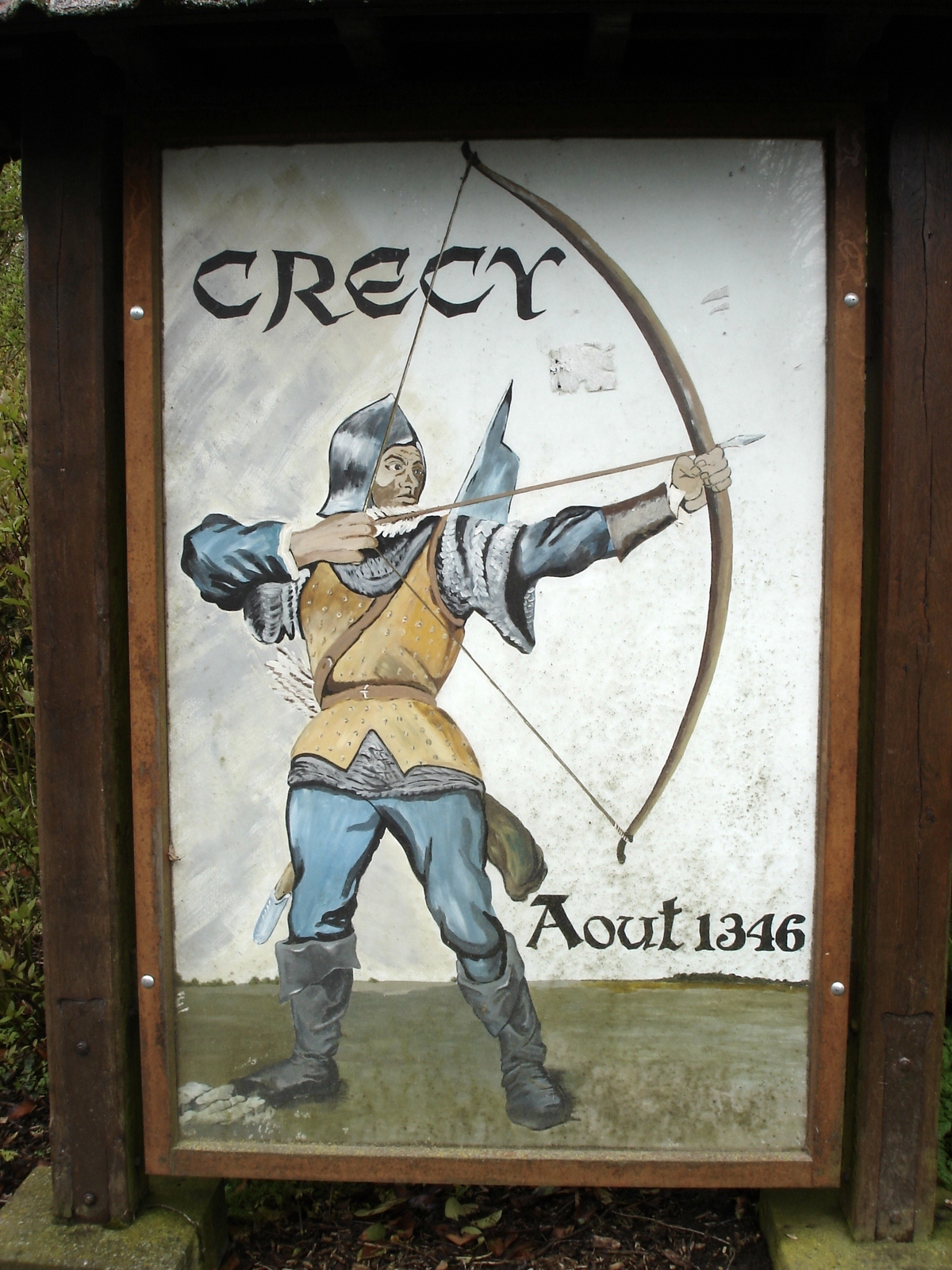
The longbow was a type of archery weapon. It had a long, straight, and relatively narrow design, ranging from 5 to 6 feet in length. It was made from a single piece of wood, often yew or other hardwoods, carefully shaped and tapered. It played a significant role in the Battle of Crecy in 1346. It was known for its accuracy, long range, and power that could pierce through armor. Longbowmen required great skill and strength to use the weapon effectively. The draw weight required to pull the bowstring back ranged from 80 to 150 pounds, making it a physically demanding weapon to use.
“We have more than enough, I can assure you.”
“You have 50 to 60 somewhat competent longbowmen, Sir Reginald. Another 100 are being trained now by Sir Archibald, but 80 of them have been recruited only in the last year or two. It takes 10 years to master the weapon. All our men, and many of our women, are experts — it’s been our preferred pastime for two generations. You have no more than 100 who have a good chance on the battlefield, while we have at least 1,000 men.”
“Your numbers are wrong,” said Sir Reginald, but the thousandth of a second hesitation told Sir Gavriel that the figures were accurate.
“I’m sure I missed a few. Nothing a few Genoese crossbow men couldn’t cover, yes? I’m sure your people would be more effective if Sir Falstaff could finally snap out of his drinking. Your Genoese listen only to him. But would you? Now? More importantly, you will certainly be unconquerable as long as Prince Robert’s real mother is never revealed.”
Sir Reginald was visibly perturbed. Did Gavriel have access to the heir’s real mother, the Abbess of Wilton, who just happened to be the sister of a rival king? “You either have no proof of that, or you have a demon. Besides, what does that have to do with war?”
“I do not have a demon, I can assure you of that, Sir Reginald. And I agree it has nothing to do with war outside the walls of the Abbey.”
Gavriel had a spy, but what terrified Sir Reginald more was that he just said he had someone inside Wilton Abbey. If anything happened to Mother Ethel it would lead to a war between his king and her brother. Gavriel can certainly choose the time to create two fronts.
After asking everyone else to leave, he said to Sir Gavriel. “Now I know you have a demon. Let’s stop playing games. I know you meant to throw me to the adder. Now, tell me, are you really going to kill the Abbess?”
Gavriel remembered his childhood friend Reginald. At 8, Reginald was the bigger, the more confident and eloquent. Gavriel was shy, but he was more intelligent.
One day, while exploring the forest for mushrooms, the boys came across an adder. Although adders are normally shy, this one was unafraid. It took up a defensive position and was ready to strike.
Reginald made to back away, but Gavriel shook his head slowly and firmly pushed his hand against Reginald’s back. Then he took it away, slowly picked up a long, thick branch from the ground, then slowly waved the branch in front of him.
The snake’s attention was drawn away from Gavriel and onto the branch. The boy carefully stepped away, continuing to wave the branch, leading the snake further.
When they were at a safe distance, Gavriel spotted a deep, narrow pit. With a quick flick of his wrist, he threw the branch into the pit, and the adder, still focused on the branch, slithered in after it. Gavriel calmly picked up a rock and crushed the snake inside the pit.
The boys ran back, Reginald’s knees were shaking. They would shake again when he remembered this episode on a calmer day.
They were later separated when Gavriel was brought to his present kingdom. Both were apprenticed to knights.
Gavriel was apprenticed to Sir William de Beauchamp. Unlike most soldiers who remained illiterate, Gavriel was taught by Sir William to read Renatus’ De Re Militari and to fight. Gavriel was a very good student and fighter. Although a clever negotiator, he could not speak well in front of a crowd.
A few years later, Sir William was blinded in a duel. Gavriel stayed on to assist him. He also had to speak for Sir William on many occasions, which was good for his communication skills. Sometimes he had to fight duels on his behalf, winning every one, solidifying his credibility by his skill and extreme cruelty.
Gavriel was trusted and feared, and he made many contacts inside and outside the kingdom.
Sir William told him one day: “You are hopeless as a rhetorician. But you are unmatched in your knowledge of the world, of science, and of men. Our kingdom is small, incapable of winning a pitched battle against any of our neighbors. The only way to survive is through the mastery of difficult skills and sciences, and through information. I have convinced the king to set up a secret society. I will be its head, and you will be my second in command. I want you to put a spy in every court and in every monastery, in every brothel if you can manage that.”
“I have something else,” added Sir William, “Inside that calm and friendly demeanor of yours, I see ruthlessness. I like that. You run the spies for me, but one day you will be wealthier and more powerful than any king. They will fight their witless wars for you, their sons will bed their mistresses and piss in their pants in fear of you. You will live in the shadows, safe even from your enemies. Like me, you will die old, alone, and you will not have a single friend at your funeral.”
Sir Gavriel carried out his mandate to put a spy in every court and abbey in every kingdom near his own. And he had spies in brothels, where he found and recruited the daughter of a man he had bludgeoned to death, officially in a duel. He promised her security if she agreed to enter a specific convent for a time; he paid the dowry.
“Kill the Abbess? Sir Reginald, that would be most inconvenient for me, and for you. Rather than talk about who dies or who lives, I would rather we talk about proposals.”
“What do you offer?”
“Sir Reginald, my king has authorized me to offer you three things. First, to your king, 2% of the profits from sales of our specially treated longbows, which you know have been extremely profitable for us. Second, to you personally, 1% of the profits. And third, the three spies you have in our court, Johann the librarian, Matilda the chambermaid, and Richard the falconer, they betrayed you. I impaled them myself, so you won’t need to worry about it. Their heads are in the basket. Esquire!” he called in a booming voice, “Please bring me the basket.”
When the esquire left, the two negotiators were alone. Sir Reginald, face very pale, spoke again. “You’re a knave and I say it to your face.” Sir Gavriel just stared. Both men then left the tent and addressed their associates.
“Gentlemen,” said Sir Reginald. “Sir Gavriel has proposed terms that are most favorable to both our kingdoms. The days of expansion through combat must one day give way to trade, which is not only less costly but more productive of ideas, products, and services. That day must begin with us; that will be our recommendation.
“It takes great courage to go against what most men consider courage. To persuade with wisdom and science, rather than the sword. Let’s now return to our courts. Love live our kings!”
And to Sir Gavriel, he hissed “Rot in hell.”
Sir Gavriel replied, “See you there.”
Both kingdoms lived in peace and prosperity thereafter. And sales of longbows have never known better years until the weapons were replaced by muskets almost 200 years later.
Every organization has its own unique mix of talents, skills, method of working, and a purpose given from on high, which we call charism. A projection of that charism to the world is called the brand. To the public, the brand is the charism.
Charism and brand are not the same, but changing a brand can be good or bad for the charism. Changing a brand can change a charism like plastic surgery can change personality, and vice versa.
I will cite two examples, the first from Coca Cola and the second from Vatican the Second.
In 1985, Coca-Cola was facing stiff competition from its rival Pepsi. In an effort to regain market share, Coca-Cola decided to reformulate their classic beverage with a new, sweeter taste. They conducted extensive taste tests and market research, and the results suggested that consumers preferred the taste of the new formula. On April 23, 1985, the company announced the launch of “New Coke.”
However, the company underestimated the deep emotional connection that consumers had with the original Coca-Cola formula. The introduction of New Coke sparked a massive public outcry. Loyal customers were unhappy with the change and demanded the return of the original formula. The situation was exacerbated by Pepsi, which capitalized on the controversy by promoting itself as a stable and consistent alternative to Coca-Cola.
Realizing their mistake, Coca-Cola executives decided to reintroduce the original formula on July 11, 1985, just 79 days after the launch of New Coke. The original formula was rebranded as “Coca-Cola Classic,” while New Coke continued to be sold alongside it. The return of Coca-Cola Classic was met with great enthusiasm, and the company’s sales rebounded.
The New Coke debacle turned out to be a costly and humbling experience for Coca-Cola but also served as a valuable lesson in the importance of understanding and staying true to a brand’s identity and the emotional connections that consumers have with it. The incident is now often cited as a cautionary tale in the world of branding and marketing.
The Catholic Church after Vatican II
The Second Ecumenical Council of the Vatican, or Vatican II (1962-1965), was a change in branding that had profound effects within the Catholic Church.
It has been associated with the shift from the Latin mass to using vernacular languages. This change was supposed to make the liturgy more accessible. However, many saw it as a charismatic break from the Church’s centuries-old tradition and a move that diluted the sacredness of the Mass.
The Council also sought to promote greater engagement and dialogue with other Christian denominations and non-Christian religions. While these steps tried to foster unity and understanding, some argued that they diminished the Church’s unique identity and theological distinctiveness.
Vatican II also called for a more inclusive and active role for laypeople in the Church’s life and governance, which led to an increased emphasis on lay ministries and a more collaborative approach to Church leadership. Some felt, however, that they undermined the traditional hierarchical structure of the Church and weakened the authority of the clergy.
The changes led to divisions within the Church, with some members embracing the reforms and others resisting or even rejecting them. These divisions, coupled with the broader cultural upheavals of the 1960s and 1970s, contributed to a decline in Mass attendance, vocations to the priesthood and religious life, and overall engagement with the Church in many parts of the world.
The Catholic Church never changed its fundamental charism as the Body of Christ. However, unlike Coca Cola which is a single monolithic entity, the Church is a Body with many sub-charisms, down to the individual. For those who left the Church, the charism itself changed, at least in their regard, in many cases even at the level of their superiors, long before the first religious or priest left. Many of these negative effects are still being addressed. Other effects were good, like defining the role of laymen in the Church more clearly, which has done a lot towards increasing membership in the Catholic Church.
God certainly has willed that charisms be better articulated and clarified, as with Vatican II, and also that brands improve. I don’t think God normally changes charisms that he grants as gifts. A person might reject God’s charism, but God offers him another. From time to time He asks people “give me back the gift I gave you, that was just a preamble, because I now want to give you the definitive one”, as with St. Teresa of Calcutta’s move from the Sisters of Loreto, where she had already made her final profession of vows, to found a new order, the Missionaries of Charity, a move that she called “a vocation within a vocation”.
While Vatican II undoubtedly brought about significant positive developments in the Catholic Church, the controversies and challenges it generated serve as a reminder of the importance of understanding and remaining faithful to an organization’s foundational identity and mission in times of change.
Let’s no break down the importance of remaining faithful to the foundational identity, the charism.
Staying faithful to a charism makes a group and its members effective, personally and as a group. Fidelity to the charism defines a clear identity, helps people put up a united front, helps us stay on course, brings in and keeps the right people, and give the organization street cred.
Keeping a Solid Identity Having a clear identity is a big deal for any organization. The charism is like the bedrock of an organization, giving it a strong base for its mission, vision, and values. When an organization stays true to its charism, it keeps a unique identity that makes it stand out from the rest, making sure it doesn’t lose its way or blend in with the competition. A strong identity gets people excited: employees, volunteers, and others involved are more likely to be dedicated and engaged.
Creating a United Front When an organization sticks to its charism, everyone feels more connected and united. With everyone on the same page about the organization’s purpose and values, people are more likely to work together to reach their common goals. This unity helps them tackle challenges and solve conflicts more effectively.
Staying on Course An organization’s charism is like its North Star, guiding its actions and decisions. By staying true to its charism, an organization can make smart choices that match its mission and values. This sense of direction helps organizations focus their resources, time, and energy in the right way, and perhaps just as important, where NOT to put these resources.
Bringing in and Keeping Great People In a world where talented people can easily move around, an organization’s commitment to its charism can be a powerful magnet for attracting and keeping the best people. People appreciate clarity not only because it’s clear where they should focus their efforts, but it is also clear how they will be evaluated. People want to succeed, and they want to know that the organization also wants that and appreciates it. Plus, a strong sense of identity makes people feel like they belong.
Earning Trust and Street Cred Organizations that stick to their charism are more likely to earn trust and credibility from everyone involved, including clients and the communities they serve. Trust is super important for success because it helps organizations build long-lasting relationships, get funding, and create a solid reputation. By showing that they’re dedicated to their mission and values, an organization convinces its stakeholders of their determination to see things through, which can only help their credibility and credit worthiness.
To sum up, staying true to an organization’s charism is super important for its long-term success. Being committed to that special sauce means an organization is better prepared to handle the challenges of today’s world and make a real, lasting difference in the lives of the people it serves, inside and outside the organization.
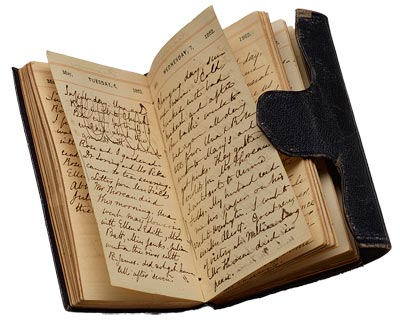
Once upon a time, in the town of Vienne south of Lyon, France, lived Pierre, a humble postman with a passion for literature. One day, while going through a pile of discarded books in the local library, he came upon an old, leather-bound journal. The pages were yellowed with age, and the cursive writing within was delicate and beautiful. As he read the first entry, he was immediately captivated by the author’s eloquence and depth. Héloïse was a young woman from the year 1823. She lived in Vienne, but two centuries before him.
With every entry, Pierre became more enthralled with Héloïse. He decided to write her a letter in response, sharing his thoughts on her writing and his life in the 21st century. Even though he knew that it was impossible to send a letter back in time, he hoped that somehow, his words would find their way to her. He carefully tucked his letter between the pages of the journal and left it on his nightstand.
When he awoke the next morning, he found that his letter had disappeared. He also found a new entry from Héloïse nestled among the old entries.
Héloïse had somehow received Peter’s letter, and she was just as intrigued by his world as he was with hers. As they continued to exchange letters, their admiration for each other’s intellect and insights grew into a deep affection, and then to love.
They nurtured by their letters their love of literature. They painted vivid images of their lives, allowing each other a glimpse into worlds they could never physically experience. In the pages of the journal, they found solace and understanding: Pierre in his fear of breaking into professional writing, and Héloïse, who was expecting a child.
The letters did not cross the time barrier on a regular schedule. But three days after Héloïse’s last entry, the last five pages were suddenly blank. Pierre waited, and waited: the pages stayed blank.
Pierre researched every possible clue regarding a Héloïse from Vienne. For sixteen years he searched. But though futile, his search gave him the courage to write and to sell his work. He was able to quit his job as a postman and was now a respected writer and journalist.
One day, while sitting in a café in Lyon, he noticed an elegant woman in her 80’s crossing the street. The lady sat at one of the tables, took out a journal and began to write. Something inside urged him. He stood up and approached her.
“Bonjour, Madame, excuse me for disturbing you,” he said to her with great respect. “I couldn’t help but notice your journal. It’s so beautiful.”
“Thank you very much, Monsieur!”, replied the woman. “I made it myself. Hand-made journals are still much appreciated today especially by people who love to write. Do you love to write, Monsieur?”
“Very much, Madame. Pleased to meet you, my name is Pierre Girard. I’m a journalist.”
“Enchantée, Monsieur. Héloïse Gauthier. I own the antique book shop across the street,” and they shook hands.
“A beautiful name, Madame. I had a friend who was called Héloïse,” he said. “But we lost touch about sixteen years ago.”
“Was this Héloïse your girlfriend?”
“Not exactly, Madame. But she was the one who encouraged me. If not for her I wouldn’t have had the courage to do what I am doing now.”
“I would have loved to meet her. I also couldn’t help noticing the journal you’re carrying. May I see it, Monsieur? Merci bien.
“The cover, worn and slightly scuffed brown leather, has aged gracefully, a rich patina. The supple leather embossed with intricate designs and the owner’s initials, H.D., gilded and slightly faded, with a discerning taste and a touch of modesty. I hope I’m not boring you.”
“I am very fascinated, Madame. I never realized how rich a real journal or book is.”
“Yes, Monsieur. At least two artists left this as a trace of their passing through this world.”
Madame Gauthier continued to describe the journal as she saw it: the familiar creaking of the spine, sewn together using a traditional 19th-century technique called the “cased-in” style. The spine itself, slightly rounded, shaped by backing, creating a small groove where the spine met the cover, allowing the book to open and close more easily. The paper, handmade laid paper, still strong and supple despite its age. The texture of the pages, wonderful to the touch, revealing the skill and craftsmanship of the papermaker. The edges of the pages, gilt, providing an elegant contrast to the creamy hue of the paper. She imagined its owner spending countless hours dipping a quill pen into an inkwell and carefully etching his or her thoughts onto these very pages.
“Excellent workmanship. And familiar,” she said, crinkling her forehead.
She turned to the first leaf, and stopped, a look of surprise on her face.
“Madame, what is it?”
“My family has been making hand-crafted journals since the 16th century; regardez, this is my family’s trademark, here.” Then taking her own journal, she showed him the first page. The trademarks were exactly alike.
Pierre didn’t know what to say.
“We still make them, Monsieur. This is from 1823, it says here. May I ask how it came to be in your possession?”
“Madame, I used to be a postman and I found this in a pile the library was discarding. I’ve been, studying it for the last 16 years. Its owner called herself Héloïse Dubois. There is no indication what happened to her after her last entry here, 23 August 1823.”
The lady browsed a number of entries. “All her letters, for letters these are, are to Pierre. Here she encourages Pierre, who has no courage. Monsieur, you said you’ve been studying this journal for 16 years. I would like to know. What have you learned about this Pierre?”
Pierre did not answer. The woman continued.
“I don’t know what to say, Monsieur. I believe this journal belonged to my great great great grandmother. They say that Héloïse Dubois was very talented. She died young, in the early 1800’s, giving birth to her only child, my great great grandfather, Pierre Dubois. I do not think she is referring here to her son, obviously. Neither is she referring to Pierre’s alleged father, a certain Hubert de Villeneuve, from an aristocratic family. I do not think so.
“The secrets of families. I think she had a lover, someone named Pierre.”
He turned pale. “You are right, Madame. She had a lover. But they only wrote to each other, they could never have met.”
“How do you know that, Monsieur? She might or might not have said it here. But how do you know?”
“Madame, you will not believe me if I told you. I would be happy, Madame, if you read the journal first. Perhaps if I told you then, it would make more sense.”
“I will Monsieur. And, thank you. It is not often that one meets family in such a manner, separated by a hundred years.”
They agreed to meet again on the morrow.
The next day, Pierre is sitting in the café. Madame Gauthier again crosses the street. He stands to greet her and pulls a chair.
“Monsieur, I read this journal at least four times last night. This ink was evidently laid down a very very long time ago. But, Monsieur, can you explain why she refers to airplanes here, and then here to Hitler, and then here to war in Indochine? Now I do not believe in clairvoyance, but if this is proof…”
“Madame, I’m sorry to interrupt. I do not wish you to think of this as a trick. Héloïse Dubois was gifted, but she was not clairvoyant. She had a lot to teach. And the person she taught was me. I am the Pierre she has been writing to.”
He told her about how he and Héloïse corresponded, how it ended, and how he had been unable to find out anything more.
Madame Gauthier was surprised, then she understood. After a long silence she spoke.
“Monsieur,” she said, “I’m afraid we know almost nothing about my ancestor. She died too young, before she could publish anything that would make her a writer in the eyes of the world. No one wrote anything about her, no one painted her, we do not have a single image of her. Even our family knows very little. We know she was very intelligent and independent and headstrong from the fact that she and de Villeneuve never married, and so her son, my great great grandfather, was illegitimate. For the same reason, she stayed away from her family. This journal is the only thing now that connects us to her. As for de Villeneuve, he disappeared from our family’s history. Pierre was raised by his aunts. I don’t even know all their names.
But about my great great grandfather, Pierre Dubois, we know a bit more. He was a successful writer and a journalist. Here is a daguerreotype dated 1859 that hangs in our house. These three are M. Morin, M. Beyssac, and M. Chanoine, founders of Le Progrès. This one is M. Dubois. Do you notice anything special, Monsieur Girard?”
Edition from 1914. Image: leprogres.shorthandstories.com/Le-Progres-depuis-160-ans-avec-vous/assets/p3kJLZaVF5/bjp_q15_03-10-14-909×618.jpegEdition from 2015. Image: img.kiosko.net/2015/10/07/fr/progres.750.jpg
“Pierre Dubois looks exactly like me!”
“I only noticed it when I looked at the picture again. C’est incroyable!
“I don’t believe in the supernatural. But I believe in you, Monsieur. I believe that somehow you corresponded with my ancestor, that she taught you, that you became what you are now because of it.
“I don’t believe, either, that your love led to a conception. Cela est impossible. But, Monsieur, love is a two way street. I think that you also left her something of yourself, something so powerful it showed in my great great grandfather. So much that you two look exactly alike and that you have the same gifts. Do you understand?
“Pierre Dubois, was born in September 1823. When were you born, Monsieur Girard?”
He smiled. “Ah Madame, I was born in July 1995. I don’t think whatever anomaly in the universe could be so precise we would be born on the same date.”
“I agree, Monsieur. And I’m glad we met. It’s almost as if I’m talking to my grandfather.”
“Please keep the journal, Madame. I’m very happy that she has found her way back to her family.”
“I will keep it but for just a while. Je vous merci beaucoup Monsieur Girard.”
Pierre and Madame Gauthier met at the café every Friday. They talked about their lives, their families and surroundings, about peace and the conflagrations of last few years, about hand-made books, antique books, quills, pens, paper, words, and modern media.
Their friendship, however, was to last for only a short time.
Two months later, Madame Gauthier died in her sleep. On her nightstand were the picture of Pierre Dubois, and the journal of his mother Héloïse. Also there was a letter, with a note that it and the journal be given to Pierre Girard. The note read:
Monsieur Girard,
I could not thank the good Lord enough for having met you. I was happy for a time to have Héloïse Dubois close to me, but now I return her to you for she is truly yours. I also enclose a gift, a journal I made. May this be your good friend and companion in all your writings.
Also, I realized we never talked about your letters to Héloïse. Could they still be extant? I have talked about this to my son. He said that finding and authenticating those letters will be a truly important find! He has begun his search. I hope he finds at least a trace of them.
I feel I do not have much time. Once again, thank you.
In the small town of Freshman lives a mild-mannered superhero known only as Mr. Word who has dedicated his life to battling thought devourers, brain leeches, and text maniacs.
Mr. Word, born as William Wordstar, was an unassuming 50-year old schoolteacher by day, but when the enemies of clear thinking threatened the sanctity of language, he donned his superhero hoodie and glasses, ready to defend the written word. With his trusty sidekick, the 75-year old former grammar Nazi now responding only to “Diction Dacy” or “Mein Fuehrer”, Mr. Word sought to protect Freshman from the chaos these creatures caused.
Mr. Word gained notoriety for battling the Grammatical Culprits, a gang of creatures that wreaked havoc on the written word, mostly among freshmen.
One of the most feared Grammatical Culprits was Nebulous Neville, a shapeshifting creature who thrived on creating confusion by masquerading as various pronouns without clear antecedents. The duo could spot his deceptive tactics and swiftly return him to his true form.
Unhinged ‘U2’ Ulric, a dangling modifier that looked like Bono with wings, loved to perch on the edge of sentences, causing all sorts of havoc with misplaced descriptions. Mr. Word used his powerful Revis-o-Ray to realign Unhinged Ulric with the appropriate subject, ensuring that each modifier found its rightful place.
Runny Ron and Fraggy Fran were a notorious duo of lazy villains. Runny Ron merged independent clauses without proper punctuation or conjunctions, while Fraggy Fran left sentences without subjects or verbs. Mr. Word, armed with his semi-colon, separated Runny Ron’s clauses and fused Fraggy Fran’s fragments, creating harmony and coherence in the text.
Then there was the dreaded trio: Comma Splicer, the naked creature who joined independent clauses with just a comma; Tensey Wensey, a 45-year old recently-single alpha female who twisted verb tenses and drove men mad; and Preppie, who misused and misplaced prepositions, and who is believed to have contributed to the bombing of Hiroshima on August 6, 1945. Mr. Word and Diction Dacy were never truly credited for their role in preserving world peace since then.
These were the small fry. The most dangerous culprits belong to two gangs that often collaborated: Logical Fallacies and Cognitive Biases. They were extremely dangerous because they especially ally themselves with Ph.D.’s in every field.
One of the most notorious Logical Fallacies was Straw Barrymore, who deliberately misrepresented arguments, crafting flimsy, easily defeated straw men. Mr. Word, armed with his powerful Clarification Quill, could identify Straw Barrymore’s ploys and reconstruct the original argument to restore intellectual honesty.
The slippery duo of Ad Hominem Hank and Red Herring Regina wreaked havoc in Freshman by attacking people’s character rather than their arguments and leading debates astray with irrelevant distractions. Mr. Word and Diction Dacy sometimes collaborated with the mysterious Luca Brasi-Barzini to expose their tactics, refocusing discussions on the matters at hand and promoting civil, issue-based debates.
Anchoring Andy, a crafty Cognitive Bias and ivermectin pusher, loved to influence people’s judgments by making them rely too heavily on the first piece or last piece of information they encountered. It took the end of the COVID pandemic for Mr. Word to fully save the people and clinicians from making bad decisions before considering all available evidence.
Confirmation Connie, a PhD and full-time OnlyFans model, was a Cognitive Bias who encouraged people to seek out information that confirmed their preexisting beliefs while disregarding evidence to the contrary. She pushed hydroxychloroquine. Mr. Word and Diction Dacy teamed up with Allocation Avenger to prove that conspiracy theories are bad for your wallet.
The worst we leave for last: the cunning duo of the drop-dead gorgeous False Cause Fiona (who looks like Jessica Rabbit) and the dashing Slippery Slope Steve (who looks like a young Robert Redford). The duo’s preferred victims are biologists and sociologists. False Cause Fiona’s MO is to trick people into believing that correlation implied causation, while Slippery Slope Steve convinces them that one event would inevitably lead to a series of disastrous consequences. Their activities are behind a continuing string of retractions of COVID papers. They were also involved in serial academic prostitution, allied with Predatory Journals, a network of gangs with shady Chinese addresses. Mr. Word and Diction Dacy collaborated with Retraction Watch to triage genuine cause-and-effect relationships from misleading correlations and assess the validity of predicted outcomes. At one point, many believed Mr. Word was really John Ioannidis, but that was just a rumor planted by False Cause Fiona.
Mr. Word, Diction Dacy, and their friends have been keeping Freshman safe from the dangerous influences of Grammatical Culprits, Logical Fallacies and Cognitive Biases. Their unwavering dedication to reason and truth have inspired batches of thinkers, debaters, and decision-makers to join them in their never-ending quest to preserve rationality and foster enlightened discourse.
When talking about science and magic — or, mystery, to be more precise –, we’re actually talking about two sides of the same coin. I mean, what’s the big difference? Both of them deal with the mysterious parts of nature, right? Science tries to explain the inexplicable, while magic is just another name for the unexplained. So, let’s dive into this mind-blowing connection between the two.
First off, let’s talk about how science has its roots in magic. Back in the day, people used to think that the forces of nature were magical. Lightning? That’s Zeus tossing thunderbolts. Earthquakes? It’s the Earth god getting all mad and stuff. So, it’s no wonder that early scientists were like magicians in their own right. They were trying to understand the mysteries of the world around them, and even though they didn’t always get it right, they were onto something.
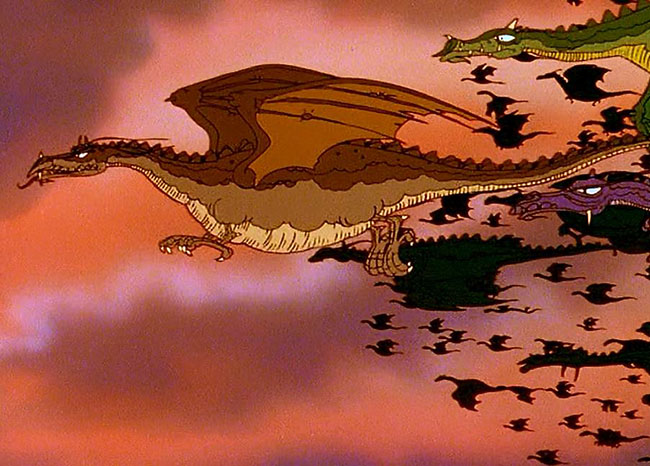
One of my favorite movies growing up was Flight of Dragons (1982). A medieval, magical world is threatened with extinction by the rise of science. Its keepers, wizards, propose to hide a tiny part of this world behind an invisibility shield to protect it. “A foolish retirement village,” scoffs the evil wizard Ommadon, who offers instead to corrupt mankind, causing humans to use their science to destroy themselves. Carolinus, a good wizard, summons Peter Dickinson, a science nerd and dragon geek from the real world of the future, and transports him into this other world and accidentally puts him in the body of a dragon. As Peter and his friends face epic battles, he realizes that his science becomes his secret weapon.
For all its power, magic cannot trump what is real.
At their climactic face-off, Ommadon dares Peter to deny all magic. To do away with the evils of imagination – lies, superstition, deceit – Peter must also admit that the pleasures of it are equally insubstantial.
“SAY IT!”, says Ommadon.
Peter after some thought, replies with conviction: “I deny all magic!” Then he defeats Ommadon with incantations of his own: “algebra, anatomy, astronomy, biology”, etc. until the evil wizard sublimates. But having denied magic, he must return to the real world and forever leave Carolinus and his friends, including the beautiful Princess Melisande.
The movie and especially the book of the same title, explained a lot to a kid. Why and how did dragons fly and breathe fire? Both were the result of an evolutionary specialization to fly like a blimp. Dragons were balloons. Hydrochloric acid, what we have in our stomachs, reacted with calcium carbonate from either limestone or renewable bone to produce hydrogen, which lifted the dragon, its wings more like fins for maneuvering or propelling rather than for lifting as with birds and bats. The acid is the highly noxious “dragon’s blood” of legend, and the reason there are no dragon fossils. The dragon at rest produced gas in smaller amounts. Whether it burped gas to land, or released excess gas at rest, it had to ignite it, probably with chemicals like the bombardier beetles, because unburned hydrogen is toxic especially if it accumulates in the dragon’s lair: caves. Fire later became a weapon and a form of display. Since dragons ignite gas in their sleep, they hoard gold as bedding material because it is soft, acid resistant, and non-flammable.
So, even in this mystical world, rational questions aren’t out of place, and there is a reason behind the workings of these fantastical creatures. Ah.
Now, adult, think about how science has evolved over time, in the real world. We’ve figured out a ton of stuff that used to be considered magical. Electricity? We got that down. Flight? No problem. And though we’ve come a long way, there’s still so much we don’t understand. Dark matter and dark energy make up like 95% of the universe, but we barely know anything about it. It’s like we’re still chasing after those magical mysteries, and every time we learn something new, it feels like we’re pulling back the curtain on a magic trick.
Now here’s the kicker: the more we learn about the universe, the more magical it seems. Quantum mechanics is just straight-up bizarre. Particles can be in two places at once, and they can change their behavior just by being observed? It’s like nature is saying, “Hey, I’ll let you in on some of my secrets, but there’s always gonna be more magic waiting for you.”
And so, back in 20th century Boston at the end of the movie, Peter is selling a magic flute and shield to a pawnbroker when Melisande enters the shop as a normal Bostonian girl, carrying Ommadon’s power crown, and the two embrace.
What’s the moral of the story? Science and magic are like best friends forever, and they’re always going to be linked. We’ve come a long way since the days of ancient myths, but we’re still chasing after those mysteries. And as long as there’s something left to explore, we’ll never lose that magical sense of wonder.
Two peas in a pod. Both try to explain the mysterious parts of nature. As we learn more about the world around us, we can’t help but see the magic in it. We stay curious as children.
Once upon a time in the heart of the Cozy Canopy Forest, there lived a mischievous monkey named Prankutang. Prankutang was known for his love of speculation and wild imagination. One day, an acorn fell on his head. He put two and two together and came up with some believable real estate market forecast: the sky was falling.
As he swung from tree to tree, he chattered excitedly to anyone who would listen. “Did you hear? The Majestic Oak Mansion is moving to the other side of the forest! The Forest Council has finally made the decision! You better pack up and leave before it crushes your homes!” Prankutang’s voice was filled with a sense of urgency that made the property gossip sound all the more convincing.
At first, the animals were skeptical, but as the hearsay spread, more and more started to believe it. The squirrels were the first to panic, scampering around in a borrowing frenzy, gathering their nuts in a rushed decision. The birds began to flap their wings nervously, pondering how they would relocate their nests. Even the wise old owl, Professor Nestor the Noteworthy, started to doubt his own data-driven market projections.
But, not all the animals were convinced. A group of fact-checking critters, led by the ever-skeptical tortoise, Inquiretort ‘Mr. Terry’ Terrance, decided to verify the facts before joining the mass exodus. They formed the “Fur-ensic Squad” and started their investigation.
As the Fur-ensic Squad traveled deeper into the forest, they consulted the Forest Council’s records, discovering no mention of The Majestic Oak Mansion’s relocation. Perplexed, they questioned the Forest Council members; most, with raised eyebrows, denied making any such decision.
The Fur-ensic Squad returned to the panicked forest-dwellers, ready to debunk the rumor. But it was no easy task. The animals, already having sunk assets in a housing bubble, were not eager to listen to reason.
The Fur-ensic Squad needed a new strategy. Mr. Terry came up with a plan. He called for a grand meeting in the heart of the forest, announcing that the Forest Council would reveal the new location of TMOM. Curiosity piqued, the animals gathered to hear the news.
Once the animals had assembled, Mr. Terry called the head of the Forest Council Chairbird Chattercrest to step forward, and step forward he did. The Chairbird cleared his throat, and said, “Dear friends of the Cozy Canopy Forest, I regret to inform you that news of TMOM moving has been nothing but a rumor. That is an unfounded speculation.”
In the awkward silence that followed, the Fur-ensic Squad presented more evidence. The animals slowly began to see how a combination of laziness, excitement, and fear took them for a ride on the bandwagon fallacy. The news also caused a massive debt crisis especially among squirrel-folk that would take years fix. Prankutang was not available for comment.
The Fur-ensic Squad continued their fact-checking adventures, ensuring that the Cozy Canopy Forest remained a land of truth and laughter.
Moral of the story: Check your facts, and always be studying. Misinformation is the side effect of being uninformed.Follow the 1-10-100 rule: It takes $1 to validate a fact, $10 to correct it, and $100 to repair the chaos.
Once upon a time, in a bustling city, there lived a rat named Mickey Marconi. Mickey was a young and ambitious rat who had always been hardworking, resourceful, and fit. As a young rat, he had learned the ropes, how to navigate the city’s alleys and sewers, always finding food to support his crew. As time went on, Mickey “Two Teeth” Marconi became the go-to guy of his fellow rats, earning their respect.
One day, Two Teeth discovered a hidden jackpot in a tiny warehouse: a massive block of cheese. It was nothing like he had ever seen before. The scent of the cheese reeled him in, and he figured he’d found his piece of paradise. Two Teeth made a bold move; he’d retire from the streets and live inside the block of cheese.
Two Teeth carved out a cozy crib for himself in the cheese, and as time passed, his once lively and daring life was swapped for one of luxury and laziness. As Two-Teeth feasted on the cheese day after day, he grew bigger and more content. His once fit body turned into a fat, clumsy mess, and his mind became slow and self-centered.
Two Teeth’s rep in the rat world started to fade, and the admiration he once had turned into hushed gossip and pity. Despite this, Two Teeth kept himself locked away, ignoring the world outside his cheesy hideout.
One freezing winter’s day, when the city was gripped by hunger and hard times, a bunch of poor rats got up the nerve and knocked on Two Teeth’s door. They’d heard the stories about the giant cheese block, and with desperation in their eyes, they begged Two Teeth for help.
“Please, Mr. Marconi,” they pleaded, their voices barely a whisper from hunger. “You got plenty of cheese to go around. We’re starvin’, and our families are sufferin’. Can’t you find it in your heart to share some of your loot with us?”
Two Teeth listened to their pleas, his beady eyes narrowing as he checked out their scruffy looks. He could still remember the days when he’d struggled to find food, and a small part of him felt for these poor rats. But his years of being cooped up and gorging on cheese had made his heart hard as stone.
Instead of helping out, he told them, “”Listen up, youse guys, I feel for ya, I really do. I’ll say a prayer for all of ya tonight, but you gotta clear outta here. Nothin’ I can do for ya here. Now scram, all of ya, and may Lady Luck shine on youse soon..” Two Teeth slammed the door in their faces, his chubby paw shutting it tight, his harsh words reaching the desperate rats outside.
As days turned to weeks and weeks to months, the city kept suffering. Lots of the rats who once looked to Two Teeth for help didn’t make it, their families left to grieve. But Two Teeth stayed in his fortress of cheese, his heart growing colder by the day.
One night, as Two Teeth lay alone in his cheesy grave, he was hit by a deep sense of emptiness. The weight of his selfishness was too much to bear, and he realized that by turning his back on the world, he’d lost the very thing that made him rich: the love and respect of his fellow rats.
Two Teeth tried to leave his cheese prison, but his now huge body couldn’t squeeze through the entrance. He was trapped, a prisoner of his own greed and indifference. As the cheese block started to rot and decay, so did Two Teeth’s spirit.
And so, Mickey Marconi lived out the rest of his days alone in his crumbling cheese fortress, haunted by the ghosts of the friends and family he had forsaken. The once-admired rat had become a lesson to remember, a wake-up call for everyone about the cost of being selfish and the real value of showing some heart.


 jaylazzo