Wholesome entertainment

Summer’s on its way, and the topic of fun stuff to do pops up again.

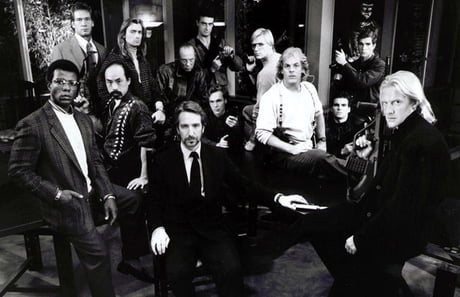
Merry Christmas! The Hans Gruber Family Wholesome Entertainment (Die Hard 1, 1988). Hans Gruber (in tie, center) was played by Alan Rickman (1946-2016). Image: https://img-9gag-fun.9cache.com/photo/az9Mxgb_460s.jpg

The Church has a bunch of wise advice about rest, taking it easy, and enjoying ourselves. As an Indian proverb says, “A harvest of peace grows from seeds of contentment.”

Even though we see downtime as super valuable, sometimes people think it’s just wasting time. Leisure lets us step back from life’s worries. During these moments of leisure, we recharge our batteries—culturally, socially, and spiritually—and find balance in our personal and public responsibilities.

Leisure lifts our spirits. Going to Sunday worship and praying, reading a book, doing outdoor activities, watching good TV shows or movies, attending concerts or art exhibits, or just having a coffee break are all similar.

Whenever we choose entertainment, we make a moral and aesthetic judgment. A judgment implies criteria. We read in the Catechism of the Catholic Church, 2495-99: “Decent entertainment has the obligation to serve the truth and support the inviolable dignity of the person and of the common good; this dignity is given by God and may not be violated or taken away by another person or government. Decent entertainment not only pleases its consumers, but also respects their intelligence and sensitivities.”

TV and the internet, which I’ll just call “media” for short, are a big part of our daily lives. Media can bring people together by sharing stories. Through media, we’ve seen acts of incredible moral courage and peaceful fights against injustice.

Good media promotes values like self-discipline, compassion, respect, responsibility, bravery, determination, honesty, loyalty, and faith. Example: “The Mandalorian,” a family oriented show where a lone bounty hunter protects the adorable Baby Yoda.

Sadly, some programs show the darker, more disrespectful side of humanity. Violence, rudeness, selfishness, broken families, lies, cruelty, and the over-sexualization of our culture. It makes us think that the worst in us is normal, even good.

Author and pastor Jason Byassee observes that “we are so awash in pornography these days that most of us don’t recognize it any more.” Pornography, with its ugliness, mainly targets our bodily desires. It corrupts the soul, degrades people, and treats them like objects, far from the psalmist’s view of humans as “a little lower than gods” (Ps 8:5).

While pornography might excite, it leaves us restless. On the other hand, good entertainment provides lasting satisfaction. As our culture becomes more sexualized, our youth, who deserve their innocence, and all of us are at risk of being influenced by it. Deep down, though, we’re turned off by degradation and naturally drawn to what uplifts life.

According to the monk Thomas Merton (1915-1968), “bad art [indecent entertainment], is like “polluted air” and “constitutes a really grave spiritual problem;” it “affects us only slightly at first, but in the long run, the effect is grave.” A culture of reverence and a retrieval of our infinite dignity as persons, made in God’s image and likeness, has assumed new urgency. We gasp for beauty! We need loveliness “to prevent us from sinking into despair,” wrote Paul VI (1897-1978) at the close of Vatican II.

How can we improve the quality of media? Here are five ideas:

1. Take a closer look at your media choices. Develop a discerning taste.
2. Switch channels if a show offends you or your family’s dignity. Reach out to media producers, sharing your concerns. Many will appreciate your feedback and suggestions.
3. Back family-friendly channels, especially Catholic media.
4. Enjoy family-oriented films. Look for websites that promote “Family Entertainment.”
5. Get creative and make your own entertainment by using your talents and those of your family members.

A final thought. What if it’s “just art”? Okay, but let’s remember this simple truth: At any given time, only one of two things drives a man’s mind – sex or success. The choice isn’t always easy, but it’s ours to make.

So, if you see a naked woman, and it’s not like you can change the subject, try this: Think, “Wow, she looks like she could type 2000 words a day. Tomorrow, I’m gonna write a 2000 word manuscript,” and start planning it in your head: PRERP, Point, Reason, Example, Rebuttal, Point. BOOM! Success has just taken the driver’s seat.

(Q.C. 230416)

Be Cheery

Being cheery is a good thing, so we should totally try to make it a habit.

St. Thomas Aquinas (1225-1274) talks about affability as part of justice, like treating others the way they deserve without feeling like it’s a chore. We’re supposed to help others on their way to Heaven, not just by giving to the needy or sharing advice, but also by being nice, chill, and easy to be around.

Having a cheerful vibe helps those we hang out with. If we’re a grumpy, unsocial, or gloomy person, we can make others feel uncomfortable and more likely to feel sad. But, if we smile, we can lift their mood, make them trust us more, and give them hope that they can do good things too.

If we’re always giving off a bummed-out vibe and bringing down everyone around us, we might be feeling sorry for ourselves. We might also be jealous of the good stuff others have that we don’t, which can make us not even try to be happy. Or maybe we’re just letting our moody nature take over.

Being truly cheerful doesn’t mean we can’t be serious when we need to be. It’s not cool or helpful to laugh off the consequences of our actions, or be super distracting during moments like mass or other serious events. If we can’t feel for others when they’re hurting, avoid people in pain, or refuse to let their troubles affect us, that’s a problem with our cheerfulness too.

Real cheerfulness doesn’t rely on substances. Drinking actually make us act dumb, silly, and downright embarrassing.

We don’t have to be all smiles, laughs, or chatty to show we’re cheerful. We can be serious and sympathetic, but still share hopeful and supportive thoughts that help others find strength and patience. It’s all right to let our friends face the tough stuff and not downplay their feelings.

If we’re only cheerful sometimes and sad or moody other times, it means our emotions are in control. It’s bad, too, if we act all happy around certain people but not others.

It’s tough, but we’ve got to learn to rise above our emotions. Being guided by our will, not our feelings, isn’t faking. Let’s aim to be consistently nice, friendly, understanding, and supportive to everyone—that’s what being truly cheerful is all about.

There are three key virtues that make peeps truly happy: hope, courage, and brotherly love.

Hope helps us keep our eyes on Heaven as our life goal, which we can reach thanks to Jesus Christ’s merits, promises, and faithfulness. Having something amazing to look forward to keeps us happy. Hope is a supernatural thing, but it takes effort and practice to make it work.

We can’t be cheerful if we give in to despair.

Living for worldly pleasures makes people chase after every possible joy here and now. But that leads to sadness ’cause nothing in this world can completely satisfy our hearts. This mindset also creates jealousy, greed, impurity, and other things that bring us down.

Courage helps us face life’s unavoidable sorrows and, death, while serving God with bravery and patience. We can find inspiration from Christ’s suffering and look forward to Heaven with a hopeful heart. Even the biggest struggles are worth it for that ultimate reward. So, let’s try to beat fear, self-pity, and doubting God’s goodness.

We shouldn’t take ourselves too seriously. It’s important to learn not to freak out over making mistakes ’cause no one’s perfect.

We shouldn’t let our handicaps eat away at us.

Take Nick Vujicic (1982 – ), for example. He’s like: no arms, no legs, no worries! He’s a successful author and motivational speaker, beautiful wife, four kids. He said: “I know for certain that God does not make mistakes, but he does make miracles. I am one.”

Image: https://www.leaderbiography.com/wp-content/uploads/2021/09/NickVujicic.jpg

Instead of wasting time and energy on regret or self-blame, it’s smarter to just get back in the game. People don’t have much sympathy for those who feel sorry for themselves since they’ve got their own challenges, responsibilities, and joys. They expect us to deal with it, and that’s a reasonable expectation.

Bravery is contagious, and by spreading them, we’re doing everyone (including ourselves) a huge favor.

Happiness is the reward of love. This happiness is different from other joys ’cause it’s lasting, and it’s one of the few joys that stays with us even when we’re dying.

When Jesus was saying goodbye, He said He wanted His happiness to be in His followers: “I have told you this so that my joy may be in you and your joy may be complete.” If we imitate even a tiny bit of God’s great love, we’ll find springs of happiness bubbling up in our hearts, just like Jesus said: “Whoever drinks the water I give them will never thirst. Indeed, the water I give them will become in them a spring of water welling up to eternal life.”

If our heart thirsts for joy, let’s do good to others. St. Augustine (354-430) says, “Our hearts were made for Thee, O Lord, and they are restless until they rest in Thee.”

(Q.C. 230416)

A mentor’s legacy

Image: https://bcgavel.com/wp-content/uploads/2015/11/manup2015-e1448318165309.jpg

I remember it was around 1981. I was in 3rd year high school. My uncle fetched me from school. Back then he was a bright junior executive working for one of the Philippines’ biggest corporations. He would eventually become the President of the country’s biggest petroleum company.

He summarized what he said were the three most important lessons he learned from corporate. These are:

1. You work for your boss, not your company.
2. Take care of your people.
3. No matter what you say, if you do not make money, you’re wrong.

In the more than 40 years since my uncle articulated these rules, I have reflected on their power and their limits. I assert the truth of every one of those rules.

In this essay, I will focus on the insights I have distilled regarding Rule #3. I have seen that this rule has a specific implication for men.

The 3 big insights of Rule #3 are:

1. “Money” is external to the person; it is a single metric that encapsulates the performance of the organization in terms of its mission and vision.
2. “Wrong” does not refer to moral right vs. wrong, but to “credibility”.
3. The whole rule is about the relation between power and credibility: if you’re not credible you cannot get things done.

First, on “money”. Every organization will have one metric that encapsulates its mission and vision. A religious institution may have “number of conversions”; an academic will have “number of publications” or “grants in dollars received”. You don’t choose the metric, you do it: a person’s internal values, such as his morals or self esteem are of interest to the organization only if they contribute to the latter’s mission and vision.

An honest and hardworking person IS more likely to produce money because money comes from working hard and well. If he does not make money, then the company concludes that there are other factors that are not as strong in this person as they should be. If the person fails consistently, there is a problem, and it may even be a moral one.

It is possible that a person can have immoral values and still produce money. If the organization has reason to anticipate, say, a sexual harassment case or a legal case stemming from immoral behavior, they have to consider whether they can really expect good performance from that person in the long term.

Second, on credibility. People in an organization measure how much they trust others before they decide when and how to work with them. This measure is done on present performance: the rule says “do not make money”, not “did not”. Past successes only matter if present success proves consistency and demonstrates growth. Rule #3 is about growth.

Now, it is possible for colleagues to trust and respect each other at work, yet never interact socially. If the organization perceives that this state of affairs limits the group’s potential for growth, then they must address this issue. If they can manage it, fine. Some colleagues at work have strong personal animosities, none of which interferes with their work or the performance of everyone else in the organization. We just don’t put them in the same teams.

And third, if a man is not credible he has no business being a boss, or even an employee. Credibility recruits others to make things happen. Credibility is tied to power.

And power is tied especially to being a man. Remove a man’s power, you remove his masculinity.

It is universally true that organizational failure has a much worse PERSONAL effect on men than on women. Men, are more willing to take on even the most dangerous jobs because of their need to succeed. Women, on the other hand, have a stronger drive towards STABILITY and will not risk themselves as much, especially when they have kids.

Although these peculiarities of men and women are not true for all, these are traits that cultures from all times and ages have observed. The Rules seem specially crafted for men, suggesting there may be equivalent rules for women that leverage their unique strengths. Men and women collaborating on challenging tasks, such as forming families, benefit from following their complementary rules.

No one has yet told me what the rules for women are.

(Q.C. 230415)

Obscure Fables 6: The Monkey and the Leopard

Once upon a time, the forest animals decided to organize a talent show they called The Funniest Forest Idol to lift their spirits after the very public meltdown of Madame Thunberg and bring laughter to their community. The Monkey, known for his wit and humor, is confident he’ll win the competition, while the Leopard, renowned for his beauty and grace, believes his charm will be enough to secure the title.

As the contest begins, animals take turns showcasing their talents. The Elephant does a stand-up routine but ends up forgetting his punchlines. The Tortoise does a slow-motion slapstick routine. The Python molts and gets catcalls. The Monkey, feeling the pressure, starts with his usual witty stories, but they fail to elicit laughter. Someone shouted “Bring back the Elephant!” Desperate, he resorts to impersonating the other animals, including the Leopard, in a series of exaggerated parodies.

The Leopard, initially annoyed by this mockery, realizes the potential for humor in his own vanity. He embraces the comedy and his sexuality and joins the Monkey on stage, creating an impromptu comedy skit. The audience wonders what will come next.

“The Fabulous Jungle Jesters”

(Scene: A small stage in the middle of the jungle, with a glam spotlight shining down. The forest animals are gathered around, waiting for the next fabulous act. The Monkey sashays onto the stage, dressed in a fab makeshift leopard costume, complete with sparkles.)

Monkey: (in a sassy voice) Darlings, allow me to introduce myself. I am the fierce and fabulous Leopard, the most charming and graceful creature in the entire jungle, honey!

(The Leopard, standing among the audience, looks annoyed and saucily crosses his arms.)

Leopard: (muttering) This better slay.

Monkey: (continuing the act) As the Leopard, I must say, my spots are everything, darling! They say that every leopard’s spots are unique, just like snowflakes. And I, of course, have the most gorgeous snowflakes of them all! Yasss!

(The audience chuckles, but the Leopard rolls his eyes.)

Leopard: (grumbles) Ugh, that’s not even how I talk, sweetie.

Monkey: (exaggerating a prowl) Watch me, honeys, as I gracefully stalk my prey. Prowwwl! Prowwwl! No other animal in the jungle can match my elegance and poise. Whoops! (The monkey pretends to trip and falls, making the audience laugh.)

Leopard: (starting to crack a smile) Okay, that was low-key funny, sis.

(The monkey notices the Leopard’s amusement and calls him to the stage.)

Monkey: Oh, fabulous Leopard, would you grace us with your presence on stage? Perhaps you could demonstrate the real prowl of a dazzling feline, darling.

Leopard: (hesitates, but eventually agrees) Fine, but only to show you how it’s done, hunty.

(The Leopard joins the Monkey on stage, and they begin to prowl side by side, with the Monkey exaggerating his movements for exquisite effect.)

Leopard: (laughing) All right, all right, you’ve made your point, sis.

Monkey: (smirking) Well, since we’re both here, why don’t we team up for the Ultimate Jungle Improv act, queen?

Leopard: (pauses, then grins) You know what? Let’s do it, girl!

(For the remainder of the act, the Monkey and the Leopard perform various skits, throwing shade at each other and the other animals in the audience. Their spark is undeniable, and the forest animals can’t stop cracking up. In the end, the Monkey and the Leopard bow together, receiving a standing ovation from their newfound fan base.)

Leopard: (whispers to the monkey) You know, you’re not so bad for a cheeky little monkey, hun.

Monkey: (grinning) And you’re not so bad for a vain, spotted cat, queen.

(They share a laugh and sashay off the stage, having formed an unexpected bond through their newfound comedic partnership.)

At the end of the show, the two Divas tie for first place, discovering that by combining their unique talents, they can bring even more joy and laughter to the forest. The experience creates an unlikely friendship that keeps the forest entertained for years to come.

(Q.C. 230414)

Obscure Fables 5: The Coach and the Fly

Le Coche et la Mouche (The Coach and the Fly) is a fable by Jean de la Fontaine (1621-1695) that teaches a lesson about humility and recognizing one’s true contribution to a situation. Some people tend to overestimate their importance and insert themselves into situations where they are not truly needed, becoming a nuisance instead.

In the more famous story, six strong horses struggle to pull a heavy coach up a steep, sandy hill. Everyone inside the coach, including women, a monk, and elderly passengers, have dismounted to lighten the load. In the less famous story, there was also a university professor. The horses are exhausted and sweaty from their efforts.

A fly arrives on the scene and believes it can help the horses by buzzing around them and occasionally biting them. The fly thinks that its actions are the driving force behind the coach’s progress. It sits on the coachman’s nose and observes the people walking alongside the coach, attributing the vehicle’s movement solely to its own efforts. The fly compares itself to a sergeant rallying soldiers to advance and speed up their victory.

The fly complains that it is the only one working and that nobody else is helping the horses in their struggle. The monk is saying his prayers, the professor is smoking weed, and a woman is singing, all seemingly uninvolved in the situation.

The fly continues to buzz around and annoy everyone with its misguided sense of importance.

Finally, the coach reaches the top of the hill. The fly proudly claims that it was its hard work that brought them there and asks the horses to reward it for its efforts.

We know this from an article that was later written by the professor, a visiting biologist from the University of Padua and who happened to be the world’s leading expert on the neurobiology of the housefly (Musca domestica). Said the professor:

“Flies have a complex language, but it’s like, you know, to them everything’s in crazy slow-mo, man, way slower than what we’re used to, ya know. For this reason, their sense of agency, accountability and responsibility are dilated. Psychedelic!”

A Professor from the University of Padua

This theory has been called the Theory of Relative Accountability or the Theory of Accountable Relatives. It states that the sense of agency and accountability varies inversely with the mass of an animal’s brain. A big brain with slow processing speed has time to observe slow-moving causes that have a lag time, but a small brain with high processing speed will only perceive what is most immediate.

To the fly, what are most immediate are 1) what it does; and 2) what happens right afterwards.

Researchers from Padua and Bologna have shown that while the nervous system of a fly is less complex than that of mammals, it is capable of processing sensory information, coordinating movements, and engaging in basic learning and memory tasks. However, because of the extremely short distances traversed by nerve signals, information is processed so fast that flies are able to dodge individual raindrops like balloons falling from the sky.

Then why are we still able to swat them some of the time? Because 1) flies are myopic; 2) we usually swat them from behind, where they have a blind spot; and 3) though they might see it coming, they launch themselves backwards, in the path of the swat. Before takeoff, they shift their body weight to their hind legs and then use their legs to push off the surface. This backward launch allows them to quickly evade predators and escape potential threats from the front.

The fly’s brain is located in the fly’s head; it processes sensory inputs and controls behaviors, and is divided into several regions called ganglia, each responsible for different functions. The ventral nerve cord goes from the brain down the front of the body and is also divided into ganglia. One ganglion coordinates sensory and motion functions per body segment.

According to the professor, a fly is not able to notice, much less worry about multiple causal factors that move very slowly. It, therefore, failed to appreciate the fact that people and horses needed to coordinate for the coach to reach its destination.

Makes sense, but how do we know what the fly is even thinking?

Through language, said the professor. But the trick is to somehow see things in slow motion, to coordinate ourselves with the speed of the fly. The way to do that, he said, is to smoke pot. The humans, not the flies.

Marijuana users commonly feel time slows down, but the exact neurobiological mechanism behind this perception is not yet fully understood. Altered neurotransmission caused by tetrahydrocannabinol binding to CB1 receptors may disrupt the normal functioning of certain brain regions, said the professor. The cerebellum, basal ganglia, and frontal cortex are some of the areas involved in the perception of time; they are rich in CB1 receptors, and their activity is modulated by the endocannabinoid system. He thinks that THC’s influence on these areas might lead users to experience time as passing more slowly than it actually does.

He reported that he could see subtle, very fast movements in body parts that are imperceptible to most humans. He has catalogue thousands of body part twitches, wiggles, flexes, jerks, extensions, contractions, flails, swings, slides and rotations, from flies and other insects, correlating speeds and frequencies among several parts at once. But, he says, it’s not enough to move one’s body parts: one must release chemicals through these movements.

What is communication like to the fly? The professor has tried “talking” to a fly using his own body movements, and the flies seem to understand. But it’s not from watching the man’s body movements, that would be hilarious. Instead, they do it through their antennae. Antennae are able to sense volatile chemicals, pheromones, humidity, temperature, air currents, and vibrations.

“Hey man, like, you ever think, like, flies can like, read our minds, dude?”, asked the du– the professor. “You wanna smash ’em, but they just, like, buzz away before you even make a move, man. Trippy, right?” That’s because they can detect chemicals released by excitement. They can’t read emotionless thoughts. They can’t read thoughtless motions. And they can’t read motionless emotions.

How are they able to “read”?

Movements of the body produce heat and sweat. Mental states release volatile substances through sweat glands that are then wafted to the insect. Thus, a combination of 1) thinking about what to say (mental state), and 2) saying it with the body (sweat), produce a combination of the above that are detected by receptors on the antennae. The fly has enough memory to make sense of thousands of combinations of these variables.

Therefore, we cannot say that when flies communicate with weed users both of them capture the same thing. It’s all educated guesswork.

Below is an educated transcript of the professor’s dance off with said fly.

“Man, like, you really believed, dude, that it was just you, like, all by yourself, makin’ the horse move and stuff.” cha-cha’ed the professor.

“I buzzed, the horses moved,” twerked the fly.

“Dude, like, you didn’t even notice the driver, man. And, like, the whip? Totally missed it. And, whoa, there was this accountant and nun, man, cheerin’ him on, and you, like, didn’t see ’em at all,” breakdanced the professor.

“I buzzed, the horses moved,” twerked the fly.

“Like, you wanna grab all the glory, dude, for us, like, gettin’ to the top and stuff? That’s wild, man,” the professor required two hoola-hoops and an ice cream cone to say this.

“I buzzed, the horses moved,” twerked the fly. “And, this is a good sandwich you have, by the way. I tasted it with my feet, spat enzyme-rich saliva on it, and then sucked the liquified digest. Now it’s your turn. Enjoy!”

The professor watched the fly do all this and laughed. He was so high.

(Q.C. 230413)

Obscure Fables 4: The Hare and the Tortoise Reunite

“He will see you now, sir.”

I thanked the nurse and entered the room. The curtains were drawn. I heard the hum of the air-conditioner and the pings of the monitor. I saw one i.v. line and a collection of other of wires connected to the one lying on the bed, my old nemesis, the Hare.

“Hi. It’s me.”

The Hare struggled to open his eyes. He squinted, and smiled. “Ah, my old pal Tank. I thought you’d never come. No, let me rephrase that: I thought you’d never make it on time.”

I smiled. “Smartass, you haven’t lost your touch, E.P.. I came as fast as I got your daughter’s message. It’s just a 4 hour trip. No, thank you, I didn’t walk. I drove my Santa Fe.”

“Thanks for coming, Tank, I mean it. I do not think I’ve ever properly apologized for being so resentful of you. I may have disrespected you a number of times. But the joke’s on me. I was almost hoping you’d never recover from my buy-out, but you came back, stronger. I’m finally dropping out of the game. You, you’re still in it, and really, I’d like to thank you. And wish you well.”

“Thank me, E.P.? I was an arrogant Turtle, too. The race was a fluke. Sure. Made me famous, got into my head for a while. But everyone knew it was a fluke. Except kids who have no idea what talent and luck really are. You’ve won every game you were in, ever since. You’re consistent, that’s what matters.”

“Tank, you’re right, I am awesome. But do those children know the real story? That you were as patient as I was fast. You were consistent too. You built a great business in an industry that valued patience and moving slow. I could never have beaten you there, as you could never have beaten me at mine. Even your failure came from your talent. That’s why I bought you out.”

“At a good price. You saw potential where I did not, I guess.” I felt the shame of failure returning after so many years, but seeing the dying Hare brought me back to my senses. Pamana Finance was run to the ground by my own incompetence and lack of aggressiveness. E.P. bought it at a higher price than we valued it, then sold it for 100 times that. I started a new business, and now Ironshell Realty is worth at least 10,000 times what my finance company was worth when I gave it up. To this guy.

“Right again, Tank. Ironshell Realty was successful because it matched your talents. Sure, there was a learning curve and lots of luck and connections. You know, I tried, but I didn’t have the patience. You know me, I want to make astronomical margins with dangerous deals. I could’ve won that damn race and you know it, but my loss, your victory, became my driving force. I must thank you for that. And I have to thank you for another thing. Now that I’m on the way out, I’m glad I’m not leaving with that dirt on my soul.”

“E.P., you’re now the richest Hare in the world! But you know, my victory was not all that good. So many expectations I had to meet. Beat you again? In business? What was I thinking? But thanks to Ringer’s book [Winning Through Intimidation, in case you’re not familiar, dear reader] I got a lot of PR, and Ringer helped me to see that I had the slowness to make it big in real estate. If you had not bought me out…”

“… You’d have gone bankrupt. Then it’s good. You sold because you knew finance was not for you. My aim is to win. But yours is to stay in the game, to survive. I went bankrupt once, you almost, but never did. You’ll have Ironshell for the next 100 years, but Enterprise Finance will be bought within a month after I die.” The Hare was silent for a while. Then said, “And there’s this other thing I have to thank you for.”

“Almost forgot. What is it?”

“You were pretty arrogant after you won, yes?”

“For a good while, yes.”

“And blinded. As I had been by my being a poor sport. I’m not being mean, my friend. You would’ve been jolted to reality, but it would’ve been too late to get rid of that stupid dream Pamana. When did you decide to let go, Tank? In you mind, what killed the dream? What was your rock?”

“My rock? I see. How do eagles kill tortoises? They fly very high, drop the tortoises on rocks far below to break their shells, and then eat the insides. Pamana was my eagle, E.P. But Chelsea was my rock.”

“Your wife.”

“She convinced me to sell. She didn’t really care for the company as much as she cared for me. Seeing me going through all that mess made her sick, until her heart couldn’t take it anymore. A few months before she died, she implored me to sell. She had an intuition. But who would buy it? ‘Your old friend, E.P.’, she said. Hell, no! I’d have divorced her right there. But, seriously, she didn’t want to see me lose the company to bankruptcy, and you did have a solid position with Enterprise Finance. ‘Tank’, she insisted, ‘sell it. Now. Then I can die.’ I finally agreed. So, you bought, at a good price, then sold it at a huge profit 5 years later.”

“I did pay a good price for it, yes. But did you think I wanted it?”

“Of course not. But now, for the first time, I actually get to thank you.”

“Well, I also get a chance to thank you. Or rather, you and I have to thank your wife. Chelsea persuaded me to buy Pamana at that price.”

She what?

“If it were me, Tank, I’d have bought front row seats for my family and friends to watch you burn. But your wife was very kind, and very smart. Your refusal to invest heavily in mortgage backed securities was your saving grace. She also convinced me to divest, a year before the crash. She saved me, too, Tank. Chelsea was smarter than either of us. Why you never let her be a part of Pamana is because of that armored skull you have for a head. She saw the crash coming! She also saw how you could profit in the aftermath, but just not through finance. She knew she did not have much time anyway. I did make Pamana work. Then you set up Ironshell, and you made that work. Now, we’re in different games. The world’s no longer too small for the two of us.”

I was silent. E.P. was no altruist. It was just cold, hard logic. Chelsea’s. Why did I fail to appreciate her talent? I know: to take care of the kids.

“I’m sorry I resented you so much, E.P. I’m just, well, why did I resent you when we were no longer in the same game all these years?”

“It’s because aside from a thick skull, you have a heart, Tank. A big one. A heart that feels things. You coming here, that’s big, very big, very big for me. I have very strong feelings, too. It’s our weakness, you and I. Chelsea put me in my place. Is that what dying does, Tank? Did it block out the unimportant and distracting? Did she see things more clearly than any of us? Something like that happened also with Don Beako “Corleone” Cognibeak, remember?”

“Yes,” I said, “Don Beako, the Eagle mafia. How is he, would you know?”

“No. Haven’t seen him since ’13. I’ve come to respect the guy, Tank. I was in the garden one day looking at bunny clouds, when he landed right next to me out of nowhere — I thought I was going to f*****g die. But he just stood there for a minute or two, looking at the bunny clouds, saying nothing. Then he said: ‘You’ve had a good life, Enterprise. Live it.’ Then 2 more minutes, and he flew off with not another words. Next I heard from his was two days ago. He sent a card. ‘Get well, Enterprise.’ Mailed from Tibet. I think he lives in a monastery.

“They said he killed so many in his lifetime. You’d think nothing’s of any worth to him anymore. But you know what I think? I think because he took others’ lives so easily, he came to value everything, every little damn thing. Didn’t matter if it was his or someone else’s. He is as generous as he is murderous.”

“To Don Beako”, “To Don Beako”, and we clinked imaginary glasses.

Having moved closer to him I could see that E.P.’s eyes were much clouded. His breathing had become rapid and shallow. Saliva had begun to form around the edges of his mouth. I called the nurse.

“I guess this is it, Tank,” he said. You know, I’m glad we raced. I’d race you again if not for these,” indicating the tubes and wires.

“You’re a winner, E.P. I’m glad we raced, too. I guess you’re preparing for a bigger race now.”

The Hare closed his eyes and smiled. With some effort he raised a hand, made the thumbs up sign, and turned his head to the side, still smiling.

I said my goodbyes to his family; I made no effort to hide my tears. Poor E.P., his children had no interest in running his firm.

On my way home, I made a detour. I parked the Santa Fe by the side of the road next to Chelsea’s tombstone, and paid her a visit.

“Thanks, love.”

The End.

(Q.C. 230412)

Obscure Fables 3: Le Diable de la cote

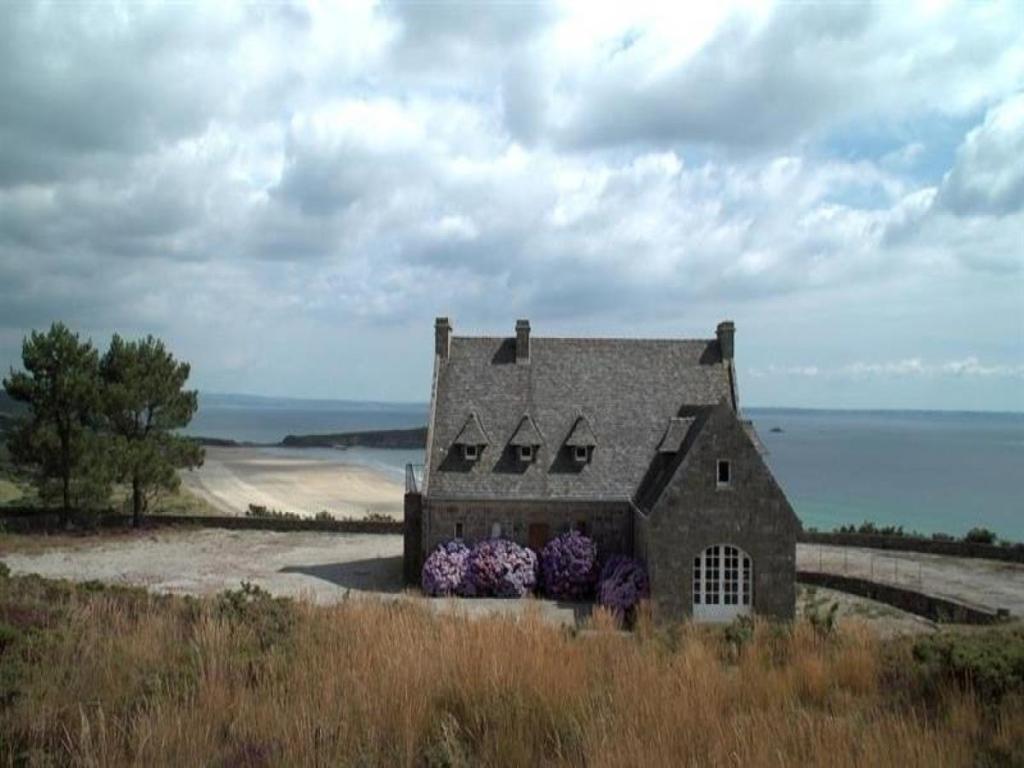
Brittany, in northwest, is a land of breathtaking beauty, where the sea and land intertwine to create a unique and captivating landscape. Its charm lies in the diverse mix of rugged coastline, picturesque fishing villages, enchanting forests, and serene countryside. The coastline is a stunning sight to behold, with its dramatic cliffs, pristine sandy beaches, and idyllic hidden coves.

It was to one of these rugged coastlines near Brest that my friends and I went on an excursion. It was around September or October, 2000; the sky was overcast and it was cold. This wasn’t a tourist beach and there were no other people besides us. One of my friends recalled that many years ago, on a gloomy day and place just like this, a strange and frightening event took place.

It happened in the late 1980’s. He and a group of buddies went for an overnight excursion near a beach in this region. They borrowed a house owned by family friends. The property was by a small paved road; access to the beach was through a dirt road that went down an embankment. The property had a garden, and in the garden was a toolshed where they kept gardening equipment. The lock on the shed’s door was damaged. This was to play a significant part in what was about to unfold.

Late in the afternoon that day, while most of the group were in the house reading their books and playing Trivial Pursuit, one of the guys, Robert, decided to take a walk along the beach. He put on a jacket and walking shoes, and with hands in the pockets of the jacket took the road, turned into the dirt road, went down the embankment. It was a short walk to the abandoned beach. Except that, he found, he wasn’t alone.

At a distance, perhaps 100 meters, was a man walking in his direction; the man was alone. Robert smiled at the thought, “I might just make a friend today,” and continued normally towards the man.

As they got closer he noted more features. The man was wearing a faded black kabig, a kind of jacket made of heavy material like wool traditionally worn in the region. It had a boxy, oversized fit and had a high collar that was turned up to protect the neck from the cold. He wore a ribbed woolen cap, also faded. Focusing on the face, Robert guessed the man to be around his late 50’s.

When they were about 20 or 30 meters from each other he noticed that the man had been looking at him, expressionless he thought. He began to see more clearly the man’s eyes, unmoving, piercing. And they were piercing him.

As they got closer, Robert noticed that the man’s expression was not neutral. It was menacing. It was demented like nothing he had ever seen. And it was an intelligent look, as if they man knew exactly what he was going to do in the next few seconds.

It was then that Robert, for the first time, and not knowing why it took him so long, looked at the man’s feet. Except that he had no feet. In their place were a pair of goat’s hooves.

Looking back at his face Robert saw the man had begun to smile. He showed teeth. Not human, for he seemed to have twice the number of teeth, and his smile literally went from ear to ear like someone put a knife to both cheeks. The man was mouthing something.

But Robert did not want to know.

He turned around and ran. Back towards the house he ran. Certain as if he had eyes at the back of his head Robert knew the creature — for it was not a man — was giving chase. He ran like he had never run, his legs unfailingly strong, his shoes crunching the course sand like a Range Rover’s tires. He ran up the embankment, turned to the empty road, towards the house, the creature just behind him.

Robert saw the shed first, saw that the door was ajar. A voice in his head told him to run there. He made it, thrust himself inside, latched the door, braced it with his back, recited Hail Mary’s.

Then it came. A force immensely powerful struck the door. It shook the shed so hard that tools crashed to the floor. Robert bounced off the door but rebounded and held. Then the creature shrieked. It was very very angry, like a famished beast that had just lost its prey.

And then, all of a sudden, silence.

The next thing he heard were the sound of his friends running out of the house.

“What was that?”

“It’s no dog from Bretagne, putain!”

“It came from the shed!”

“You two, check the garden. You, check the road, and you, the beach. I’ll go with Pierre to check the shed.”

“F**k, man, where’s Robert?”

They found the shed locked from the inside. “Open up! Open up!” they pounded.

Robert unlatched the door. The man was dead pale.

“Robert, qu’est-ce qui s’est passé? You ok? What the f**k happened?”

The friends looked for the man who Robert said chased him to the shed. They made a thorough search of the property and of the road and down to the beach. Of the man they found nothing. But then —

“Pierre. Regarde. Là, sur la porte. C’est quoi ça? What is that?”.

Putain, merde.

On the door, burned in as if by a branding iron, were two, black marks: a goat’s cloven hooves.

Robert — now Father Robert, Catholic priest — is sometimes asked about this episode, which has never happened to anyone before or since. But he never likes talking about it. He says that his refusal to make a big thing of it is not out of fear. After all, some like the Cure of Ars, St Jean Marie Vianney, were sometimes physically harassed by the devil. But all, saint or not, are harassed spiritually.

The Devil, also known as the Ankou, plays a significant role in the folklore of Brittany. He is portrayed as a trickster, and his presence is felt in various legends and tales that have been passed down through generations. There is some basis to this.

“The devil is always present, always active; but he is most dangerous when he is invisible,” says Fr. Robert. “At the same time, I don’t want you to think — and I’m not even saying it was the devil — that unusual events like this are a normal part of the life of faith.”

(Q.C. 230411)

The Danse Macabre

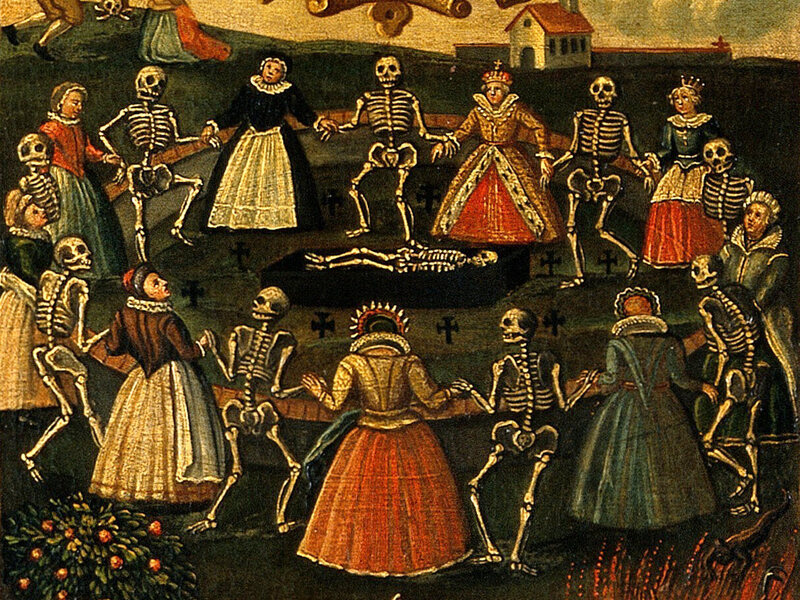
The Danse Macabre, or the Dance of Death, is an artistic genre from the Late Middle Ages on the universality of death. The Danse consists of the Death summoning representatives from all walks of life to dance along to the grave. Images typically show an emperor, a child, a pope. The effect was both frivolous, and terrifying. It reminded people of the fragility of their lives, and how vain were the glories of earthly life.

Image: https://assets.atlasobscura.com/article_images/46977/image.jpg

The word macabre comes from an Old French word from the Late Middle Ages. The earliest mention of a “danse macabre” appears in Jean Le Fèvre’s Le respit de la mort (1376). The protagonist is seized by a sudden illness and argues before a tribunal for a lettre de répit (letter of continuance) to die at a later date. In a passage discussing death’s inevitability, Le Fèvre writes:

I did the dance of Macabré
who leads all men to his dance
and directs them to the grave,
which is their final abode.

Jean Le Fèvre (1376)

“Macabré” here refers to a person in charge of a dance that eventually wends its way towards the grave.

Macabre may have been a corruption of Maccabees. The Books of Maccabees are a collection of four Jewish historical texts.

The books revolve around the Maccabean Revolt, which took place in the 2nd century BCE in the region of Judea (now part of Israel and the West Bank). The Revolt was a Jewish rebellion against the Seleucid Empire, which attempted to impose Hellenistic culture and religious practices on the Jewish population.

The Second Book of Maccabees includes theological reflections and martyr stories. One of these is the story of the mother who saw her 7 sons martyred on the same day.

Antiochus IV Epiphanes had arrested a mother and her seven sons, and tried to force them to eat pork. One of the brothers said, on behalf of everyone, that even if they were all to die, they would not break the law. The king ordered to heat up the pans and cauldrons, and he ordered the first brother to have his tongue cut off, the skin to be removed from the head and the limbs cut off. All this in front of the rest of the brothers and mother, who encouraged each other to passively resist. When the first martyr was inert and still breathing, Epiphanes ordered him to be thrown into a frying pan. When he died, the next one was brought in, and thus, each of the seven brothers endured the same torture. Each makes a speech as he dies, and the last one says that his brothers are “dead under God’s covenant of everlasting life”.

Finally, the mother died; the narrator does not say whether she was executed, or died in some other way. He adds that the mother “was the most remarkable of all, and deserves to be remembered with special honor.

I first encountered the Danse Macabre in a film I watched around the 1990’s.

The Seventh Seal (1957) is a Swedish film directed by Ingmar Bergman; it is widely considered a classic of world cinema. Set during the 14th century in Europe amidst the backdrop of the Black Death plague, the film follows the journey of a disillusioned knight named Antonius Block and his squire Jöns.

Upon returning home from the Crusades, Antonius encounters Death personified and engages him in a game of chess to postpone his own demise and gain more time to seek answers about life, death, and the existence of God. As Antonius and Jöns travel through the plague-ridden countryside, they meet various characters, including a group of traveling performers, a mute girl, and a self-flagellating religious procession.

The Seventh Seal (1957). Max Von Sydow as Death and Bengt Ekerot as Antonius Block. Image: https://assets.mubicdn.net/images/film/173/image-w1280.jpg?1558111471

Throughout the film, Antonius grapples with existential questions and the silence of God in the face of human suffering. His chess game with Death continues, representing his struggle to find meaning and purpose in life. As the story unfolds, the characters must confront their own mortality and the inevitability of death.

Danse Macabre in the ending scene of The Seventh Seal. Image: https://www.closeupfilmcentre.com/download_file/view_inline/7005/

The Seventh Seal is renowned for its striking imagery and allegorical themes that explore existential and religious questions that remain relevant today. The iconic scene of the knight playing chess with Death has become a symbol of the existential struggle for meaning in the face of life’s uncertainties.

The Seventh Seal was parodied by Woody Allen. Death Knocks is a one-act play that appeared in Allen’s collection Getting Even (1971).

The protagonist, Nat Ackerman, is a middle-aged man. He is reading a book one midnight. To his surprise, Death climbs in through the window, trips, falls into the room, and informs Nat that his time has come. Instead of succumbing to his fate, Nat tries to delay by engaging Death in conversation and suggesting they play a game of gin rummy.

Death reluctantly agrees, with the condition that if Nat wins, he will be granted a reprieve of one day. As the two play, Nat tries to distract Death by engaging him in conversation, discussing life, and sharing stories. Meanwhile, Nat is also taking advantage of Death’s inexperience with gin rummy, and eventually wins the game.

However, Death is not pleased about losing and demands a rematch. Nat asks Death to return the next day. Nat figures that he’s liable to win an extra week or month, even years, the way Death plays.

Death Knocks is a satirical exploration of the human fear of death. In a humorous way, it highlights the inevitability of our own mortality, while also questioning whether we can ever truly outwit or escape death.

Obscure Fables 2: The White Lady of Balete Drive

Between N. Domingo Street and E. Rodriguez Street in Quezon City lies Balete Drive. A part of it runs through New Manila, an old street lined on both sides by expensive ancestral houses hidden behind balete trees and tall walls.

On August 14, 2016, a tornado struck Manila and tore through part of the street. One of the houses that was worst hit belonged to one of the most powerful political and business personalities in the Philippines. People said that he was dying (he eventually gave up the ghost in 2020) and his wife had left him. People also said this was karma for all the people they said he ordered killed, that he had made a deal with the Devil and was now getting pay-back, and all sorts of nasty things. These were myths.

But the legend of the White Lady is real.

The first accounts date from the 1950’s. Most describe a white lady who supposedly haunts taxi drivers. According to one legend, the ghost is that of a teenage girl who was run over and killed by a taxi driver at night then buried around a balete tree. Another claimed that a student was raped and killed by a taxi driver and her spirit roams the street looking for her killer. Another account says a resident of one of the old mansions was abused and killed by her family, and her spirit haunts the road seeking help.

My direct experience began with a taxi driver I interviewed in 2018 between the Buddhist temple on N. Domingo to Anytime Fitness in UP Town Center in Diliman. I asked him if he believed the legends. “Mmm,” he said. And he continued:

“On July 16, 2015, between 8:35 and 8:45 pm I was driving between 25 to 35 kph between Aurora and E. Rod, hoping to find a passenger. It was dark, there was no one–“

“Why were you driving slowly if there was no one?” I asked.

“Habits.”

“Sorry, continue.”

“Then, I don’t know, I felt a chill. I checked my rearview mirror and I saw ‘her’! She was in the back seat looking –“

“At you?”

“No, she was looking at her cell-phone. OF COURSE SHE WAS LOOKING AT ME!! I hit the brakes. When I checked the mirror again she was gone. I started going again, slowly because I think my knees were shaking, and when I checked the rearview mirror, I saw her!”

“The same woman?”

“Long hair, pale face, white dress, of COURSE, it was the same woman. And she was looking at me! I hit the brakes again, BOOM! Checked the rearview mirror, and she was gone. Again, I started going forward, checked my rearview mirror again –“

“Uh huh, hmm.”

“– Same woman. But this time there was blood on her face. I was freaking out by now and forgot to hit the brakes like the last time. Then she spoke…”

“She wants revenge because she was raped. She was killed by her family and is looking for help.”

“Not declarative. Interrogative. She asked a favor. ‘Yo, driver, like, can you not brake so hard?’ she said. ‘I slammed my face into your seat and it’s low-key painful.'”

Cool. I got so interested by this drunk’s account that I did further research. I tracked down her agent, a certain Madame Stephanie, and got an appointment for a 1 point 5 minute interview, because apparently that’s how long it takes for a white lady to turn into black asphalt. We were to meet at some intersection, and soon enough I checked, And I Saw Her Standing There.

After 3 point 5 minutes of the usual interview questions — who was she, where was she born, say three things about yourself, two of which are true — we got to examine the facts in the case of the Drunk Driver. She said that she remembered taking that taxi cab on a Saturday because she is in Mandaluyong the rest of the week. (July 16, 2015 was, in fact, a Thursday.)

“Why,” I asked. “Why the rest of the week? Why not stay in Quezon City the rest of the week and in Mandaluyong on Saturdays?”

“I’ve got schizo vibes. My mental health professional has a clinic in Balete Street. I hustle Mondays to Fridays.”

“Ghosts work?”

“Dude. Seriously. Ever heard of a ghost, like, playing piano? They can’t even use a keyboard, lol. Are you for real? So, I’m a molecular biologist, okay? Does that make sense to you? I work super hard! I follow instructions to the letter, but still, no results like 99% of the time. Ugh, so frustrated – no, Mom, I didn’t get your Berroca yet – sometimes I just walk to Balete – I said I’ll get your Berroca after this ridic interview, chill! – just to clear my head, kill some time at Rob Mag before heading to the shrink’s – Seriously?? No, Mom! Mom! No! Not the knife! Not the knife!–”

What a nutcase.

(Q.C. 230409)