This advice calls to mind something that author Steven Pressfield wrote in his smart little book Do the Work. He wrote
Stay stupid. Follow your unconventional, crazy heart.
Steven Pressfield in “Do the Work”
Children, what do they know? Precisely because they know nothing, they’re creative, they’re courageous. They feel everything is possible. They know it, that’s why many are stubborn. Adults, on the other hand, know so much they can pose a million reasons why anything will not work.
Pressfield is saying: “Stupid” and “Stubborn” is to have child-like energy and daring even as adults. An added benefit is that people who have energy attract others who are willing to go on adventures and can contribute to the mission of those adventures. In contrast, people who are too reasonable give up often even before they start, thus failing to attract even the beginning of a team.
The problem is rarely the problem; 99% of the problem is caused in your head by you and your thoughts. 1% of the problem is caused by reality, what actually happens, and the outcome. Most of the time the problem isn’t the problem. The way you think about the problem is.
This reminded me about a girl I knew; let’s call her Clara. She had a reputation for being exceptionally level-headed and calm in the face of trouble. She did not live in a trouble-free world, having been born to a very poor family and now working as a maid, but she understood that the problem is rarely the problem itself.
One day, we got news of an impending super typhoon. The sky grew darker, and the wind whispered bad tales. As we were anxiously preparing, Clara remained strangely composed.
“Clara, aren’t you scared? The storm is coming, and it looks fierce!,” asked one of our cousins.
Clara replied, “Tars, my dear, chill; the problem is rarely the problem. Let’s not let our thoughts drown us before the storm even arrives.”
Clara gathered the cousins. She reminded us that the challenge lies not in the storm itself, but how we react to it.
As the first raindrops fell the cousins were busy — with their toys. We enjoyed the company. And to our non-surprise, the storm just meant more time to play indoors. To this day, me and my cousins associate typhoons with toys.
True power lies in transforming challenges into opportunities. And also something else that we failed to notice: Clara and the grown-ups were busy securing the windows and provisions and doing all sorts of things in case of power outage or flood, but no one was making a big fuss of it.
As the wind howled and rain beat down, it’s the adults, with all their responsibilities, who had reason to worry the most. But in the end the skies cleared for everyone.
In fairness, this event happened on high ground. Had this happened in some place like Marikina the best thing would have been to evacuate. Overthinking can also give way to the opposite, underthinking, when we resort to wishful thinking and do nothing out of fear or inertia.
In any critical event, give it time, and silence. Most problems aren’t solved with more thinking, but with less. If you can’t solve a problem stop trying to.
Instead, act. Taking action is the best way to think.
The quest for meaning and purpose has often led individuals to connect with something greater than themselves. We are convinced of the presence of God. The idea of dwelling in the divine presence holds profound implications for one’s perspective on life, morality, and the very nature of existence.
Living in the presence of God implies a continuous awareness of a divine presence in every aspect of life. This awareness transcends ritualistic observance and permeates all daily activities. It suggests a mindfulness that prompts us to reflect on the sacredness inherent in each moment.
One aspect of living in the presence of God is the cultivation of ethical behavior. The belief in God serves as a moral compass, guiding us to make choices rooted in compassion, justice, and kindness.
Furthermore, awareness of living in God’s presence often engenders a sense of solace and purpose. We find comfort and resilience In the face of life’s uncertainties and challenges. We sense we are not alone, fostering a profound sense of belonging and interconnectedness with everyone.
The presence of God is most intense when we do the norms. We carry that sense of presence in between the norms.
Living in the presence of God has tangible implications for relationships and interactions. We recognize the inherent worth and dignity of everyone. To see in each person the image and likeness of God challenges the divisions that often plague humanity.
To conclude. Living in the presence of God represents a universal human aspiration for connection and purpose. It influences not only individual beliefs and behaviors and shapes the moral fabric of societies. Doing our norms and acting in consequence of them brings to life a profound sense of meaning, morality, and interconnectedness.
I learned yesterday about transference. This happens when you are triggered by someone’s behavior or words to act like a Child (emotional) or a Parent (authoritative) toward that person, recapitulating a similar exchange with a parent/authority figure or child that occurred in your past.
Transference is common; it is not always negative. For example, when a peer of mine talks about games, I tend to go into Child mode and deal with this person like another Child — we then get creative, finding joy in bouncing around new ideas. Negative transference can happen. Search for “triggered” or “karen” on Youtube to see what I mean.
Usually transference is not disruptive, even the negative ones. However, I know some colleagues who are so easily triggered that I avoid interacting with them outside of work.
So, how do we know transference is taking place? Let’s take a look at boss/subordinate relationships and start with transference behaviors exhibited by subordinates.
1. One is overly sensitive and selective with regard to what he pays attention to in the behavior of others. 2. One uncritically favors certain interpretations over possible others. 3. One’s responses to others can be traced to beliefs held about oneself, others, and the world. 4. One tends to behave in such a manner as to invite responses which are consistent with and confirm his expectations. Manipulation.
Here are examples of transference exhibited by one who is a boss.
1. He offers advice rather than listen to the subordinate’s experience. He does not leave much room for the subordinate to reflect and decide on her next action. 2. The boss inappropriately discloses personal experiences, stories about himself. 3. The boss doesn’t have boundaries with the subordinate. 4. The boss makes judgments related to his perspective, not the subordinate’s. 5. The boss pushes the subordinate to take action that she is not ready for. 6. The boss is too worried about the patient, as if he wants to save her. 7. Boss asks for irrelevant details and is overinvested in the subordinate’s story. 8. The boss wants to relate to or socialize with the subordinate outside of the professional setting. 9. The boss gets angry with subordinate over a belief they don’t agree with.
These same behaviors also manifest in transference between peers.
How can we deal with transference in the office?
Here are some strategies to address transference at work. These strategies apply whether you or another is experiencing the transference.
Be self-aware. Strive to recognize when you are experiencing transference reactions. This involves acknowledging and understanding your emotional responses to colleagues, which may be influenced by past experiences.
Maintain professional boundaries. Distinguish between personal emotions and professional conduct. Avoid allowing unresolved personal issues to affect work relationships or decisions.
Communicate openly, sincerely, and honestly. If you find yourself reacting strongly to a colleague or superior, consider discussing your concerns or feelings with them in a professional and non-confrontational manner.
Seek feedback. Encourage open dialogue and feedback from colleagues and supervisors. Their perspectives can provide valuable insights into any misunderstandings or miscommunications that may be fueled by transference.
Resolve conflicts. If transference leads to interpersonal conflicts, address them promptly and professionally. Engage colleagues who are experienced in resolving these.
Develop yourself professionally. Invest in personal and professional growth to enhance your emotional intelligence, communication skills, and conflict resolution abilities.
Seek therapy or counseling. If transference significantly affects your well-being or job performance, consider seeking professional help outside of the workplace. A trained therapist can help you explore the origins of your feelings and develop strategies for managing them.
Seek a mentor or coach. Find one from among experienced colleagues or supervisors. They can provide guidance, perspective, and support in navigating complex workplace dynamics.
Involve HR. If transference issues involve misconduct, harassment, or other violations of workplace policies, consider involving your organization’s Human Resources department. HR can provide mediation and guidance on resolving such issues.
Get some training in conflict resolution. Some organizations offer conflict resolution training programs to help employees develop skills for handling difficult workplace situations, including those related to transference.
Transference can also be made to work for us as a positive force. It can be challenging. Transference often involves powerful emotions and subconscious patterns, so turning it into a constructive force requires self-awareness and deliberate efforts. Here are some strategies to make transference work for you:
Begin by examining your own transference reactions. Understand your emotional triggers and patterns. Ask yourself why certain individuals or situations trigger strong emotional responses.
Identify a positive trigger. Sometimes, people may transfer positive feelings onto others based on past experiences. For example, if you have positive feelings or admiration for someone due to transference, channel those emotions into motivation for self-improvement. Use this admiration as a source of inspiration.
If you have a mentor or colleague you admire, you are probably being triggered in a positive way to seek guidance AND to follow it. Explain your admiration and desire to learn from them. They may be more willing to support your professional growth.
Still, transference is based on memories, not here-and-now data. Ensure that your expectations of others are realistic and not based solely on past experiences. Understand that people are individuals with their own strengths, weaknesses, and motivations. Embrace the diversity of people, their beliefs and their feelings. Recognize that everyone is unique, and that transference may not always be a reliable guide to understanding others.
Making transference work for you involves emotional intelligence, and a willingness to not play manipulative games.
Transference in the workplace is a common occurrence. Recognizing and addressing it in a constructive and professional manner is a skill worth mastering.
The concept life positions is useful to help understand people’s self image and life scripts through how they communicate and interact with others. Here are the four life positions described in Transactional Analysis:
I+/U+, I’m OK, You’re OK (OK = has worth, value)
I+/U-, I’m OK, You’re NOT OK
I-/U+, I’m NOT OK, You’re OK
I-/U-, I’m NOT OK, You’re NOT OK
Once in a meeting, one of my colleagues just went into an emotional tirade. He was ranting against a collective decision made in a meeting where he was invited but did not attend. He questioned the decision, and implied that those who took part were incompetent.
Later, some of us were talking about this incident. We thought our colleague went off on a tangent.
I’ve been trying to understand this kind of interaction and what it reveals. What are people actually trying to say behind the overt messages?
A model I use to infer is Transactional Analysis. First developed over 40 years ago, this psychoanalysis-based approach to the study of communications has since been validated by numerous studies.
The model posits that every person has an Inner Child and an Inner Parent, apart from the “manager” or the Adult who coordinates everything. Transactional Analysts are careful to point out that these three personalities are NOT objects, they are not three persons. Instead, they are thought of us modes that the same person expresses every time he or she communicates a thought or feeling. These “ego states” are, therefore observable, serving as pigeonholes to classify statements we make.
Thus when I exclaim “Oh Wow!”, that statement is classified as having come from my Inner Child. If I say “We should always consult extraordinary expenses,” that statement is coming from a Parent ego state. And when I say “Parking is full“, I’m making a statement of fact pertaining to the here and how, characteristic of the Adult ego state.
Without reducing the ego states to monotonic emotions, we may for convenience describe the Child as emotional, the Parent as judgmental, and the Adult as rational.
When we speak from a Parent ego state we usually communicate to a Child or a Parent ego state in our listener. “We shouldn’t be allowing students to use laptops in class” is a statement spoken from a Parental ego state addressed to the Inner Child of the listener.
“Hey, do you now what’s going on between Rob and Marta?” “Do tell!” Gossip is usually an exchange between two Parents. What do mothers do while waiting for their kids to end their classes?
“Boss, can I leave early for work? It’s my son’s birthday.” This statement appears to come from a Child ego state. Children ask permission, and so the speaker is addressing himself to the Parent ego state of the boss.
“Hey dude, wanna grab a beer?” This question has a tinge of fun. It is a communication from a Child to another Child, an invitation to play.
“It’s getting late, we haven’t even finished half of what needs to be done,” is a statement of fact about the here and now. No rules, no judgments, no feelings, this is a communication from an Adult state. Such communications are addressed to the Adult ego state of the receiver: the speaker assumes that his listener wants to hear just the FACTS.
The examples above are fairly straightforward. But, the real messages are often covert. They are revealed by tone, body language, and by the context itself.
“It’s getting late, we haven’t even finished half of what NEEDS to be done,” might be a Parent to Parent or Parent to Child communication depending on the tone and on the context. The accent on NEED said in a way that imitates a boss everyone dislikes is likely a Parent to Parent or Parent to Child communication.
What happens if I respond to that last statement with “What’s the deadline given by head office ANYWAY?” That looks like an Adult question, reasonable. But the accent suggests it is a Parent communication. Thus we have two Parents, and they are going to have fun the whole night trashing the boss, using apparently Adult, reasonable language.
My colleagues were discussing corporate matters in a factual reasonable manner. We were talking as Adults to other Adults (sometimes telling jokes like Children, or broadcasting a gossip like Parents). When this colleague of ours exploded it cut right through a smooth Adult to Adult exchange. The effect was silence. That’s what happens when one has a crossed communication. An example of crossed communication is shown below. Here the supervisor addresses the Child of the direct report, who replies as an Adult addressing another Adult.
A crossed communication may end in a termination of the exchange.
Furthermore, the fact that this colleague exploded in this context revealed something about was going on his mind. A Parent to Child communication, mature to immature, manifests at least a temporary belief that “I’m OK, you are Not OK.” I say temporary and only in this context, because what really matters in getting to know a person is seeing how consistently he manifests this life position, by observing how that person generally interacts.
If my colleague were a true “I’m OK, You’re Not OK” he would regularly manifest blaming behavior, often spiteful, triumphant, euphoric or furious. In fact, as far as I know him, these adjectives are quite accurate but I wouldn’t say all the time. Again, I only know him at work. He may be a very different person at home.
If, for example, his life position was “I’m Not OK, You’re OK” he would be depressive, guilt-ridden, worried, blank, or easily confused. He might constantly seek validation, These do not describe him as far as I know.
If his position was “I’m Not OK, You’re Not OK“, he would manifest a sense of futility and despair. He would show signs of being unloved, worthless, hopeless. Again, not him.
And if his position was “I’m OK, You’re OK“, there would be no feelings to characterize that. Which suggests that feelings are in the other life positions, which also suggests that the other life positions are not intrinsically bad or definitive. We express feelings all the time, so we tend to go through these positions, sometimes through all of them several times in the course of the day, without most of them defining us.
I do not equate these life positions as personalities. I prefer to think of them as communication styles so as not to judge people rashly.
Nonetheless, if a person manifests one life position consistently, or to stay at one transition state most of the time one cannot help but wonder why. It seems that people tend to “prefer” a specific ego state because it is comfortable. It is also possible that they “decided” this was going to be their preferred state and therefore the basis for their script in life.
Imagine going around life with the tag “I’m OK, You’re Not OK.” If most of this person’s interactions are based on that position then we might say that person was living according to a script. He may have decided this script was going to be the theme of his life based on childhood experiences. But being very intelligent and experienced, I know him also as rational — “I’m OK, You’re OK” — and think that he has a rather exciting life script worthy of a movie.
Does his life script betray anything about his self image? It’s hard to be more specific than the generic “I’m OK, You’re Not OK“. This is a life position with a spectrum of options, from nice, highly confident people to lethal psychopaths. I do not think my colleague is psychopathic. I think he’s just hyperintelligent with many accomplishments. He may be difficult to work with — he violently berates his secretaries on the phone — but his success in life depends on the context. He seems to be best placed in his current job. But I wouldn’t go out with him socially.
My colleague is a guy. If he were a woman, I probably would need an interpreter. I found a blog that helps us guys interpret what women really mean. This is his “dictionary” of what a woman says and what she actually means.
1. I’M FINE I am most certainly not fine. I am upset/angry/annoyed or all of the above, but I’m not going to tell you why – you have to work it out for yourself.
2. WHATEVER, I’M OVER IT I am not over it – I just want you and the rest of the world to think that I am so I can wallow in self pity in solitude with a bottle of white and large box of chocolates.
3. FINE, JUST DO WHAT YOU WANT Not fine, don’t you dare do what you’re planning on doing. Or do… and suffer my wrath – your choice.
4. IT DOESN’T EVEN MATTER NOW ANYWAY It does matter, it really matters actually, it matters more now than it did when it first happened and it’s affecting every single facet of my day this week.
5. I’M ON MY WAY/JUST RUNNING OUT OF THE DOOR/STUCK IN TRAFFIC I’m currently sitting in my bath towel, with wet hair and no make-up and haven’t even chosen an outfit yet – see you in an hour… minimum.
6. I DON’T MIND I do mind, I mind very much actually. I know exactly what I do want to eat/do/watch, but I’m going to test you. How well do you really know me? Now is your chance to read my mind and you better get this right first time, or you can expect a flurry of ‘fines’ and ‘whatevers’ for the rest of the evening.
7. HOW DO YOU KNOW HER? What is your entire past history with that woman, sexual or otherwise? Should I be threatened and am I prettier than her?
8. I MEAN I COULD EAT I’m absolutely starving, but I don’t want to say I’m starving because this implies I’m greedy and fat, so I need you to take charge right now and find me a restaurant and a bread basket ASAP.
9. SORRY, WHAT? Oh I heard you, I heard you loud and clear, I’m just giving you a chance to change what you said.
10. I DIDN’T EVEN LIKE HIM THAT MUCH ANYWAY I really liked him, in fact I think I was falling for him, but he hurt me and my pride and now I’m trying to a put on a brave face – hand me the vodka!
People who have a secure sense of “I’m OK, You’re OK” would rarely engage in duplicitous games.
Games are transactions in Transactional Analysis — dialogues, exchanges — designed to achieve negative feelings for all players. Why would anyone play a game like that? Because the negative feelings validate and reinforce one’s negative views about oneself, others, and life. Therefore, in a game at least one player is either himself Not OK or thinks of the other as Not OK or not worthy of being.
That said, a person who thinks of himself and other is OK will not play a game has no negative self image to validate.
How do games go? Will will see this in terms of the roles involved and the parts of a game.
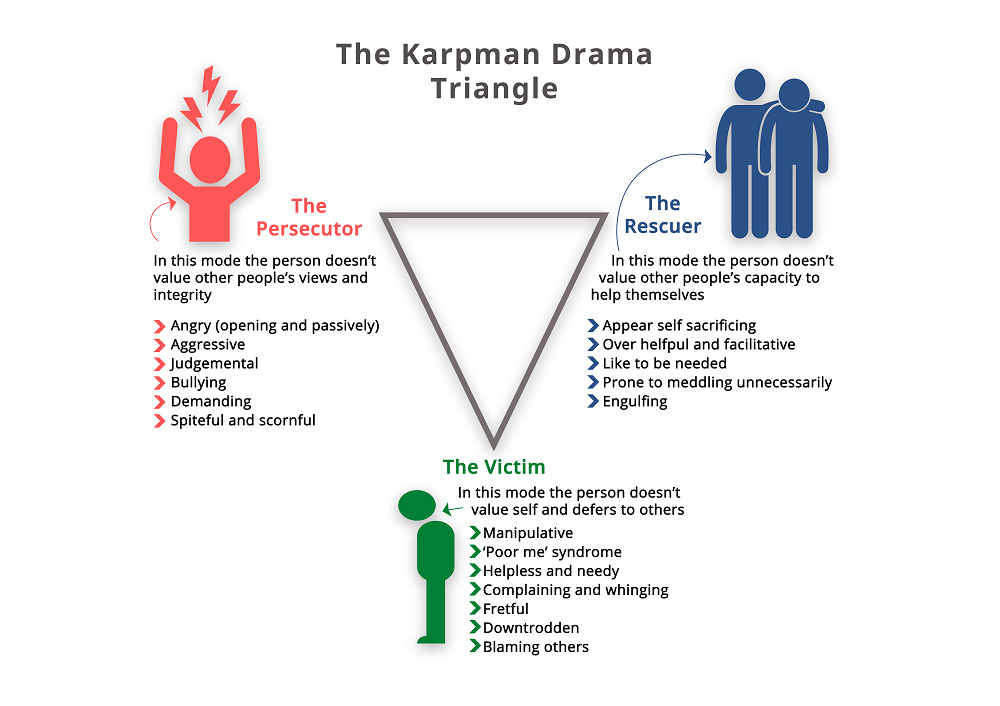
What roles are involved? Three: Persecutor, Rescuer, and Victim. This doesn’t mean 3 players. If there are 2 players, one might be the Persecutor, the other the Victim.
The duplicity in this game lies in the fact that people are baited into it. There is the appearance of sharing, of asking for advice, of giving advice, but also the intent to hurt. The moment when this happens is the shift, e.g., when a Victim suddenly plays the role of Persecutor. A game could be going on for days before the shift happens. When it does, everybody feels bad. But the one who initiated the shift intended it this way to validate the negative image he has of himself.
Aside from validating a negative self image, one also gets recognition (or strokes), a negative one being better than none at all. And one gets it without the risk of intimacy. Intimacy is the opposite of a game: communications are open. Intimacy involves risks. The kind of people who are comfortable with risking disappointment and rejection are those who have a sense of worth that is not threatened. These are OK people. They don’t need games for validation or recognition.
Once they spot a bait initiated by their interacting partner, mature people may call out the duplicity or terminate the conversation. They have the strength of character ot refuse. Perhaps the only reason they will appear to play is that they are inexperienced or because they are gathering information.
Although all games like the Karpman Drama Triangle are duplicitous, some may be so benign they can be enjoyed. Canadia psychiatrist Eric Berne (1910-1970) has described one of these called Happy to Help:
In this game of two players called White and Black, “White is consistently helpful to other people, with some ulterior motive. He may be doing penance for past wickedness, covering up for present wickedness, making friends in order to exploit them later or seeking prestige. But whoever questions his motives must also give him credit for his actions. After all, people can cover up for past wickedness by becoming more wicked, exploit people by fear rather than generosity and seek prestige for evil ways instead of good ones. Some philanthropies are more interested in competition than in benevolence: “I gave more money (works of art, acres of land) than you did.” Again, if their motives are questioned, they must nevertheless be given credit for competing in a constructive way, since there are so many people who compete destructively. Most people (or peoples) who play “Happy to Help” have both friends and enemies, both perhaps justified in their feelings. Their enemies attack their motives and minimize their actions, while their friends are grateful for their actions and minimize their motives. Therefore so-called “objective” discussions of this game are practically nonexistent. People who claim to be neutral soon show which side they are neutral on.”
Anyone playing a psychological game must enter as Persecutor, Rescuer, or Victim. They are decribed below. Two people can play this, shifting roles along the way.
Each role starts with a discount. The Persecutor discounts others’ sense of worth. The Rescuer discounts others’ ability to think for themselves and to act on their own resources. The Victim discounts his own ability to think and to solve problems.
At some point, someone switches. For example, from Victim to Persecutor.
Always starts with a CON: a bait or a hook. Then follow up with a GIMMICK, i.e., weak spot or vulnerability, the button in the other that when pushed makes him buy the Con, leading to a RESPONSE.
Then the SWITCH, e.g., Victim –> Persecutor. The Switch grabs control through the use of confusion and surprise, called the CROSS UP. The switch is the essential part of the game, one might say its object: to hurt the others.
Then follows the PAYOFF, i.e., the negative emotions that everyone experiences as a result of playing the game. One might say these emotions are the object of playing the game.
Here’s an example:
Once upon a time, there lived three characters entangled in a curious dance called “The Karpman Drama Triangle.” Meet Victor, the Victim; Pam, the Persecutor; and Rachel, the Rescuer.
Victor, a sensitive soul, often found himself overwhelmed by life’s challenges. One day, he encountered Pam, a stern and critical neighbor, who constantly pointed out Victor’s perceived flaws and mistakes. Pam assumed the role of the Persecutor, placing blame and making Victor feel like the perpetual Victim.
Enter Rachel, a well-intentioned friend who couldn’t resist swooping in to rescue Victor from Pam’s harsh judgments. Rachel offered comforting words and advice, trying to shield Victor from the Persecutor’s relentless critiques. In doing so, she assumed the Rescuer role.
All of a sudden, however, Victor changed and began accusing Rachel of siding with Pam. What did Rachel say? Something to the effect that Pam’s actions were “objective observations”. Victor accused Rachel of being inconsiderate of his feelings and beliefs. As he attacked Rachel and his adrenaline flowed, he also attacked Pam, who being a strong woman didn’t give any shit. Rachel, however sought a Rescuer in Pam, who assumed that role to Rachel, now the new Victim. Everyone feels bad now.
At what point did the game start? When Victor baited Rachel. This isn’t the first time he played this game. He knows from past experience that at some point the Rescuer would point out flaws in his reasoning, using “objectivity”. He was waiting for just this point to spring the bait.
His objective? To underline the fact that everyone but him is wrong. Victor is trying to feel superior, because in truth he is so lacking in self esteem that he must play games like this to feel good, by making others feel bad. Quickly, however, he lapses back into misery as he realizes the feeling is short-lived; beside, Rachel has now distanced herself.
Psychological games are sometimes fun, but most of the time they cause much hurt. They could be a waste of time, except that they do reveal a lot about what’s going on in the minds of others. My advice: don’t play, but if you are dragged into it, use it to get information.
But first, how you escape a game.
First, learn to spot Games. Learn to spot the Con. People like Victor are not that rare and the opening moves are similar.
Second, if you regularly participate in games it may be because you are either NOT Ok or think of others as NOT Ok; you discount as a Victim, Rescuer, or Persecutor.
Not wanting to play, and then having spotted the Con, you might either call the instigator out: “Are you playing a game?” or simply refuse further communication.
Be aware that a game player might try another game.
In the long term you might try replacing your discounts. So, instead of discounting as a Rescuer, show respect as a Teacher, who cares and respect other’s abilities while asserting your own needs. Trust that the desire to rescue Victims might come from not trusting them.
Instead of discounting as a Victim, respect yourself as a Survivor, vulnerable, but willing to ask for help, take advice, and make the needed sacrifices.
And instead of discounting as a Persecutor, show respect as a Challenger, assertive and firm, but not to punish, manipulate, shame or belittle.
Some notable players in my life.
1. Garfield. Loves the Victim role, and constantly criticizes others like a Persecutor. I avoid playing games with this guy, just give him facts and short responses, not to cut the conversation but to direct them along. 2. Amber. Perennial Rescuer, believes everyone has a problem that she could help with. I do not have the problems she claims. Disses other people at every opportunity. 3. Virginia. Normally a Challenger, extremely competent, But she occasionally explodes and turns everyone off. Highly competent professionally, but not many real friends. 4. Napoleon. Persecutor, always authoritative, dominant, critical and condescending. Hardly even smiles, is aloof from the friends he spends time with the most, but is congenial with the ones he sees occasionally. Always complaining. 5. Clark. Most of the time a Teacher, but tends to be Victim very easily. Feels himself persecuted by some people, and then becomes a Persecutor himself. The way he talks is offputting, actually. He is readily triggered, very sensitive. 6. Jack. Professionally, he knows his stuff. He is very talkative. In a table among friends you can always be sure he will try to dominate, regaling with lots of details (he has a powerful memory), with an air of authority. He likes predicates like “I told you so,” “Of course,” and similar definitive versions because he has an explanation for everything like many Rescuers. But he rarely asks genuine questions; YOU ask him the questions. I minimize social conversations with this guy. Professionally, however, very competent. 7. Steve. This guy has formal authority, but does not articulate clearly what he wants and so leaves many of his people confused. In my dealings with him he is more of a critique than a problem solver. 8. Vincent. Very smart. Always playful, and as a consequence, is not very orderly. People are complaining. 9. Augustine. This guy is losing his memory, is awkward, takes on a lot of tasks and is overwhelmed. Very balanced overall, but does not retain many details and for this reason can be tiring. A survivor.
I’m sometimes baited because of a service orientation I learned from my parents. But I’ve learned to be a little less nice, especially to Victims who find my helpfulness soothing. However, I have become more willing to trust that most people can deal with their dramas on their own.
Transactional analysis (TA) posits that injunctions and counterinjunctions,early life messages often transmitted unconsciously from parent to child, influence an individual’s behavior and attitudes later in life. The concepts help in the analysis of communication patterns and interpersonal transactions.
What are injunctions and counterinjuctions?
Injunctions:
Definition: Injunctions are restrictive or prohibitive messages received by individuals during their early years, typically from authority figures or caregivers (often parents). These messages shape a person’s beliefs about what is permissible or not, acceptable or unacceptable.
Types of Injunctions:
Don’t (Don’t Exist): Messages that deny a person’s right to exist or have needs.
Don’t Feel (Don’t Feel Anything): Messages that discourage expressing emotions.
Don’t Think (Don’t Think You Are Important): Messages that undermine one’s intellectual capabilities or self-worth.
Don’t Be (Don’t Be Strong/Don’t Be a Child): Messages that restrict a person from being themselves or fulfilling certain roles.
Counterinjunctions:
Definition: Counterinjunctions are responses or strategies developed by individuals to cope with or rebel against the injunctions they received. These counterinjunctions can either reinforce the original injunction or serve as a defense mechanism.
Examples of Counterinjunctions:
I’ll Show You (I’ll Show You I Exist): A counterinjunction where an individual may rebel against messages of “Don’t Exist” by asserting themselves or engaging in rebellious behavior.
I’ll Feel However I Want (I’ll Show You I Feel): A response to messages of “Don’t Feel” by expressing emotions openly and refusing to conform to emotional suppression.
I’ll Think for Myself (I’ll Show You I’m Important): A reaction to messages of “Don’t Think You Are Important,” asserting intellectual independence and self-worth.
I’ll Be My Own Person (I’ll Show You I Can Be): A counterinjunction against messages restricting one’s identity, emphasizing independence and individuality.
The presence of these messages can be inferred from the content and manner words delivered by interacting partners. Transactional analysts identify and challenge these messages to help individuals gain insight into their behavioral patterns and work towards more fulfilling and autonomous lives.
Messages can be true or false. Thus, counterinjunctions may be negative. To what extent can positive messages (counterinjunctions, permissions) be just as problematic as negative ones (injunctions)?
When they are false and conditional. Let’s illustrate the dynamic beginning with injunctions.
Injunctions are non-verbal or emotional conclusions reached by the child upon seeing and interpreting non-verbal or emotional messages that come from the parents speaking emotionally.
For example, when the child has broken an expensive vase he gets a disapproving look from his father, probably accompanied by verbal tirades and even a hard spanking. The child interprets this look as an injunction, a “Don’t” message. He might, for example, interpret his father’s look as “I wish you weren’t around,” or to simplify, “Don’t exist.” This is clearly a false conclusion, and painful.
The same child will also receive verbal messages emitted by authoritative side of its parents that serve to counter this injunction. “Behave, take care of the things in this house“, or to simplify, “Be perfect“. The child then combines this with the injunction to reach the conclusion “Be perfect, and you can exist.” This “rule” has the nature of a program. A child might conclude this early, say around the age of 7. That program can stay for life unless changed.
The program is false because it’s not possible to be perfect, a fact that becomes clear with every mistake. Furthermore, the conditional that if you are perfect you can exist is not only false because of an impossible premise; it is also illogical because one can be perfect and still be made to feel that one doesn’t exist, as with a child who is ignored no matter what it does.
Yet, the rule has consequences.
The child, now grown up, lives the rule “Be perfect and you can exist” and its variants “If I do things perfectly, I can exist“, or “If I do things perfectly I shield myself from the pain of feeling I shouldn’t exist.” The person rarely says this script out loud, but the script is there, and it will explain much of what that child does in his adult life.
Usually as a means to avoid pain. The only event that validates that statement is that the child is insulated from the pain, but this never really lasts. As long as the person is “perfect”, whatever that means to him, he feels a sense of worth; he is OK on the outside. He acts normally, he might even achieve great success. But when he fucks up, he no longer enjoys the protection perfection afforded. Surfacing again is the feeling that he is Not OK, not worth anything. He feels the pain of “Don’t exist.” And this will happen again and again because we all make mistakes.
If a mistake at the wrong time or is big enough, say, when he makes a big mistake up the eve of his marriage, he could become helpless, blame the world for his sad state, end up despairing about getting any help or improvement, and then not show up. Or perhaps kill himself.
When there really was no reason for any of that.
The only way out of this is to change the conditional into an unconditional “I’m OK regardless of what I do.” By challenging the entire conditional, this person is not so much shielded from childhood injunctions, which will not be erased from memory, but is strengthened to respond to their occasional surfacing.
A good sign that one is in the grips of a wrong counterinjunction is that his emotional states tend to fluctuate rather wildly: one day feeling great, next day feeling depressed. Or lively with colleagues, depressed with family. A lack of consistency in behavior, a lack of consistency in general suggest that one is living by rules that could be discarded.
We just have to consider that such rules have been used for years and that it might take a lot of sacrifice to discard them.
A goal of therapy in Transactional Analysis is to achieve an “I’m OK, You’re OK” state. This state describes a relationship where one considers oneself and the other as having worth. By extension, other groups also have worth: I’m OK, You’re OK, They are OK.
This is one of four life positions. In shorthand,
I+/U+: I’m OK, You’re OK
I+/U-: I’m OK, You’re NOT OK
I-/U+: I’m NOT OK, You’re OK
I-/U-: I’m NOT OK, You’re NOT OK
Each life position is formed through one’s childhood experiences, particulary through one’s dealings with one’s parents. As one exits childhood, one recalls these interactions and then decides on a life position that becomes like a theme. A child will not often articulate its life position, but most interactions the child will have all the way to adulthood will follow that theme.
A life position is a cognitive habit. Like any habit, it can be changed with some effort, conditioned by other elements of the personality, existing habits and vices, and one’s physiological state.
People who see each other as worthy (I+/U+) deal with each other as equals. Their interactions are free of manipulation and duplicity. They are not afraid of intimacy, or its risks in the form of hurts and disappointments. They express their ideas and debate them freely, even criticizing them in ways that are not taken personally. They express their true feelings without having to hide them with a substitute, more acceptable feeling. They also accept that the relationship might not last, and that permanence isn’t a requirement for entering a relationship in the first place.
People who see each other as worthy do not think it’s necessary that they enter into intimacy. As they are not attached to people, their freedom in this manner is intact. They may engage in rituals and pastimes, such as talking about the weather, feelings, and dreams, without the intimacy proper to friends. These surface exchanges help them gauge whether they would like to be friends and then choose relationships free of manipulation or duplicity.
The I+U+ state, however, is not the life position most people decide upon as they exit childhood. The most common state is “I’m Not OK, You’re OK“, that of the child who knows itself to be dependent (Not OK) on the support of a competent (OK) parent. Many continue to hold on to this life position thinking they are less worthy than others even as adults, leading to relations of dependency and lack of assertiveness, and positions of weakness masked by duplicitous displays of smugness and a contant search for validation. No matter how it may appear on the outside, a pervasive sense of not being worthy cannot be disguised for long.
However, as a child grows especially in a supportive environment, it learns skills and acquires knowledge. The child is able to solve problems using information in the here and now. In other words, without the baggage of memories of its NOT OK’ness. Certainly, the child will be recalling painful memories of its interaction with its parents, but it gradually is able to assign relevance to these memories in the light of present circumstances. The child becomes confident, with little need for strokes as there is no defect in its self esteem that it needs to soothe. Even feelings reminiscent of its Not OK childhood will be expressed or suppressed but under the control of the mature mind.
In other words, a child with proper support can redecide its life position, from “I’m Not OK, You’re OK” to “I’m OK, You’re OK“.
An important goal of therapy is to move people to this state. Aside from the I-/U+ are the I+/U- and the I-/U- positions. All Not OK positions imply at least one person in a relationship is not considered by the other to be worthy. Relationships where people don’t see each other as worthy are marked by duplicitous games and fake feelings. People who engage in games don’t deal with each other as equals, but instead take on roles such Rescuer, Persecutor, or Victim. The essence of a game is that one party in the interaction shifts its role suddenly, e.g., from Rescuer to Persecutor. Intimacy is feared and avoided, and developing true friendships is very difficult.
I said that a child “with proper support”. This implies that ridding oneself of Not OK habits of thought, beliefs, and behaviors could take some time. As with a vice, the feelings associated with feeling less worthy may be the more comfortable option.
Some people, for instance, fear happiness. Their “I’m NOT OK” position may be so comfortable and convincing that a show of esteem from another will be most uncomfortable. It is common for people with low esteem to have problems receiving compliments, for example. They may engage in validation-seeking behaviors to soothe the pain of not feeling worthy, and can spend years within abusive relationships that at least keep them in their comfort zone of NOT OK.
I found a clip on Youtube where this guy described a date he had with two girl buddies. The girls were both gorgeous and dressed about the same. One of them, however, became the object of numerous inappropriate advances by other men in the bar, while the other was not approached by anyone in that manner. Our guy reflected on why one of his friends was approached but not the other. He concluded that the first girl was subconsciously communicating her need for validation through her demeanor, tone of voice. The other girl had no need for validation and exuded an air of “I’m not to be messed with,” and so no one dared. People who are hungry for validation are perceived as “easy”, often in the bad sense of the word, while those who have no need for validation attract others who don’t need it either.
Is it a person’s fault that he or she attracts disrespect? Perhaps a person in his or her 20’s might be excused, but not one who’s older. Unless a person is mentally challenged, under the influence of drugs, or otherwise forced, behavior is almost always the result of a conscious choice even if we understand that behaving in the right way for someone not used to it can be extremely difficult.
And what choice is involved? Whether or not to give in to memories and feelings.




 jaylazzo