Obscure Fables 1: The Fox and the Constipated Stork

Jean de La Fontaine (1621-1695) was a French writer of fables and one of the most widely read French poets of the 17th century. His Fables provided a model for subsequent fabulists across Europe and numerous versions in France, as well as in French regional languages. 

The Fox and the Stork was written around 1668. It is part of La Fontaine’s first collection of fables, titled Fables Choisies, Mises en Vers. It’s a dramatic story; I thought I’d tweak it a bit.

Once upon a time there lived an uncultured Fox who loved to deceive his friends. One day, he invited the Constipated Stork for dinner. It was a simple meal of broth — the Fox may be cunning, but he was cheap. He served the broth on shallow flat plates.

The Constipated Stork, who had a long beak, had great difficulty getting even a drop of the broth. The Fox found this very funny and could barely hide his glee as he lapped up his meal noisily. Dinner ended, the Stork barely got a taste of the broth, and he went home with revenge on his mind.

So one day, the Constipated Stork invites the Fox over for dinner.

“You will just love what I picked from the North,” the Stork said.

“I can’t wait!” said the Fox. On entering the house he noted a beatific smell that filled the room, the glorious odor of cooked viand, or was it veal (I never could tell, was that from France?), and the food served…

…in Dulcolax bottles.

“Ah,” said the Fox, “Ran out of long necked bottles?”

“No,” said the Constipated Stork, “They’re still there, just drying.”

“You know these are wide mouthed plastic medicine bottles.”

The Constipated Stork nodded.

“You know I can just get the stuff out and eat it like this,” said the Fox as he smugly shook out pieces of luscious cooked meat and stuffed them one after another into his mouth.

“I can see that, of course,” said the Constipated Stork watching as the Fox consumed the meat on his plate.

When the Fox was done, the Constipated Stork asked him, “I feel stupid to ask though, seeing how simple you are with all things culinary, but I have to: how did you like my latest creation? I truly welcome your feedback.”

Magnifique! The veal, or viand, I never could tell, was your best yet! I didn’t think you were stupid to repeat a prank. But why did you have to put the meat in Dulcolax bottles?”

That wasn’t meat.”

The Fox retched, scurried home, tail between the legs.

Moral of the story: not all that glitters is glit, not all that shimmers is — shiny.

(Q.C. 230408)

The work ethic of Anton Chekhov

My favorite fiction writers? Stephen King, John Grisham, Robert Ludlum, Michael Crichton, Guy de Maupassant, Fyodor Dostoevsky. But one writer is not on this list who should be, a master of the mundane whom I have not read until now.

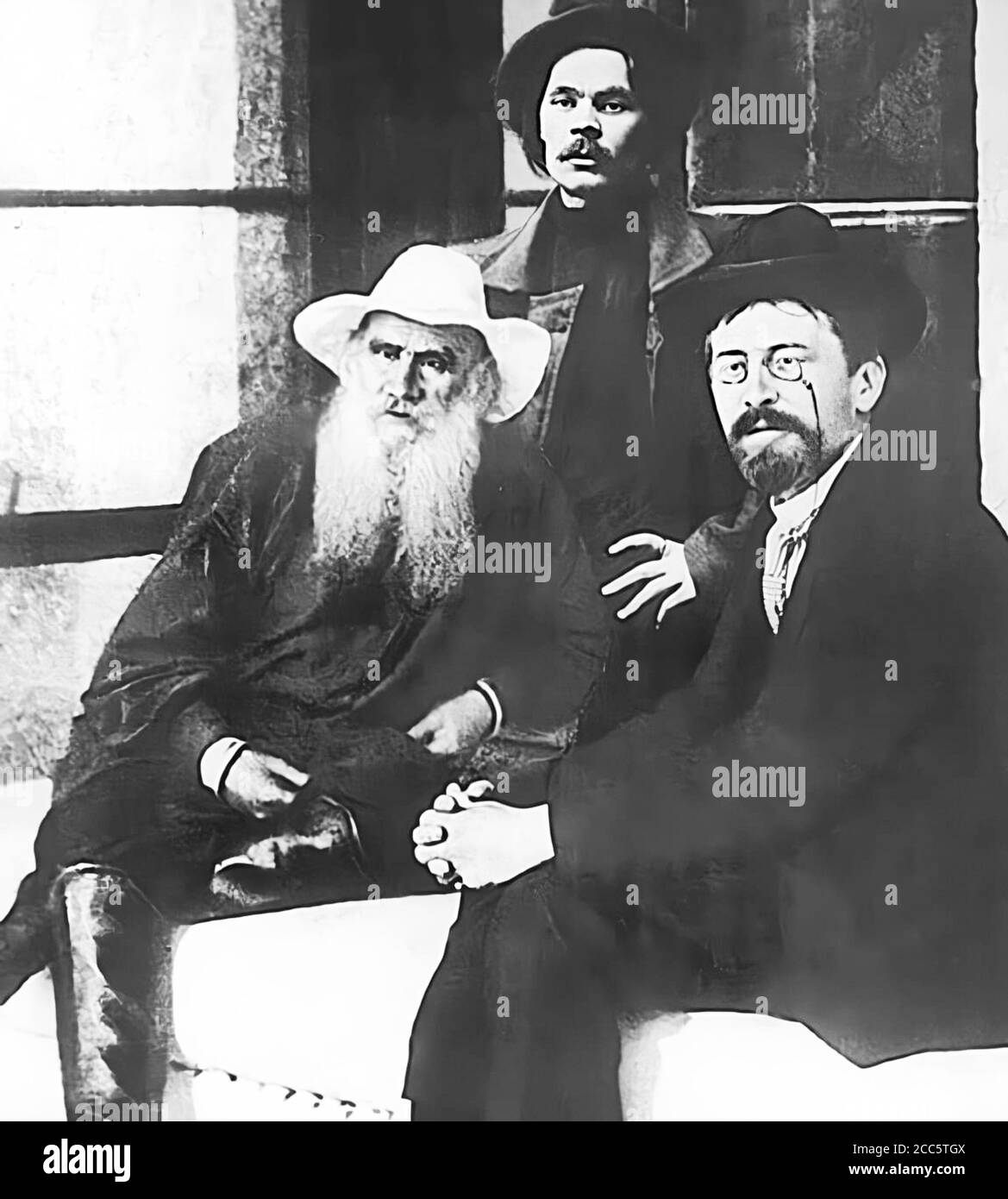
Anton Chekhov (1860-1904) is one of greatest writers of all time. He was a contemporary of Maxim Gorky (1868-1936), Fyodor Dostoevsky (1821-1881), Leo Tolstoy (1828-1910), Ivan Turgenev (1818-1883), and others. Unlike the great Russian novelists, he mainly did short stories. Also unique to him is that he wrote about the banal, the ordinary. He did not psychologize like Dostoevsky, or moralize like Tolstoy, but only wrote about what he saw. And unlike many of his contemporaries, he did not put the peasants on a pedestal. To him rich and poor have the same problems, all strive for moments of joy in lives just as filled with moments of misery.

Chekhov wrote:

If in the first act you have hung a pistol on the wall, then in the following one it should be fired. Otherwise don’t put it there.

Anton Chekhov

This advice is known as Chekhov’s Gun. It says that every element in a story must play a part in the story. This led to a minimalist style that has become characteristic of today’s stories. Chekhov is considered the father of modern fiction.

But it is the man’s work ethic, not his writing, that first got me interested to know more about him.

While there are no definitive records of the exact number of hours Chekhov wrote each day, it is well known that he kept a disciplined and consistent writing schedule. His productivity suggests that he devoted a significant amount of time to his craft.

What have I learned about his discipline?

Chekhov would spend hours every day writing, revising, and perfecting his stories and plays. I think his schedule would not be very different from that of another minimalist writer, Japanese author Haruki Murakami (1949 – ), for whom we have more precise information: Murakami spends the first 4 to 5 hours of his day writing.

Chekhov was a practicing physician. He managed to write and to heal by dedicating specific time blocks to each profession. We know he spent 3 hours a day, 6 days a week seeing patients in his clinic and on house calls. His output attests to his time-management skills.

He was deeply committed to his writing, continually honing his skills and developing his unique realist style. He placed a strong emphasis on creating vivid characters, engaging dialogue, and exploring the complexities of human nature. He had the best beta readers and correspondents, his friends Tolstoy, Gorky and other members of the Russian literary elite.

He faced numerous rejections early in his career, but he persisted in submitting his work and learning from feedback. He himself did not realize and in fact felt a little embarrassed to learn that he had, in his lifetime, become one of the most significant literary figures of his time. He died of tuberculosis at 44 before knowing that he had become one of the most greatest literary figures of all time.

Chekhov, the doctor, had very sharp powers of observation. He incorporated his experiences and observations of people and society into his work; if his short stories were read in chronological order one would in fact be reading his autobiography. He had a keen eye for detail, which allowed him to create realistic and relatable characters and stories. He aggressively pointed Chekhov’s Gun on his work and polished it to great precision and clarity.

I greatly admire Chekhov’s discipline, dedication, and a commitment to his craft. I hope I can adopt his ability to balance multiple roles and to persist in the face of rejection.

(Q.C. 230407)

If you are eccentric, do not be average

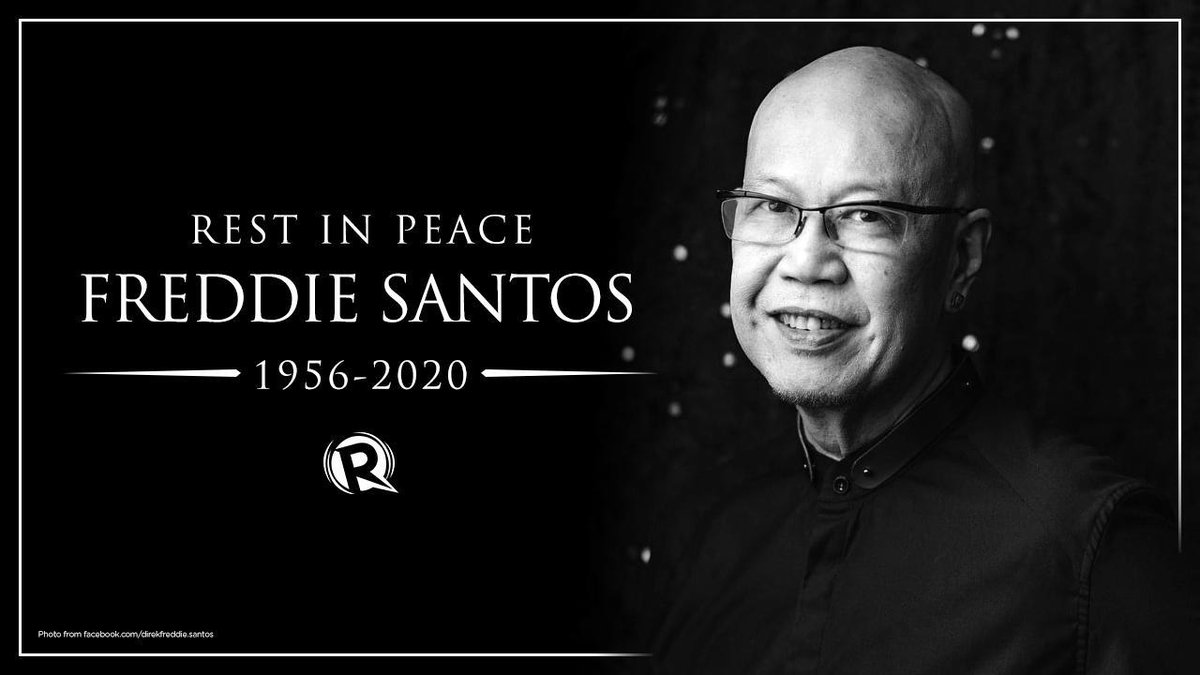
My uncle Freddie Santos (1956-2020) was eccentric. He was a multi-awarded theater actor and director, very talented, and pleasant to be around with. He wore his eccentricity with all the obviousness of his all-black clothes, but everyone could see there was serious substance underneath. His jokes were off the top witty, sometimes hurtful without intent — but what is humor without a little cruelty, eh? A tireless professional, he was working on a play when he died.

We loved him. I pray for him everyday.

Freddie Santos. Image: https://pbs.twimg.com/media/EpbbJZfW4AEtPFv.jpg

In contrast is this person I know; let’s call him “Garfield”, like the cat.

His eccentricity? “Garfield” has the airs of one who has the low down on everything and everyone. But any amusement one might experience on meeting him for the first time quickly wears off. Why? He is a freeloader. He has no work, and shows no initiative to find one. He has no volunteer engagement, and even chores he leaves to others when he can. He has an inflated sense of entitlement. He runs up thousands in medical bills per month, paid for by family of course because he has no income or pension. Why no pension? Although he has an engineering degree he never held down a job for long. He was fired from his first job at corporate in Singapore after only 2 years, worked again, fired, then hired by old acquaintances. Then fired. Then hired. In this last job he often called sick, when present took frequent smoking breaks, always delivered late, complained about everything and everyone. He made silence of office a source of gossip. Fired. He probably should have been a talk show host. More likely, he’s s mentally ill.

Other than dressing up like a sack, “Garfield” does not have the fashion of an eccentric. In contrast, my uncle, who may have been inspired by Elton John at one point, later adopted an all-black clothing style. He explained to me:

The speaker must stand out. Most backgrounds are light colored. By wearing black I’m always prepared.

Freddie Santos

He did have the unconventional arrangement of living alone. He was loud, which was good because he enunciated well, had a picturesque vocabulary and a sharp wit. “Garfield”, though he speaks sonorously and is well read, doesn’t listen. Once I explained that “Vaccines are safe”, plus the evidence, and within 30 seconds he asked “Are vaccines safe?” Typical behavior of him. Most of our mutual friends do not take him seriously anymore.

Eccentricity has a cost. Acting differently from societal norms or expectations sets off an alarm bell in our brains that we inherited from our hunter-gatherer ancestors. They had to think with and behave with the group to survive; those who had the gene for eccentricity were eaten by the saber tooth tigers before they could pass on their genes. Though not inherently negative especially today, these behaviors can lead to misunderstandings, social isolation, or negative judgments from others just because of this evolutionary quirk.

But, whether these miseries actually happen depends on how hard we need to work to be useful.

Some eccentricity may be an asset in theater, but it is a liability for most other work especially corporate. How much performance does it take to balance the cost of eccentricity in corporate? We can estimate. It has been said that in an organization a very small number of people, the stars, outperform the median by a factor of 3 or 4. That is, in a sales force of 100 where the median cold calls is 50 per day, the one or two stars in the group will do 200. This is called a power law distribution and is seen in all kinds of organizations. I estimate that to safely compensate for the cost of eccentricity, the flamboyant salesperson must be a star: he must make around 200 cold calls everyday, or do 3X to 4X better than the median on some measure of performance. Anything significantly less risks putting him in the outcast zone.

Steve Jobs (1955-2011) was a legendary eccentric: his strange mix of Buddhism and ruthlessness is well known. He was also a star businessman of the kind we see only once a century. Excepting sabotage, he could get away with anything, and he did.

One should not be eccentric AND average.

(Q.C., 230406)

The Four Disciplines of Execution

The hardest part about goals is execution. How to execute, this what the book The Four Disciplines of Execution, by Chris McChesney, Sean Covey and Jim Huling teaches the reader. The book is one of the most popular in the management genre; its principles are easily searchable on the Web.

Here is a brief summary, with a few examples from my lab.

The four disciplines are:

Focus on the Wildly Important Goals (WIGs): WIGs are a small number of well-defined high-impact goals. “High-impact” means they are the most important for the individual or the organization. “Well-defined” means you can visualize them. Focus on them; other goals may be de-emphasized, delegated, or eliminated.

Act on the Lead Measures: Lead measures are metrics that are within our control; lag measures are not entirely within our control. Leads predict lags. Lags get you the WIGs.

Keep a Compelling Scoreboard: Track progress on lead measures and WIGs using a visual scoreboard or dashboard. Scoreboards motivate teams and excite spectators. We keep scoreboards only for a few of our WIGs.

A scoreboard. Image: https://i.pinimg.com/originals/aa/22/cc/aa22cc721516be9ca3b778d628d3a7dd.jpg

Create a Cadence of Accountability: Regularly review progress and make necessary adjustments. Hold people accountable for their performance, and commit to specific actions that will improve results.

How can one implement 4DX?

1. Identify your WIGs: Choose 1-3 specific, measurable, and time-bound goals that are most important to you. Ensure they align with your values and long-term vision. We have two yearly WIGs: 1) discover a new species of microbe; 2) discover a new drug.

2. Determine your lead measures: For each WIG, identify 2-3 actions that directly contribute to achieving it. Make sure these actions are within your control and can be consistently measured. For example: the number of days each person performs an experiment per week, or the number of journal articles each one reads per day, are leads. Lag measures include the number of papers we publish per year; we don’t have control over the decision of a journal to publish it. The better we meet the leads, the more likely we will meet the lags, and the more likely we will get the WIGs. After 14 years of successful grant awards, publication and so on, we have still failed at the truly important WIGs 1 and 2. Then, in 2023, we may have identified our first new species of bacterium. We originally isolated it in 2014, but did not have the technology, resources, or insight to realize how novel it was back then.

3. Design a scoreboard: Create a visual representation of your WIGs and lead measures, including targets and progress. The scoreboard can be a graph, giant numbers as in sports, or a dashboard like that in cars. Update the numbers regularly and place the board where you can see it daily, first thing. The next user of the lab sees in the logbook who worked; competitive people love this.

4. Establish a weekly review routine: We meet on Monday mornings to review our scoreboards, our progress, and we identify any obstacles. We commit to specific actions for the following week that will advance our WIGs.

5. Stay disciplined and consistent: Keep the focus on the WIGs and lead measures, and make adjustments as needed. Hold people accountable and celebrate progress along the way. This means food!

The 4DX has an enemy: the “Whirlwind“. This refers to the phone calls, deliveries, forms to fill, and a million other urgent but unimportant concerns that scream for attention but take away focus from important goals. It is a sad fact that most people spend their entire day and weeks sucked inside Whirlwinds, unable to move forward on their personal and professional road.

[The concept of important-versus-urgent was introduced in the book The 7 Habits of Highly Effective People by Stephen R. Covey (1932-2012). This concept is presented as part of the time management matrix in Habit 3: Put First Things First. Covey’s matrix classifies tasks into four quadrants based on their urgency and importance:

Image: https://www.dreamendstate.com/wp-content/uploads/2020/12/Important-Urgent-2-1200×905.jpg

Covey suggests that highly effective people prioritize Quadrant II tasks (important but not urgent) to achieve long-term success, personal growth, and a balanced life.

Stephen Covey was the father of Sean Covey, one of the authors of 4DX.]

You can’t avoid most of the Whirlwind; but the 4DX helps you along the road in spite of it. The 4DX helps one to get important things done SYSTEMATICALLY, without guesswork or improvisation, with consistency, and therefore with confidence.

The consistent ability to set goals and meet them: that is real confidence.

(Q.C. 230506)

Take Massive Action!

I just loved the counterintuition in this book.

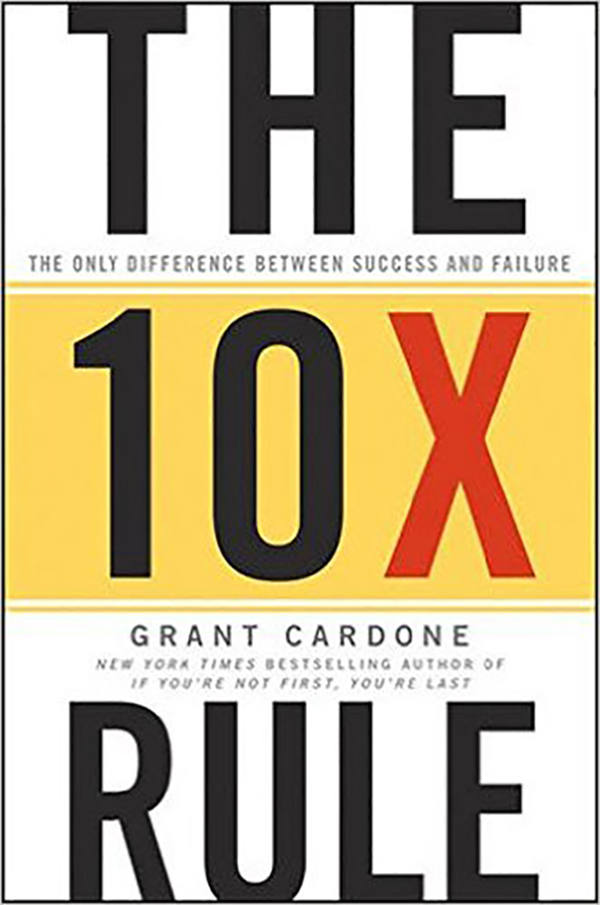
The 10X Rule: The Only Difference Between Success and Failure” by Grant Cardone is about a powerful approach to setting and achieving goals. The premise of the 10X Rule is that you should set targets that are 10X higher than what you initially thought possible, and then take 10X more action than you previously believed necessary to achieve them. Cardone argues that by adopting this mindset, you can achieve extraordinary success.

Many people tend to overestimate what they can do. They take on commitments until they are so full they can’t deliver. Technology makes it worse by creating the illusion we can increase our goals without an increase in effort, time, and resources. But if technology is so awesome, why are mental health issues and cardiovascular diseases on the rise everywhere technology is advanced?

Get rid of commitments that are neither important nor urgent.

See, energy is finite; effort can exhaust that energy and sap our joy. Cardone’s counterintuitive idea is that yes, but if one’s goals were BIG ENOUGH, the opposite happens: you get tired, but the sense of fulfillment will make you want to jump out of bed the next day to do it all over again.

But we must be willing to take massive action. We must be willing to go above and beyond the ordinary effort required, relentlessly pursuing our objectives, and constantly pushing ourselves to do more.

The 10X Rule requires that you face the fears and obstacles that stand in your way. Do not, however, think you have to unleash a tsunami: a small but constant trickle will cut ravines into mountains.

Your commitment and dedication must not waver.

Commitment and dedication require you to take full responsibility for your own success. Opportunities will never be handed to you on a plate, but blame will be heaped on you. So what. Take ownership of your mistakes. Another counterintuitive idea: owning one’s mistakes motivates because you admit you have power.

So, here’s Cardone’s kick-a** advice:

Think BIG. Identify your personal and professional goals, then multiply them by ten. This will push you to think bigger and aim higher than ever before.

Make a plan. Outline the steps and the actions you must perform to achieve your massive goals. Be realistic about the effort required and be prepared to invest significant time and energy.

Take massive action. Commit to taking 10X more action than you first thought necessary. You may have to work longer hours, invest more financial, technological or emotional resources, and get out of your comfort zone.

Track your progress. Assess and adjust your plan of action as needed. Hold yourself accountable for your achievements and setbacks. Tracking massive goals have great power to motivate and inspire creativity.

Persist. Stay determined and committed especially in the face of setbacks. Stay focused.

Embrace responsibility. Take ownership of your success. Seek out opportunities. Recognize that your achievements are the result of your own efforts.

The hard part, of course, is execution. I will write about that in my next blog.

(Q.C. 230406)

Is there such a thing as unnecessary suffering?

I joined a new group on Discord yesterday. It was run by a friend. From the voices and descriptions of interests I think many were college students (my friend is a PhD student).

The question under discussion was Is there such a thing as unnecessary suffering? In past Sundays the group had already discussed necessary suffering. E.g., they agreed one had to go through the suffering of study to get good grades, or the suffering of a surgery to get well.

The discussion this time started with a rather extreme example: A young man about 18 years old is not allowed by his mother to buy a PS2. To exact revenge, he kills her. He goes to jail and is in danger of the death penalty. Where is the unnecessary suffering here?

It seemed clear that killing the mother was unnecessary suffering because it benefited the son in no way. Unnecessary = no benefit. By locking the son in jail, society is said to inflict a suffering necessary to protect itself and repair somewhat the damage caused by the crime.

However, the group was divided on whether the electric chair benefited anyone. People held different views about the sacredness of life (in the non-religious sense), different ideas about whether heinous crimes meant the criminals forfeited this sacredness, and whether the gas chamber was necessary for society to achieve certain benefits.

I will try to summarize the witty repartees that flew around during this lively 1.5-hour conversation. I structured my summary within the framework of a simple schema: cause —> effect.

In this schema, suffering is the cause of some effect. Necessary means the cause is “required” to bring about the effect. There are at least five ways by which might be unnecessary to achieve a given effect.

First: the cause does not lead to the effect. Worrying about one’s lack of money cannot lead to acquiring a PS2, but getting money and going to the store will. Worrying is an unnecessary suffering. On the other hand, killing the mother is necessary because it is required to achieve the pleasure of revenge. However…

Second: the cause is not the only way to achieve the same effect. The son could achieve the pleasure of revenge through a silent treatment, which inflicts much less suffering. Killing the mother will also lead to that effect, but a less painful alternative makes this killing relatively unnecessary.

Third: the effect has changed. For example, if the desired effect were to get the PS2, then killing the mother becomes unnecessary, but stealing money to buy the PS2 could be.

Fourth: the effect leads to another effect that wipes out the original benefits. For example, killing the mother leads to the pleasure of revenge, but going to jail leads to the pain of jail. Pain is 180 degrees from pleasure. This fourth way is an extension of the other ways above.

And fifth: the suffering is invented. The mother’s suffering is not invented, but the son worrying he could never get the PS2 is. Everyone identified with my example of a guy who was dumped by his girlfriend. The guy felt he could not move on, when in fact he could. He invented his own suffering.

What practical lessons can we learn from this exercise?

I suggested that people read Kim Wehle’s How to Think Like a Lawyer, which starts off with the observation that all situations involve multiple issues. Real life is more complex than this extreme case of matricide. The son stealing money from his mom to buy a PS2 is stealing from a family member, which morally and legally is not the same as stealing from a stranger. Wehle gives the reader a few tools to navigate complex cases like this one.

Another useful take-home message is how the cause —> effect model can be a useful tool against the threats to mental health to which young people are exposed. These dangers are suggested by the five ways by which causes are unnecessary.

  1. Do only what brings you closer to your goals. Worrying accomplishes nothing, but action does. If you can do something now, do it now. Avoid useless activities, but treat yourself to a movie or ice cream for something awesome that you just did. Get out of your comfort zone, because the zone of discomfort is where we find our best options. Note that NOT acting is acting: if there is some good you can do to someone, do it, for you might never pass this way again.
  2. Consider alternatives. You think you have to skip classes because you are stressed. But, what you really need is to relax, and there are more ways to relax that than to skip classes, for example, breathe in (1…2…), breath out (3…4…5…6), for about a minute. Your “enemies” are NOT causing your stress; you just want them to be the cause of your stress. Find the true cause, in this case, you can’t let go of their imagined insult. Forgive.
  3. Change the terms. What do you do when faced with an unsolvable problem? Change the terms. You want to write a an essay worthy of a 90+, but no matter what you do, you’re mentally blocked. Change the terms! Don’t aim for 90. Set your font color to white and type on a white background, anything in your head, non-stop, for 10 minutes. Change to black, then edit for the next 45 minutes. Don’t aim to get a super essay.
  4. Beware the unintended effect and the side effect. Slow down and think about consequences or side effects. Especially for big decisions, learn to say “Maybe” not “Yes”, not “No”, and then think about it.
  5. Don’t worry. Worry, anxiety — invented. False Expectations Appearing Real = FEAR. You think it is inhuman to bike to work under the summer sun? But this is absolute joy to some. Attitude change is all it takes to remove a lot suffering.

I congratulate these young people. They had a true conversation.

(Q.C. 230404)

Go for quality

This book is more than just one of my favorites.

Zen and the Art of Motorcycle Maintenance (first edition 1974) is a fictionalized autobiography of the author, Robert Pirsig (1928-2017); it is based on a motorcycle trip he took with his son from Minneapolis to San Francisco in 1968. The narrative is interspersed with philosophical discussions on the author’s ideas about “Quality” and the nature of reality.

The book was born out of personal challenges, including Pirsig’s struggles with mental illness and the dissolution of his first marriage. He sought to make sense of these experiences by delving into the concept of Quality, which he believed could provide a unifying principle for understanding the world and one’s place in it.

Pirsig describes Quality as an undefinable, transcendent characteristic that is inherent in all things, whether it be a piece of art, a well-crafted machine, or a human experience. Quality is not an objective property but rather a subjective experience that arises from the interaction between an observer and the object or event being observed.

What hooked me to the book was an experience I had in 1989. I was with a group of fellow students visiting the Louvre in Paris. We had stopped before a gigantic mural in oil, I recall not what. We were commenting to each other how beautiful it was. Our leader, the playwright Paul Dumol (Ang Paglilitis ni Mang Serapio and other plays), however, dismissed the painting as “decadent”. He didn’t explain why; he just brought us to another painting that was not. It took me another visit to the Louvre 10 years later to understand, or rather experience, Dr. Dumol’s point. When I first picked up Zen in 2003, I remembered this episode again.

For Pirsig argues that people have an innate ability to recognize Quality, even if they cannot explicitly define or describe it. Some people have a greater ability than others; they have more of what we call taste. And, taste is trained.

Although Pirsig did not outline how to acquire taste — I don’t think anyone has clearly come out with a standard protocol — he made it clear to me that the path required understanding. For Pirsig, understanding came in two modes: “classical” and “romantic”.

The classical approach focuses on the underlying structure and function of things. One might call this the science or the engineering of the object or event. The romantic approach, in contrast, emphasizes aesthetics, emotions, and personal experience. One might call this the art side.

For Pirsig, Quality transcends this dichotomy, as it is present in both the technical details and the overall experience of something. Pirsig did not explain so much as illustrate, by showing it takes years of maintaining a motorcycle and traveling on it to reach this point. In the visual arts, our experience is that the Master certifies that the Student has also become a master only after a long apprenticeship, during which the student studied to be a chemist and an artist.

Is one a Master because one has flow? I do not think it is that simple. Experts experience flow where writing is easy and pleasurable, and also experience boredom and despair searching for data and revising text. I know that in anything worth doing, failure is much more common than success; editing takes 10X longer than writing a draft and is 10X more humiliating. People see only the end product. But a few among them can feel what it took to get the product. Pirsig knew why: because they also went through that mess. It takes a master to recognize another.

What Pirsig has given me and his millions of readers is a bridge that connects seemingly disparate aspects of life, technical and rational thought and emotional experience. That bridge is Quality, or better yet, the pursuit of quality through work that is both technically excellent and aesthetically pleasing, and consistently so. Quality unifies, allowing us to achieve a sense of harmony and integration in our lives and in our interactions with the world and people around us.

(Q.C. 230402)

Ego is the enemy

A healthy self-esteem helps a person live a healthy life, and an unhealthy self-esteem can block personal growth and even survival. Self-esteem in any case is often a mask that looks nothing like the real face behind it.

When I was a kid, I was fascinated by Tutankhamun. “King Tut” was an Egyptian pharaoh who ruled from around 1332 to 1323 B.C. In 1922, British archaeologist Howard Carter discovered King Tut’s tomb, undisturbed for more than 3,000 years, its collection of gold and jewels intact. It was the most important archeological find of the century and sparked a renewed fascination for hieroglyphs, pyramids, mummies and tombs among Egyptology scholars and the general public.

Among the artifacts was a gold sarcophagus bearing a death mask of extraordinary beauty. Inside was a simpler sarcophagus, and inside it the mummy itself. King Tut’s mummy was nothing like the death mask.

Image: https://i.ytimg.com/vi/cURc95RjbmM/maxresdefault.jpg

Which image of King Tut is the most accurate? On the left is what he looks like today. In the middle, what he looked like in high school, which may not even have been how he saw himself.

But we are sure that on the right is how he wanted to be seen and remembered.

Curated, manicured, supported by just the right kind of press release. We want others to see just The Mask. We will claw our way through the day to make sure. Criticisms are scratches on the gold. We will avoid any situation, any person especially experts and friends, we will spend millions on herbs and pyramids, to protect the Mask.

Face it: the Mask is nothing like what’s under it. The Real Self (unless it is already mummified) is ever changing; it has depth, it perspires, it wrinkles with age, grays with disease, glows with health. The Real Self grows, droops with tiredness, has dreams, has nightmares, weeps, laughs. The Self is the ever-being-written-and-edited book, the Mask just the cover. Most of us want to be judged by the cover.

A healthy self esteem comes from reading the Book correctly; but we don’t often read right, nor do others. How do you manage that? By reading again and again, underlining here, editing there. By asking for reviews, putting in the work to improve, and accepting the path will not be smooth.

Some couldn’t take it. Ryan Holiday, in the book Ego is the Enemy, explores how obsession with the Mask can wreck our personal and professional lives. We become arrogant, complacent, cowardly decision makers. We fail to take criticism, fair or unfair. Many who couldn’t face an insult or the work needed to improve killed themselves with boredom, despair, or suicide.

Tell yourself honestly and bravely: “Here is who I am, there is what I want to be, and this is what I will do to get there.”

I used to frequent the San Francisco Book Company, a tiny used book store on Rue Malar in Paris. I love old books. Their ugly, worn out covers mean someone else found the pages worth reading. Oh, and the marginal notes!

I miss that store.

(Q.C. 230401)

Stephen King On Writing

If I had to recommend just one book on writing, it is On Writing: A Memoir on the Craft, by the author of some of the most beloved of children’s stories like It, Carrie and Pet Sematary.

On Writing is a memoir and a writing guide in which King shares his personal experiences and advice for aspiring writers. The book is divided into three sections: “C.V.,” which covers King’s early life and writing career, “On Writing,” which provides advice and insights on the craft of writing, and “Toolbox,” which offers practical tips and exercises for writers.

King emphasizes the importance of reading widely and writing regularly. He also stresses the value of creating a writing routine and setting specific goals for oneself. King emphasizes the need for writers to be honest and authentic in their writing, and to avoid excessive adverbs, adjectives, and other unnecessary words.

King also discusses the importance of revising and editing one’s work, and of getting feedback from others. He offers practical tips for improving one’s writing, and they are listed below.

On Writing is an engaging and practical guide to the craft of writing, filled with personal anecdotes and insights from one of the most successful and prolific writers of our time. It holds a favored spot in my Stephen King collection.

Summary of King’s recommendations, and some of my own:

  1. Read widely and often, and pay attention to how other writers use language and structure their work.
  2. Write regularly, even if it’s just for a few minutes each day.
  3. Develop a writing routine and set specific goals for yourself.
  4. Be honest and authentic in your writing, and avoid using excessive adverbs, adjectives, and other unnecessary words. [Most adverbs and adjectives are too excessively used.]
  5. Revise and edit your work carefully, and seek feedback from others.
  6. Use concrete, specific details to create vivid images in the reader’s mind. [Use concrete nouns – “what you can place on a wheelbarrow,” said King – proper names and dates, numbers in arabic. As an exercise, try writing WITHOUT adjectives or adverbs, only nouns and verbs.]
  7. Avoid passive voice and other common writing pitfalls.
  8. Practice, practice, practice! Writing is a skill that can be developed and improved with time and effort.

(Q.C. 230331)