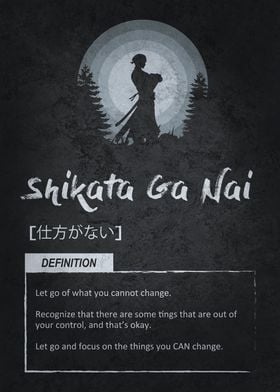
Shikata ga nai: Let go of what you can’t change

Image: https://static.displate.com/280×392/displate/2023-01-01/e24eb72ca3155ce10b5df2e03222421f_63b6e5e06d53c3edd3fae1b9af8bad70.jpg

Should we change people? Even if we can try I think we can’t really measure how much influence we in fact had.

People might say they were more influenced by some than by others. But do we really know that? Research has shown that people placed in a room with business-related objects such as brief cases and fountain pens tend not to split a cash gift evenly with another subject; in contrast, people placed in a neutral room tend to split evenly. We are all the time influenced in some way by what see, hear or feel around us without us realizing it. The less we are aware of these influences, the more we ignore their true effects.

Thus, we can arrange objects in a room to subliminally influence how others will think and behave. Robert Cialdini calls this Pre-suasion. If we can hide our intent to influence, we increase the chances that others will behave in the direction we desire.

I might think that no one has ever really persuaded me without me willing it. But knowing about pre-suasion I can explain and I can rationalize, but I’m pretty sure much of that is constructed memory, and therefore inaccurate in many important ways. On the other hand, neither can I measure how much influence I actually had on another.

Thus, I can try to influence, but short of coercion, I do not have control. What I do have control over is my message and how I deliver it. Pre-suasion, persuasion, rhetoric: professional skills a leader cannot ignore. For example, the leader can arrange the workspace in a way that reminds people to be productive (no distractions), or creative (lots of toys), depending on the situation.

Events, of course, have a life of their own. We have no control over physical laws. But we can control how physical forces are channeled. This is engineering. Our ability to engineer the flow of force through electric circuits or machines can expand or limit freedom of movement, and therefore, freedom of behavior. To speed up a decision process, for example, one could arrange for a negotiation to take place on a yacht at a time when you know the weather will turn bad.

As to the effect events have on us, we potentially have a lot of control. The mind is the final interpreter of events and the ultimate controller of behavior through the will. Certainly, mind and will are influenced by emotions, imagination and memory. But it is the mind that decides what to do with these “signals”. This is mental strength, to believe in spite of one’s fears. Not many people have this strength of mind. Not many people have the strength of will, either, to choose to behave bravely in spite of fear.

Perhaps an example of strength is a powerful inspiration that will cause others to behave bravely.

One of my professors in college made me memorize this phrase: Boredom is a choice. The power of mind and will to interpret events and to act on them is amazing: it is deception, and not deception at the same time. If our interpretation of events is wrong, we are likely to behave accordingly. But this also suggests that we can choose to interpret events in a positive way, and we are likely to behave accordingly. But events have a good side and a bad side to them. Therefore, we don’t lie when we choose to act on either one, acting more prudently however if we are aware of the existence of the other.

In spite of a lack of control and our continued refusal to admit our incompetence in the matter, we still make a difference. Just usually not in the way we expect. What really matters in the end is that one is better today than yesterday, that is, one had exercised strength of mind and will. Strength implies that mind and will are muscles. Trained, they are capable of great bravery.

We should not give up trying to influence people, events, and circumstances.

(Q.C. 230312)

How I do a SWOT analysis

A SWOT analysis is a strategic planning tool used to identify and evaluate the strengths, weaknesses, opportunities, and threats of an organization or a project. Individuals can also do a SWOT for themselves, and it is this point of view that I am taking here. Typical steps in a SWOT analysis include:

  1. Define the objective: Before starting the SWOT analysis, define your objective for doing the analysis. For example, you want to find a job. This objective ensures that you stay focused.
  2. Identify your strengths: Start by identifying your skills, knowledge, any advantage over other job seekers. Strengths should be specific, measurable, and realistic.
  3. Identify your weaknesses: Next, identify what in you can keep you from getting what you aim for. What are the gaps in your knowledge and skills, lacks in resources, or any other disadvantage. Weaknesses should also be specific, measurable, and realistic.
  4. Identify the opportunities: Identify any opportunities that could help achieve the objective. These could be events (e.g., job fair), trends (e.g., increase in coding related jobs), market changes (e.g., towards services, away from manufacturing), emerging technologies (e.g., artificial intelligence), or any other external factor you can leverage. Also include circumstances (e.g., you are about to get married into a business family). Opportunities should be specific, measurable, and realistic.
  5. Identify the threats: Identify external factors that could pose a threat to achieving the objective. These could be events (e.g., lay offs in an industry), trends (e.g., entry of new players hiring for skills you don’t have), economic downturns, political instability, circumstances (e.g., you were just diagnosed with diabetes), or any other external factor that could impact you negatively. Threats should also be specific, measurable, and realistic.
  6. Analyze and prioritize: Once all the factors are identified, analyze and prioritize them based on their impact and likelihood of occurring. This will help identify the most critical issues that need to be addressed first.
  7. Develop strategies: Based on the SWOT analysis, develop strategies to leverage the strengths, address the weaknesses, seize the opportunities, and mitigate the threats. These strategies should be specific, measurable, achievable, relevant, and time-bound (SMART).
  8. Monitor and review: Finally, it is essential to monitor and review the SWOT analysis regularly to ensure that the strategies are working and adjust them as needed. This will ensure that the organization stays on track towards achieving its objectives.

The way I do the analysis is to start with my Objectives, specifying whether these are short, middle or long term. A middle term objective might be to double my income within the next 5 years. We assume I am a RESEARCHER with specialized skills.

Then I ask:

If I failed to double my income at the end of 5 years, why might I have failed?

This is called a pre-mortem. It is the HEART of how I do a SWOT analysis.

I take a look at the Opportunities and Threats first. I classify them into ETC: events, trends and circumstances. I list them down. Then I give them three scores: Importance (how closely related is it to my objective); Urgency (I need to address it now or soon rather than later); and Likelihood (how likely is the threat or opportunity going to present itself in the time period). For each, I give a score of 0, 2, 4, 6, 8, or 10.

For example:

Threats

Events:

  1. My present company folds up. Importance = 10 [It’s my job]. Urgency = 2 [No signs of it now]. Likelihood = 2 [Possible it will fold in 5 years, but not likely.]

Trends:

  1. AI might replace my job. Importance = 2 [my work is not the sort AI can easily substitute though it may substitute some aspects of it]. Urgency = 2 [we’re not there yet]. Likelihood = 2 [it is not very likely going to replace my job].

Circumstances

  1. Diabetes could limit what I can do. Importance = 6 [Prognosis is of limitation of flexibility in a few years]. Urgency = 4 [We have to address it now, but its still mild]. Likelihood = 6 [Within 5 years, better than even chance it will limit me.]

So, I analyze and prioritize these Threats, keeping in mind a middle term objective of about 5 years.

I put this on Excel, or in an Android app called ChartMaker. The size of the bubble is Likelihood:

We can see here that the Urgent problem is Diabetes; I must do something about it now. “Company folds” is neither urgent now nor likely in 5 years, but it deserves more attention than “AI replaces job”.

If I were an ACCOUNTANT instead of a researcher, the picture might look like this:

More than the diabetes, I should be concerned about AI. I should prepare for the eventuality of losing my job, while also taking care of my health.

This is the time to look more closely at Strengths and Weakness: I will look at them per Threat.

For example, with respect to “AI replaces job”:

  1. Strengths: Fast learner; eager to learn new things; amazing people skills
  2. Weaknesses: Not a programmer at the moment; never used AI

In crafting my strategy to address the AI threat I could:

  1. Get certification from the Project Management Institute as a “project manager”.
  2. After some introductory studies, I figured I would need to spend 5 hours a week for the next 6 months, plus 1 year doing project management experience. Those are my SMART goals: specific, measurable, attainable, relevant, time-bound.
  3. And if it does come to pass that I lose my job before my PMI certificate comes or I fail the PMI exams, I will work for my cousin’s corporation in the meantime. To that end, I will be talking to him soon.

My strategy to address Diabetes could be:

  1. Exercise 1h a day, 3 days a week. Studies have shown this controls the progression of diabetes especially when one starts the program early.
  2. Watch my diet: always balanced.
  3. Get 7 to 8 hours of sleep everyday.
  4. And if it does come to pass that I get the full force of Diabetes in spite of my efforts, I will have to resort to insulin. To that end, I’m upgrading my insurance and increasing my savings rate.

I then monitor my progress on these goals. For example, I put marks on a calendar if I studied as planned, if I exercised, etc.

I of course also monitor the SWOTs: the scores will change. Even the wording of the SWOTs will change.

I do a similar analysis for Opportunities.

I do a similar analysis for my Team.

The key here is to specify clearly one’s objectives, which leads to SMART strategies. Then to commit to habit of monitoring. The future will have many twists, but the discipline of specifying and monitoring make it more likely that we will adjust effectively as needed.

(Q.C. 230306)

Technical Writing: The Short Communication

Science story plots

After the opening comes the plot.

A small number of plots dominate literary fiction; nearly all stories are variations on them. One list of plots is the following:

1, Overcoming the monster
2. Rags to riches
3. The quest
4. Voyage and return
5. Rebirth
6. Comedy
7. Tragedy

It’s the same with science: few plots.

The kind of writing we will be illustrating here is the research article. With a little wordsmithing, you can always turn your scholarly work into a popular work.

Let’s begin with a common plot in experimental sciences, a deductive one:

Data —> Rule —> Conclusion

Data: “I did A, and got X. I did 30 trials.”
Rule: “If you do A and get X most of the time, you can conclude…”
Conclusion: “…That something in A causes X.”

Think of the Data here as an experiment that helps establish causality. Let’s thank the philosopher John Stuart Mill for coming out with about 4 or 5 basic plots or experiments or studies, that together establish causality.

These basic experiments are called Mill’s Methods. They consist of the methods of addition, subtraction, concomitant variation, and the method of residues; two are also combined, addition/subtraction. Examples:

  1. Addition. “I burn some tobacco leaves, I don’t get a high. I burn some tobacco leaves spiked with Cannabis leaves, I get a high. Therefore, Cannabis leaves cause a high.
  2. Subtraction. “I get a mixture of tobacco and Cannabis, and I painstakingly separate the leaf particles. I burn the tobacco part, I don’t get a high. Therefore, Cannabis leaves cause a high.
  3. Joint addition/subtraction. “I get tobacco leaves, mix it with Cannabis, and split the mix into two parts. I burn the mixture and get a high. I then take the other part, painstakingly separate the Cannabis, and burn what’s left, and I don’t get a high. Therefore, Cannabis leaves cause a high.” (This might be familiar to some of you as the “knock in/knock out” experiment in genetics: replace Cannabis with a foreign gene.”)
  4. Concomitant variation. “I get tobacco leaves, mix it with Cannabis in increasing concentrations. When I smoke the mix that has more Cannabis I get a faster high. When I smoke the mix with less Cannabis, slower high. No Cannabis, no high. Therefore, Cannabis leaves cause a high.”
  5. Residues. “Cannabis leaves contain at least 3 components: THC, tar, and proteins. I extract with solvents to give three preparations, each containing pure THC, pure tar, and pure proteins. I burn each. I only get high with THC. Therefore, THC in Cannabis leaves causes a high.

We may include supporting experiments, like standard curves, to ensure that the methods we use work well. We also use supporting experiments to test assumptions. Supporting experiments strengthen other experiments directly, and the conclusion indirectly.

The data (in our example, experiment + result) are then run through some rules. Examples of rules:

  1. If you do a t-test on two groups and get a p < 0.05, the treatment has an effect.
  2. If you do ANOVA on several groups and get a p < 0.05, at least one of the treatments has an effect.
  3. If your concomitant variation plot has a R2 > 0.75, there is a significant association between the two variables.

These are in fact statistical rules. Other rules include models, neural networks, a theory, a previously demonstrated hypothesis, any generalizable principle.

The conclusion then “follows” after the data are run through the rules. But the conclusion does not necessarily follow, unlike in a true deduction. The conclusion that comes out is “more or less” strong. It is strong if it is supported by several experiments, or better, lines of evidence. (I say “lines of evidence” because we don’t always do experiments. For example, we can do observational studies — no manipulation of the independent variables. Yes, there are statistical rules for that kind of work, too.)

As a rule of thumb (not written in stone) posters, short communications, and research articles differ by the number of lines of evidence:

  1. Poster: 1 to 2 lines of evidence.
  2. Short Communication: 1 to 3 lines of evidence. The reason they are published is because the writer thinks it is very important for people to know now.
  3. Research article: 4 lines at least, usually 6 being the minimum.

Now, let’s return to the deductive plot:

Data —> Rule —> Conclusion

Let’s add a few more “plot elements”: the warrant and the qualifier. These elements take account of the fact that science is inductive, but is using a deductive plot. How do you reconcile?

First, use warrants to support a rule. Examples:

  1. Who made that rule? What’s the reference journal?
  2. If the rule is a neural network, what are its components?
  3. If the rule is a mathematical model, who made it? Who said we could use that model in our case?
  4. What experiments or actions were done to optimize the model, or the method, or the machine, to say for sure that they work well on the data?

Second, use qualifiers to put limits to the conclusion, toning it down. For example,

“Assuming THC, tar, and protein are independent, then we conclude THC causes a high.”

Another sentence will convey the same idea: “Unless the THC preparation is contaminated by some of the two others, then we conclude that THC causes a high.”

Other common qualifiers include:

  1. “As far as we can tell…”
  2. “Within the values of Cannabis tested…”
  3. “Until we can measure ‘high’ more objectively, then we must say for now that THC causes a subjective high.”

We see that writing scientific articles can seem daunting. How much daunting you want in your life is your choice, and the choice of your collaborators. Most articles have multiple authors because so many lines of evidence, techniques, statistical tests are involved for one or two authors to do it all.

The Seatwork: Write a Short Communication

Let’s write a Short Communication.

For this exercise our Short Communication will use ACTIVE verbs. Think of it as writing a letter to scientist friends (which was how articles were once written). Thus, write your draft IN THE FIRST PERSON. Or 2nd or 3rd. Later, you may rewrite with passive verbs as befits the style of the journal.

Select an experiment you did in a class here or in high school. Write about it following the IMRaD structure. Use the Storytelling style of the Introduction.

Describe at most 2 lines of evidence in the Methods and Results, each with supporting experiments IF appropriate.

Give the warrants (e.g., citations) of the rules you refer to in the Discussion. Put the proper qualifiers in the Conclusion.

One page only.

Technical Writing: The Review of Literature

Review of Literature

The Review of Literature is an extended Intro. Its aim is to set-up your Question and Answer, by summarizing what previous authors did. The Review sets up the reader to see a gap, which you will fill.

There are many ways to do a Review. One way is to see it as summarizing what is known about causes and effects. For example, working backwards:

1. Me: A —> X 

2. Author 1: B —> X

3. Author 2: B —> A

4. Author 3: B + Q —> X, no idea what that Q is

5. Author 4: Q —> X

6. Author 5: Q consists of A, D, and E; we don’t know what matters

7. Author 6: E has nothing to do with X

I said ‘working backwards’ because in a Review, my idea (#1) comes at the end. However, I am not saying that what previous authors have done automatically suggest A—>X. That hypothesis is a creative idea. If hypotheses automatically came out of a Review, we could just let ChatGPT do all our science for us. 

Reviews can also show the evolution of technologies:

1. Author 1: Machine A is 10% efficient in producing X.

2. Author 2: Machine B is 50% efficient in producing X.

3. Author 3: Machine B has proven to be dangerous.

4. Author 4: Machine B has a component C that can be replaced by D.

5. Me: Machine A, incorporating D, plus new component E is 75% efficient.

Reviews can also summarize the history of concepts, pointing out the gaps:

1. Author 1: A is X.

2. Author 2: criticized Author 1, and proposed that B is X.

3. Author 3: criticized Author 2 and said that B without C can’t be X.

4. Me: Author 3 is partly right, C is part of X’s definition but I replaced B with D, and logically I make more sense.

Reviews can also strengthen a hypothesis by combining ideas from previous authors. An example is the meta-analysis.

1. Author 1: A —> X from a trial with 200 mixed subjects.

2. Author 2: A —> X from a trial with 500 mixed subjects.

3. Author 3: A —> X from a trial with 700 mixed subjects.

4. Author 4: A —> X from a trial with 300 subjects but used a different method.

5. Author 5: A —> X from a trial of 50 subjects, but all female.

6. Author 6: A —> X(?) but criteria for X is not WHO-based.

4. Me: A —> X with 1,400 subjects from Authors 1 to 3. I excluded Authors 4, 5, and 6 because a) Author 4 used different methods from 1, 2, and 3; b) Author 5 used 50 subjects, all female; and c) Author 6 used a definition of disease X that is not updated by the WHO. 

Write a Review for a topic of your choice. Make it 2 pages at most.

Technical Writing: The Introduction and Logical Structures

The Introduction and logical structures

The Introduction builds up what follows. It also gives the reader some information to help him or her decide what to expect, how reading will meet the reader’s needs. A well-written Introduction will motivate the reader to continue.

I present two styles of Introductions: the storytelling style, and the essay style.

Storytelling style

Situation [something we know]: many spend hours on netflix

Crisis/Controversy [something we don’t know or thought we knew]: but the hours suggest it’s pathological in some cases

Question: is netflix addictive?

Answer: yes, and I will explain it through the pleasure/addiction path “Netflix —> dopamine [new] —> addiction”

Essay style

What is this about: This is about Netflix addiction.

Why am I writing it, and why should you read it: It’s a problem. Be aware.

What do you need to know to understand it: Netflix, addiction.

Format. Process: how Netflix —> dopamine [new] —> addiction

The Intro is the first and the last part of the document you compose.

Logical structures

In a previous lesson we looked at the Story structure. The story is an example of an inductive structure. What are others?

Common structures include deduction, induction, process or series of events, members of a class, parts of a whole, and the dialectic (which we already took up). I call these structures “logical” because they arrange ideas in a consistent way. The order or arrangement corresponds to what our mind finds easy to process. For example, the mind appears wired to make sense of reality through stories. The mind learns through association. It sees or creates patterns. It judges based on time sequence, interpreting as cause an event that came prior to another, the effect.

A. Deduction

In its simplest form the deduction contains three parts: a minor premise (data), a major premise (rule), and the conclusion which follows necessarily if the data and the rule are true. The classic example is the syllogism:

Data: Aristotle is a man.

Rule: All men are mortal.

Conclusion: Aristotle is mortal.

The syllogism can take the form of a conditional “If/Then” statement.

Rule: If it rains, the road gets wet.

Data: It rained.

Conclusion: The road got wet.

The deduction follows rules by virtue of which some syllogisms and conditionals are valid and others are invalid. For example, this conditional is invalid.

Rule: If it rains, the road gets wet.

Data: The road is wet.

Conclusion: It rained. 

But this one is valid:

Rule: If it rains, the road gets wet.

Data: The road is not wet.

Conclusion: It did not rain. 

The rules that govern deductions are covered by the subject of Logic. It is a fascinating subject, but is beyond the scope of this course.

B. Induction

Take the previous syllogism:

Rule: If it rains, the road gets wet.

Data: The road is not wet.

Conclusion: It did not rain.

But we knew it rained. So why is the road dry? Well, on some days the road is too hot and the rain too little; on other days the winds are too strong, evaporation is so fast. Heat and wind are factors that a) can vary from one day to another; or b) are only two among many, most of which we ignore, or assume, or will never know. But if we observed enough days, variations in all those known and unknown factors will “even out” enough for us to make the conclusion: rain —> wet road.

Humans are inductive by instinct. But sometimes a handful of examples are not enough to make a conclusion, e.g., ivermectin was thought to be cure for COVID based on a) anecdotal evidence, and b) uncontrolled bias in cited studies. 

And so induction has rules, too. These rules are covered by experimental design, clinical research design, statistics, and more arcane ones such as the rules that operate inside artificial intelligence programs. Again, a fascinating subject that is beyond the scope of this course.

A common induction format in science is IMRaD. Storytelling itself is inductive especially if used to argue, e.g., a court case.

C. Process, chain of events

Stories are typically a chain of events: first this happened, then this, etc. A description of a process or instructions are also like this.

A chain of cause and effect is another.

“One thing led to another, therefore my client isn’t guilty.” 

The “therefore” indicates that the chain was used as an argument. 

Processes have rules. One, you can’t leave out an essential step, nor allow steps to be assumed without basis. Another is, every step must be true, or else you might end up on a slippery slope argument, such as

Why are fire trucks red?

A firetruck has 4 wheels and 3 men.

4 x 3 equals 12.

There are 12 inches in a ruler.

There is a ruler in Russia.

Russia is Red.

That’s why a fire truck is red.

D. Parts of a whole

“The insect’s body is made up of three regions: head, thorax, abdomen. In the head we find the eyes and antennae. In the thorax we find the legs and the wings. In the abdomen we find…”. 

You got the idea. Parts can be conceptual, e.g., 

“This policy will be examined from three angles: Practicability, Needs, and Benefits.”

One rule with parts is that since they are potentially numerous, infinite even, choose a level of detail that is appropriate to your purpose, your resources, and your audience’s purpose.

Avoid banality: 

“My policy paper has three parts: intro, body, and conclusion,” 

is banal. Better, write in the intro

 “My policy paper will examine three aspects of the policy: practicability, needs, and benefits.” 

You’re giving it an intro, a body, and a conclusion anyway, so no need to announce it.

E. Members of classes

A familiar example of this format is when we name a new species and then discuss why it belongs to this kingdom, phylum, class, family, order, genus, species. This is also the preferred format when, say, classifying 

“Problems of the lockdowns include physical, mental, and economic. Under physical we have…”

F. Dialectic

We have alread discussed the thesis, antithesis, synthesis. This structure was invented in the Middle Ages, implying that structures were made by people who solved problems and then tried to codify how they solved them. The PNB format of policy papers was invented to summarize the persuasive parts of a policy speech. Even the 5-point structure of stories was invented in Classical Greece, although storytelling itself is as old as our race.

G. Other formats

Other ways of organizing ideas include “Pros and Cons”, “Strengths, Weaknesses, Opportunities, Threats”, “Compare and Contrast”, “Practicability, Needs, Benefits” and “Point, Reason, Example, Point”. In criticism of oral presentations I use “Manner, Matter, Method”, or the more entertaining “Kiss, Kick, Kiss”. There are many more.

The point is: organized ideas are easier to understand. The brain works through pigeonholing. 

Rules about lists

We see from the discussion above that a structure organizes ideas, and the structure’s name, in plural, is a kind of title for the list it heads. For example, the list 

data, rule, conclusion” 

is headed by a plural noun “arguments”. Episodes are “important events in the last 10 years”, “head, thorax, and abdomen” are “parts”. These examples lead to the first of 3 rules about lists:

Items on a list must be described by a “single” plural noun.

Two more rules help to decide what go in a list. These are called the MECE Rules. As much as possible:

Items on a list must be mutually exclusive (no overlaps).

Items on a list must be comprehensively exhaustive.

One way to make your list comprehensively exhaustive is to work on the plural noun that is the heading of that list. For example, you wish to talk about the damages brought about by the pandemic. Here are many potential ideas:

1. “The top three psychological damages brought about by lockdowns” —> a list of 3 items; you justify in the text “Who said these are the top 3?” Also, putting “psychological” means you ignore other damages that are not psychological.

2. “Here are 5 examples of story plots.” There are anywhere from 7 to 30 standard plots depending on who you ask. “Examples”, in contrast to #1, don’t require you to justify. You may do that, of course.

3. “Organisms responsible for disease include bacteria, fungi, and others.” That’s a list of 3 items that is exhaustive. Not a superb example, but you get the idea.

A final recommendation about lists, not a rule:

Limit any list (at same level) to three items at most.

So, if you have a list of 7 items, group them.

These rules are not written in stone. It may be good to violate them, for example, use a list of ONE, or a list of 10, e.g., The 10 Commandments. Still, in general, following these rules make your writing more understandable.

Discover your purpose in life (Ikigai)

While scrolling through Instagram, I came across a post by @businessgrowthmentor about 7 Eye-opening Japanese Concepts That Will Transform Your Life. The 7 concepts are:

  1. Ikigai: Discover your purpose in life, the reason you wake up. Choose what aligns your strengths, passions, and needs of the world.
  2. Shikita ga nai: Let go of what you cannot change. Focus on what you can.
  3. Wabi-sabi: Peace in imperfection. Nothing in life is perfect or fair. Find joy in the imperfections that make life colorful.
  4. Gaman: Preserve your dignity during tough times. Show maturity and self-control even when challenged. Be patient, resilient, and understanding.
  5. Oubaitori: Don’t compare. Everyone has a different timeline and unique path. Focus on personal progress rather than trying to measure ourself against others.
  6. Kaizen: Always seek to improve in all areas of your life. Even small changes add up.
  7. Shu-hai-ri: When the student is ready the teacher will appear. When the student is truly ready the teacher will disappear (Tao Te Ching). This describes three stages for acquiring knowledge:
    a. Shu: Learn the basics from one master. Imitation.
    b. Hai: Experiment, learn from other masters. Integration.
    c. Ri: Innovate. Apply what you learn to other situations.

I happened to be thinking about purpose when I found this post, and so fixed my attention on the first. I am familiar with the others, and will get to them in time.

Ikigai comes from the Japanese “iki,” life, and “gai,” value or worth. Thus, what makes your heart sing, according to Steve Jobs. What makes you want to wake up in the morning and do it all over again, according to Chris Gardner.

The Japanese believe in “nuchi du takara,” i.e., “life is a treasure.” They believed that each person had a unique purpose in life, and that by discovering and fulfilling that purpose, one could achieve a sense of fulfillment and happiness.

But Japan’s rapid economic growth in the 1960’s, left many people feeling disconnected from their traditional values and sense of purpose. Ikigai offered a way for people to reconnect with their inner selves and find meaning in their lives, not just in Japan. Ikigai spread rapidly to the West, which was also looking for connection.

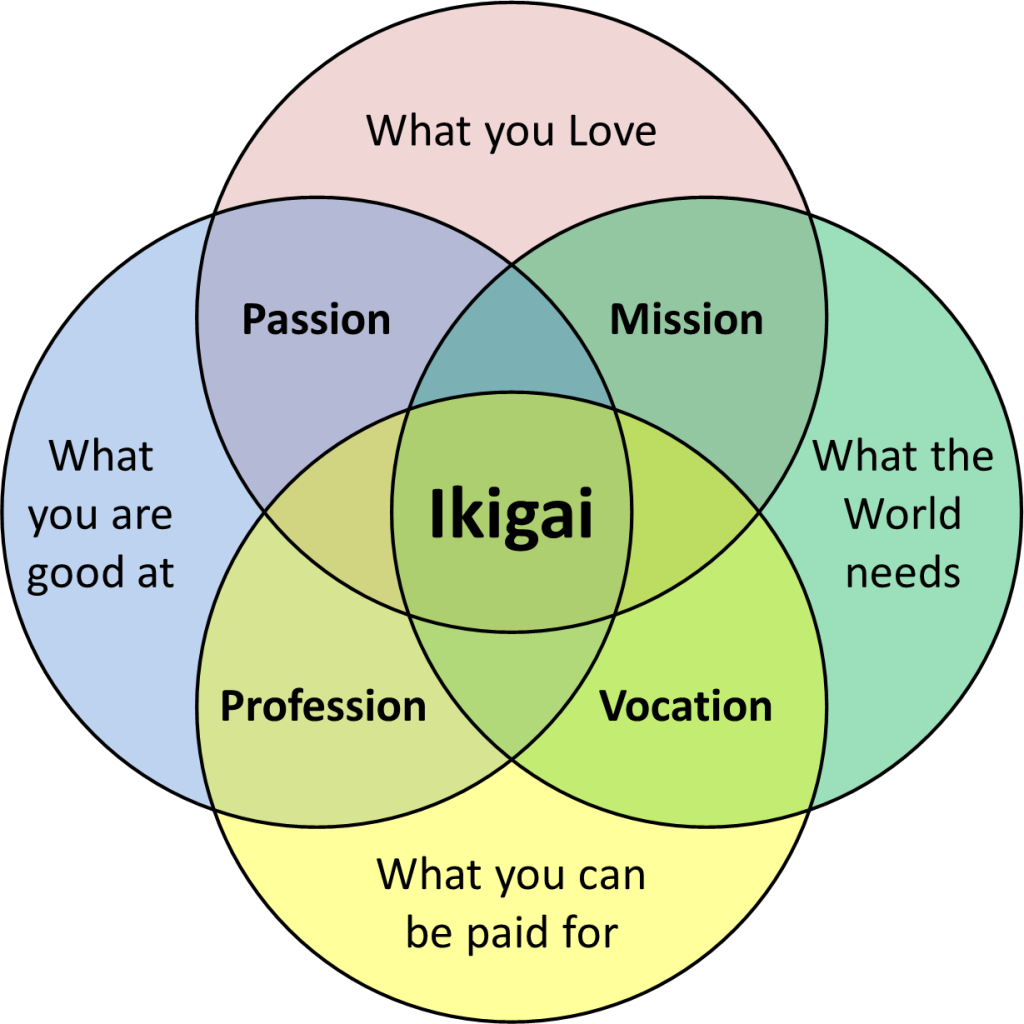
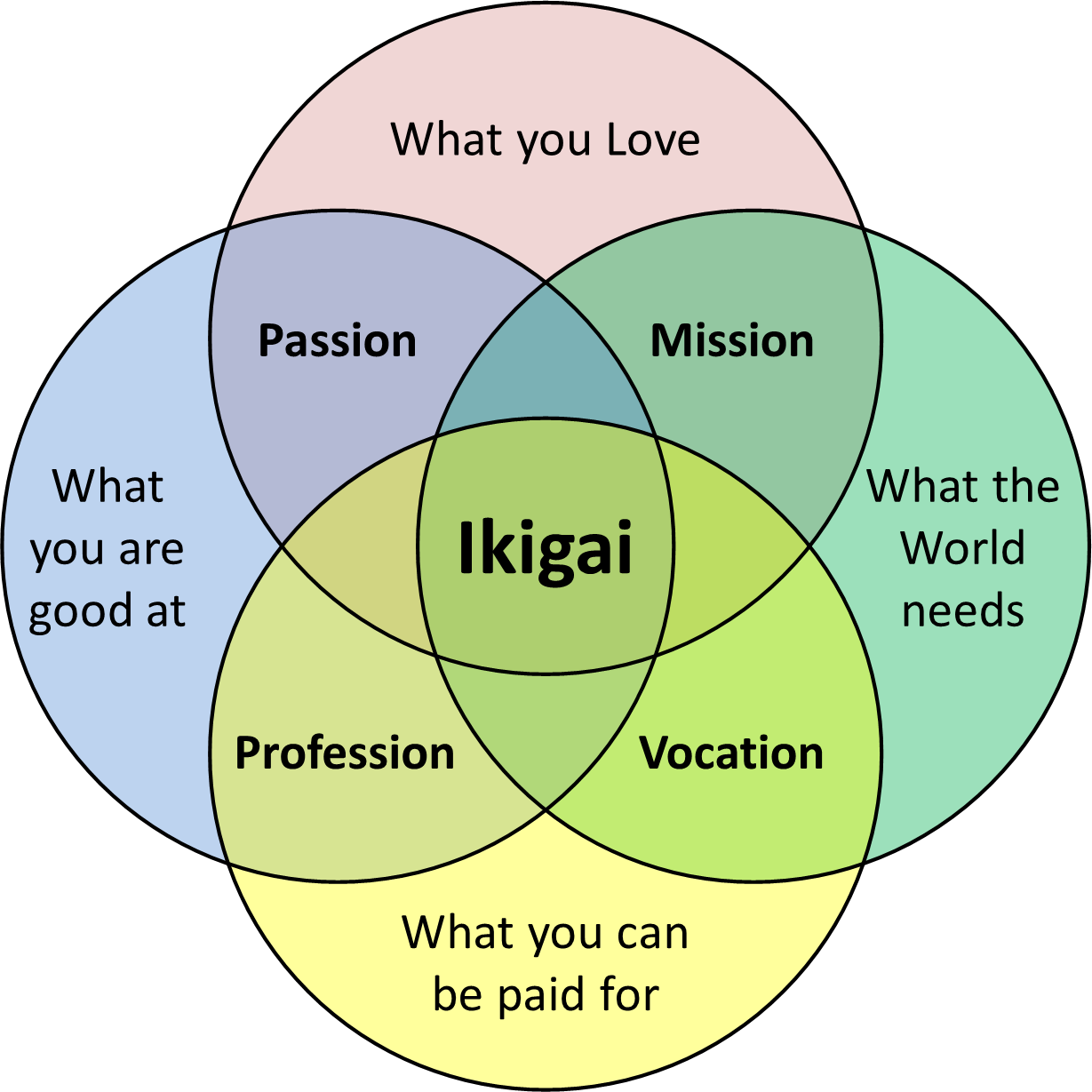
Ikigai is depicted today as consisting of four elements arranged as a Venn diagram. The intersection of what one loves, what one is good at, what the world needs, and what one can be paid for, is one’s ikigai. Fill up the spaces, that’s the exercise. This diagram will, of course, look different for each individual.

Image downloaded: https://www.allaboutlean.com/wp-content/uploads/2022/11/Ikigai.png

I think, however, that very few people can or should live their ikigai. Most doors are closed, the windows too. Most of us do what we do because we have to. We need to put food on the table — what the family needs.

But, you can love what you do. You can be good at any job, especially if you had no choice. You can get paid, somehow. Surely there’s at least one person out there who needs the product of your work. Still, it is not necessary to have all these elements settled in order to live not a happy life, but a meaningful one, a purposeful one.

And maybe you will find your ikigai and even live it, but with a much lower salary.

Do you really think life scripts ever unfold as planned? It only takes one aneurysm. But even as they make you change your script, tragedies also trigger discoveries . You might discover strengths you never had, or that the world had certain needs you took for granted. We might be thankful for such tragedies, in time.

Still, trying to discover your ikigai while you are healthy can teach you things that are useful right now. That, I think, is its beauty. The following “rules” for achieving ikigai might not actually bring you there, but they are wise and worth following.

  1. Stay active and don’t retire: Keep your mind and body active and engaged in meaningful activities throughout your life.
  2. Take it slow: Find a balance between rest and activity, and don’t rush through life without savoring the present moment.
  3. Don’t fill your stomach: Practice moderation in eating and avoid overindulging in food or drink.
  4. Surround yourself with good friends: Cultivate positive relationships with people who uplift and support you.
  5. Get in shape for your next birthday: Take care of your physical health and aim to improve it over time.
  6. Smile: Practice gratitude and positivity, and find joy in the small things.
  7. Reconnect with nature: Spend time in natural settings, appreciate the beauty of the world, and respect the environment.
  8. Give thanks to your ancestors and teachers: Honor and appreciate those who came before you and taught you important lessons.
  9. Live in the moment: Embrace the present and let go of regrets or worries about the past or futur
  10. Follow your ikigai: Discover your passion, mission, vocation, and profession, and strive to integrate them into a meaningful and fulfilling life purpose.

Find fulfillment in ‘striving’.

(Q.C. 230301)

Learn the art of asking questions

The Rational Manager, by Kepner and Tregoe (1965): Image downloaded: https://covers.openlibrary.org/b/id/9888127-L.jpg

When I was freshman years ago, a family friend, Caloy Y., introduced me to what he claimed was an “almost perfectly reliable method for solving problems”. The name of the method was the Kepner-Tregoe or KT method named after Charles Kepner and Ben Tregoe. As soon as I could, I went to the university library and borrowed a copy of The Rational Manager (1965). There have been three versions since that first one.

The KT Method that outlines a systematic approach to problem-solving and decision-making in business. The authors introduce a framework consisting of four steps: Problem analysis, Decision analysis, Potential problem analysis, and implementation.

Problem analysis was what hooked me to the book, as Caloy was most passionate about it. He thought one could solve any problem with it.

Problem analysis began by stating clearly what the problem is. KT defined a problem as a deviation. The deviation could be specified even further by comparing IS and IS NOT:

  1. What is vs. What is not. My car’s horn is working, my starter is not.
  2. When is vs When is not. My starter failed at noon, but not in the morning.
  3. Where is vs Where is not. E.g., The problem happened at school, but not at home.
  4. Extent. The problem seems confined to starting; no other systems of the car appear to be affected.

Four simple questions leading systematically to at least two hypotheses, which we evaluate based on how consistent they are with the answers we gave to these questions.

To cut the long story short, the best hypothesis in the example is vapor lock. Vapor lock happens when the fuel in the fuel line or carburetor turns into vapor due to high temperatures. The vapor obstructs the flow of fuel to the engine, preventing the engine from starting. It happens especially to older cars. To confirm this hypothesis we might try opening the hood for a few minutes to cool the engine down.

Caloy was not exactly right when he said this method was almost perfectly reliable. Sometimes letting the car cool won’t help even if the problem was vapor lock. Many problems have complex causes. The idea of a vapor lock might come easily, but only to one who knew how cars worked. There’s no golden road to knowledge; it amazes me how many car owners don’t study. We have a friend — he’d been driving for years — who did not realize that when the steel wires of your tires begin to show, you’re seriously courting violent death. Good we saw it.

When we study, we should seek information “for” and “against”, separate fact from assumptions, and keep from jumping to conclusions. Avoiding these traps is not often easy, and sometimes are the downfall even of modern car experts who do not know how older ones worked.

It all hinges on the art of asking questions. KT ignited my interest in that art very early. Questioning became my profession: I’m a scientist. And I use all the KT methods, not just that one.

Newer versions of the KT method are now in books called The New Rational Manager. One technique that wasn’t in the first version has been called the pre-mortem. It begins with the question:

“If I failed, why would I have failed?”

As a regular user, I find it interesting how the pre-mortem is sensitive to cognitive biases such as jumping to conclusions and not separating fact from assumption — errors we normally commit after a problem has occurred.

The KT method is not perfect, but it is a system. I tell people: you don’t HAVE to be in the right mood. Remember: the right mood never comes when you need it most to solve a problem or make a decision. Forget moods; use the system.

The Rational Manager is one of a few books outside my profession that I’ve read more than three times. It’s one of the top 10 books that have influenced me the most.

(Q.C. 230228)

Do Hard Things, by Steve Magness

Why do some people freeze?

The problem for most is not that they are afraid: Napoleon Buonaparte shit his pants before a battle, which must have been terrible for his hemorrhoids. And yet he fought.

Napoleon was tough.

Do Hard Things explores the idea of toughness, or resilience. What is it really? To withstand great pain no matter what? To accept abuse? Some coaches make their athletes go through hell, and it seems to work. But it’s not the abuse that works. Steve Magness argues that a hellish routine works well as a means for selection, but not as a means for training. Effective training is problem solving: question, data, process, action. This is thoughtfulness. Magness shows that true toughness lies in being able to fill with thoughtfulness that space between the feeling fear and responding to it. True confidence is also found there.

Steve Magness. Image downloaded from: https://cdn.heleo.com/wp-content/uploads/2022/07/29133036/Do-Hard-Things-1200×600-1.jpg

We illustrate Magness’ model with the problem above. Why do some people freeze?

This is the model:

FEELING —> INNER DEBATE —> URGE —> DECIDE (Go or Quit)

A stimulus causes a feeling of fear, which leads to an internal debate whether to, say, fight or flee. That debate leads to an urge to close that debate, which leads to a decision. A ‘freeze’ is a failure to resolve the inner debate. Giving up, e.g., suicide at the extreme, is a rapid jump from feeling to urge and deciding without respecting inner debate.

Thoughtfulness respects the process.

It is not a new idea. Stephen Covey called this “response ability”, where we 1) identify the fear and 2) embrace the fear rather than fight it. Embrace our fear slows us down enough to create a space where we can respect the process. Recognize your fear is just a feeling. Gather facts. Then judge.

Of course, in an emergency, we should act quickly. But, most of life isn’t lived under Code Red. Here the problem is not that people freeze, but that they act rashly, without the proper checklists. Training over a long period exposes us to scenarios that we use to develop proper checklists. Sometimes affectionately called “rules of thumb”, mental checklists shorten the time and end with effective behaviors.

Yet another set of behaviors include helplessness, sometimes accompanied by severe dread and a sense of worthlessness. Magness says that when we see a huge gap between expected effort and actual effort we tend to let panic or despair short-circuit our thinking. Again, information and training can close that gap.

Now getting information is itself subject to another bias: do you tend to see opportunities or do you tend to see threats? The bias consists of ignoring information unless it confirms what you have already decided. A thoughtful person follows where the information leads. Yet, he also knows that a situation is a mix of opportunity and threat. But, can one pretend, for example, to always see opportunities in every situation? Isn’t that what charismatic leaders do?

It does not help in the long run to fake confidence at the expense of getting good information or training. But it does help to set certain thresholds of danger or opportunity that move up and down as we gain experience. Magness calls this manipulation lowering the bar and raising the floor. For example, a young person must lower his threshold for danger so danger does not accumulate. At the same time he must not set too high a standard for opportunity lest he gets none that he can handle. Confidence is, therefore, not so much bravado as awareness of both situation and competence. Thus, the thresholds will change with training and information. Also, the thresholds for a group will not be the threshold for individuals in that group yet will also change as individuals in the team gain more experience.

Magness, writing as an athlete — and writing very well— asks us to trust our training, and tells us to do the work not out of fear but out of a desire to master our craft. Along the way we learn how we respond to challenges. What causes us to sting? Or ruminate? Or pull away? These reactions and behavior point to where we need more training and information.

Magness identifies a number of pathologies that result from failing to respect the process. Top of his list is give-up-itis, with symptoms of having no sense of control, leading to apathy and stress. Others call this learned helplessness, a factor in the failure to reach one’s goals. Magness says that the difference between those who give up and those who don’t boils down to two things: reaction time, and information. Back to the model: an extremely short reaction time means we give up at the least feeling of stress. But if you could delay reacting, and use the time to get information, achieving goals, or at least getting out of the fear, is more likely.

He suggests a few ways to achieve a good reaction time and better information:

  1. Break up the problem into its parts. Usually the parts are less formidable than the whole
  2. Give yourself the choice to fail. In golf this is called a mulligan when one is allowed a second chance at tee off.
  3. Own the fear, embrace it, don’t deny it. Fear to a tough person is not just a feeling but data.
  4. Schedule the fear. Refuse to entertain it until later, but don’t write it off.
  5. Adopt a ritual. Knit. Go to the gym.
  6. Listen to your body. Again, the body is not just feeling, it is giving data.

He says it’s a good idea to give your feeling a proper name. I call my common problem “performance anxiety”. The feeling of dread tends to fizzle out after a few minutes or seconds once I name that demon. Although feelings normally dissipate anyway, naming them makes them more like a friend than an enemy, removes their sting, and more importantly helps prevent the real cause why people freeze: the persistent return of a feeling which can take place over a long period of time. That can kill.

Another technique he recommends is to reinterpret feelings. The body does not know whether what it is experiencing is anxiety or excitement. The physiologies are very similar: increased blood pressure, increased heartbeat, tunnel vision. But the brain does. And the brain can change its interpretation at will. Hence, when anxious or worried, just tell yourself you’re excited.

Magness then launches into another set of coping strategies that he calls zooming in and zooming out.

He begins by asking: what do athletes think about? Say, when they are running the marathon: do they focus on the running, or do they view the scenery? Magness says that trained athletes are able to choose between zooming in (or clutch, focusing on their body, their breathing) and zooming out (or flow, taking the environment in). Zooming in allows one to focus energies, zooming out allows one to explore possibilities. One is efficient, the other creative. A trained athlete chooses what is appropriate in a given situation, for example, the situation when he is behind versus when he is ahead.

Putting it all together — response ability, naming your fear, zooming in and out — what Magness presents is a testament to the power of mind over matter, brain over body.

Do you freeze? Do you palpitate? Do you give up? No matter how you feel about it, you have a choice. Slow down. Breathe. And trust your “slowness” will win you control.

Sense of control is true toughness.

[Steve Magness, “Do Hard Things”. 2022. Harper Collins, USA, 308 pp.]

Art Fair Philippines (17-19 Feb 2023)

Last 17 February 2023 in the evening I went with Sam to visit The Art Fair, which returned to The Link in Makati City after three years. According to the website (https://artfairphilippines.com/afp2023/aboutartfair.php#):

Founded in 2013, Art Fair Philippines is the premier platform for exhibiting and selling the best in modern and contemporary Philippine visual art. The fair aims to mirror the vibrant local art scene and continues to generate support for Filipino art practitioners. The fair is committed to expanding the local audience for the visual arts. Art Fair Philippines makes art accessible to enthusiasts and those who want to discover one of Southeast Asia’s most exciting art landscapes.”

Over 60 exhibitors from the Philippines and abroad were spread across four levels of The Link, including special exhibitions (plus drinks) at the roof deck. It was a pleasant surprise to see Qube; I was at their gallery in Cebu last 25 January.

I did not have time to go through all the exhibits. Sam bought two Tom Epperson photos, but me, no. Apart from paying close attention to my friend, and to Pina Colada and Mango Daiquiri compliments of Don Papa Rum, I focused on one exhibitor: No Space. Not a specific gallery, this one showcased art from Baguio City.

(Left) Photo from No Space featuring art from Baguio City, Art Fair Philippines 2023 (Francine Y. Medina, https://images.gmanews.tv/webpics/2023/02/640_1_AFPh_No_Space_Green_Carpe_2023_02_18_16_00_40.jpg)

(Right) The Link (https://www.mantlemagazine.com/wp-content/uploads/2023/02/Art-Fair-Philippines-2023-will-once-again-transform-The-Link-carpark-in-Makati-City-into-a-multi-level-art-exhibition-venue-740×494.jpg). There’s a great restaurant on the ground floor, Buddy’s. But the photo itself is dated. The Makati Shangri-La is still closed and had no lights.

Baguio City in fact has a vibrant contemporary art scene with many talented visual artists who create diverse works across different mediums. A few contemporary names:

BenCab (Benedicto Cabrera) – Perhaps the most well-known artist from Baguio City, BenCab is a National Artist of the Philippines known for his figurative paintings, drawings, and prints. His works often explore themes related to Philippine identity, culture, and history.

Kidlat Tahimik (Eric de Guia) – Kidlat Tahimik is a filmmaker, actor, and artist whose works often address issues related to post-colonialism, globalization, and environmentalism. He is known for his independent films and mixed media installations. He was entertaining fans during our visit.

Mark Andy Garcia – Garcia creates paintings to installations to performances. His works often address issues related to cultural identity, social justice, and environmentalism.

Jordan Mang-osan – Jordan Mang-osan specializes in the traditional art form of pyrography, or wood burning. He creates intricate and detailed works that often depict the landscapes and traditions of the Cordillera region.

Leonard Aguinaldo – Leonard Aguinaldo is a painter who often explore themes of spirituality and nature. His paintings feature bright, bold colors and abstract forms that invite viewers to contemplate their own relationship with the world around them.


Museums

Baguio City is home to several museums that showcase the city’s rich history, culture, and art. Some of the more important ones:

Baguio Museum – The Baguio Museum is a must-visit for anyone interested in learning about the history and culture of the city. The museum’s exhibits cover the indigenous peoples of the Cordillera region, the city’s colonial past, and the development of Baguio City as a modern urban center.

BenCab Museum – The BenCab Museum is a private museum founded by National Artist BenCab. The museum’s exhibits feature works from BenCab’s personal collection, as well as contemporary art from other Filipino artists. The museum also has a beautiful garden and a café with a stunning view of the mountains.

Tam-Awan Village – While not technically a museum, Tam-Awan Village is a cultural center that features traditional Cordilleran architecture and art. Visitors can learn about the indigenous culture of the region, watch traditional performances, and buy handmade crafts and souvenirs.

Museo Kordilyera – The Museo Kordilyera is located in the University of the Philippines Baguio campus and features exhibits on the culture and history of the Cordillera region. The museum’s collections include artifacts from the indigenous peoples of the region, as well as contemporary art and installations.

Baguio Arts Guild Museum – The Baguio Arts Guild Museum is a small museum that features works by local artists. The museum’s exhibits change regularly, so visitors can expect to see different works every time they visit.

These museums offer a great opportunity to learn about Baguio City’s rich history, culture, and art. Whether you’re into traditional culture or contemporary art, there’s something for everyone in Baguio City’s museums.

(Q.C. 230226)