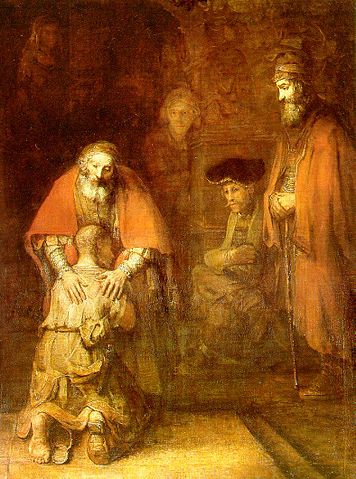
A story of three brothers

This is a story of three brothers. It begins with the Miserere: “Miserere mei, Deus, secundum misericordiam tuam“(Ps. 51) – Have mercy on me, O God, according to thy steadfast love.

The Miserere brings us to “a profound meditation on guilt and grace.” Jewish tradition puts these words on the lips of David, after the prophet Nathan reproached him for his adultery with Bathsheba and the death of Uriah. David seeks refuge and healing in God, the only one who can put things right.

Sin can seem attractive because it promises freedom from God so that we can truly be ourselves. But this apparent liberation is a mirage that soon turns into a burden. The autonomous man, who tries to silence his conscience, evetually reaches a dead end. “He has had enough of the usual explanations. The lies of the false prophets no longer satisfy,” said St. Josemaria Escriva. This is the beginning of conversion.

Conversion is not always as quick as King David’s. The blindness that precedes and accompanies sin, and that grows with each sin, can be prolonged. We can deceive ourselves by justifying our actions; we tell ourselves “it’s not that important”. To recognize the sin would mean losing certain “freedoms.” We are all exposed to this risk. We see the ugliness of sin in others, but we do not condemn our own.

The darkness of sin and lukewarmness involves a deliberate blindness. This is what needs God’s forgiveness. Jesus sees sin like that when he said from the Cross: Father, forgive them; for they know not what they do. When we separate ourselves from God we both “know” and “do not know” what we are doing. Our Lord takes pity on both things, and also on the deep sadness produced in our soul.

“Christ’s mercy is not a grace that comes cheap, nor does it imply the trivialization of evil,” wrote Pope Benedict XVI. “Christ carries the full weight of evil and all its destructive force in his body and in his soul. He burns and transforms evil in suffering, in the fire of his suffering love.”

The first conversion, and what follow, come from realizing that in some sense we are homeless. And so we meet Son #1. The prodigal son “longs for the fresh baked bread that the servants in his house eat for breakfast. Homesickness is a powerful emotion. Like mercy, it expands the soul.

The prodigal son realizes he is away from his own home. And he comes to see that the place he thought was an obstacle for his full personal development is in fact the home he should never have abandoned.

But those living in the father’s house, too, may not have their hearts there. Thus we meet Son #2. The older brother never left home, but his heart was elsewhere. “This people … honor me with their lips while their hearts are far from me.”

Son #2 “never says ‘father,’ never says ‘brother,’ and thinks only about himself. He boasts of having always remained at his father’s side and of serving him; yet he never lived this with joy. And now he accuses the father of never having given him so much as a kid to feast on. The poor father! Son #1 went away, and Son #2 was never close to him! The suffering of the father is like the suffering of God when we distance ourselves from him, because we go far away or because we are nearby without being close.

In this Gospel scene, we see not only the tenderness of the father but also the hard-heartedness of Son #2. “Whenever our interior life becomes caught up in its own interests and concerns, there is no longer room for others … God’s voice is no longer heard, the quiet joy of his love is no longer felt, and the desire to do good fades,” wrote Pope Francis.

The father tries to soften the heart of his elder son. With the fortitude of a father and the tenderness of a mother, he chides him: My son, you should rejoice. What’s going on in your heart? The elder son needs mercy too.

Tibi, tibi soli peccavi et malum coram te feci – Against thee, thee only, have I sinned, and done that which is evil in thy sight.” This nostalgia stems from a wounded relationship. We have distanced ourselves from God and left him alone, and we have left ourselves alone.

Then comes Son #3: Jesus, is the one who, though he was in the form of God, did not count equality with God a thing to be grasped, but emptied himself, taking the form of a servant. Jesus is the arms and heart of the Father: he welcomed the prodigal son and washed his dirty feet; he prepared the banquet for the feast of forgiveness.

“Cor mundum crea in me, Deus – Create in me a clean heart, O God.” Psalm 51 speaks again and again about cleansing our heart. The repentant sinner is ready to do anything to get his heart cured. “Redde mihi laetitiam salutaris tui – Restore to me the joy of your salvation.” When we look at things in this light, confession is not something a cold and routine, bureaucratic process.

A person who rejoices is thankful for being forgiven. And then penance is seen as something much more than just a dry process to restore justice. Penance is a demand of the heart that feels the need to back up its words “I have sinned, Lord, I have sinned,” with deeds. A broken and contrite heart realizes it must walk the path of returning to God, which does not always happen in a day. Since it is love that has to be restored in order to acquire new maturity, love itself is the cure. Penance, then, is the love that leads us to accept suffering – joyfully, without giving ourselves too much importance, “without doing strange things,” wrote St. Josemaria Escriva – in reparation for all that we have caused God and others to suffer.

(Q.C. 230226)

Marcelino Pan y Vino (1955)

People don’t often look forward to Lent. My early memories of it were about giving up candy; we were even forbidden to play or laugh on Good Friday. But we looked forward to watching this 1955 film based on a medieval legend, Marcelino Pan y Vino. I’d like to recall it now, with a little help from Youtube.

The main story is told in flashback by a monk, who, visiting a dying girl, tells her the story of Marcelino for inspiration.

Once upon a time in 19th c Spain there lived a boy named Marcelino, an orphan abandoned as a baby on the steps of a monastery. The monks raised the child, and Marcelino grew into a rowdy young boy. He had been warned by the monks not to visit the monastery attic, where a “very big man who will take him away” lives, but he ventures upstairs anyway, peeks, sees the man and runs back down the stairs.

At a festival, Marcelino causes havoc when he accidentally topples a pile of fruit and lets some animals loose. The new local mayor, a blacksmith whom the monks would not let adopt Marcelino because of his coarse behaviour, uses the incident as an excuse to try to shut down the monastery.

Given the silent treatment by the monks, Marcelino gathers up the courage to once again enter the attic, where he sees not a bogeyman, but a beautiful statue of Christ on the Cross. Remarking that the statue looks hungry, Marcelino steals some bread and wine and offers it to the statue, which comes to life, descends from the Cross, and eats and drinks what the boy has brought him. The statue becomes Marcelino’s best friend and confidant and begins to give him religious instruction. For his part, Marcelino realizes that the statue is Christ.

Nearing the end, Marcelino and the Statue are talking in the attic.

Que piensas, Marcelino?”

The boy thinks for a moment. “De donde esta tu madre ahora?”

Con la tuya.”

Marcelino smiles. “Y como son, que hacen las madres?”

Dar, Marcelino, siempre dar.”

Que dan?”

Dan todo. Se dan a si mismas. Dan a los hijos sus vidas y la luz de sus ojos, hasta que darse viejas. Y arrugadas.”

With a look of concern Marcelino asks, “Y feas?”

Feas, no, Marcelino,” the Statue answers kindly. “Las madres nunca son feas.”

Marcelino puts on a big smile. A bell rings. “Tengo que ir, me llaman.” He begins to leave to refill the cup with water and to get more bread. He stops on the way out, turns, and asks, “Tu quieres mucho a tu madre?”

Con todo mi corazon!”

Y yo la mia mas!” says Marcelino confidently, and with an even bigger smile leaves the room.

The monks knew something was strange when they had noticed bread and wine disappearing. One monk is sent, and follows to spy on Marcelino.

When he returns to the attic, Marcelino finds the Statue seated on a dilapidated chair.

Bien, Marcelino.You have been a good boy. And I would like to to reward you with whatever you want most.” Marcelino walks up to the Statue on the chair and puts his hand on the arm rest, his eyes fixed on the Man. “Tell me,” says the Statue, “Do you want to be a monk like Fra Bernardo, Fra Papilla, and Father Superior? Or would you like that Manuel come with you?”

Marcelino, a look both sad and hopeful spreading on his young face, without taking his eyes off the Statue, slowly answers: “Solo quiero verar a mi madre, y tambien a la tuya despues“: I only want to see my mother, and to see Yours after that.

Y quieres verlas ahora?”

Si, si, ahora,” answers Marcelino, hope now flooding his face.

Tienes que dormir.”

Tengo un gran sueno.”

The statue cradles Marcelino in its arms, and tells him to sleep.

The monk sees all this. He calls the other monks urgently. They burst in just in time to see the dead Marcelino bathed in a heavenly glow. The statue returns to its place on the Cross, and Marcelino is buried underneath the chapel and venerated by all who visit the now flourishing monastery-turned-shrine.

The film ends with the monk entering the now completely remodelled chapel in the monastery during Mass, and saying to the crucifix once kept in the attic: “We have been speaking about You, O Lord”, and then, to Marcelino’s grave, which is situated nearby, “And about you, too, Marcelino.”

The film invites us to see Jesus in suffering. We consider what he suffered in his humanity and how the divinity hid himself.

Jesus’ brutal physical sufferings can be painted and sculpted. But it is not easy to put into words what he suffered; stories do it best. Our brothers in the middle ages knew how to tell this story so well.

Suffering is like language. No suffering is any one person’s possession. I can talk about “my” pain, but many others around me are suffering, too.

Each one of us inescapably suffers physical pains and decay. Jesus chose to embrace the same so he could be like us in everything but sin—and by his obedience turn the whole story of mankind from its journey into death and onto the way of eternal life.

St. Ignatius of Loyola advices to “begin with great effort to strive to grieve, be sad, and weep.” It is never easy to suffer, or to enter into another’s suffering. We have to work at it, to grasp that Jesus knew the terrifying vacuum of God’s hiding and leaving him to the merciless experiences that scotch life. Most of us will sink into that dreadful feeling of despair at some point in the chaos of our world.

Jesus did not despair because he refused to. He trusted that his suffering made sense. Every day of his life, he wanted to do whatever he could to ease the suffering of those around him. But he was thwarted. He died in the hope that he would live again in our flesh.

Those who really do know and love him will suffer this way, his way. Right here is the deepest spiritual root of the impulse to work for peace and justice. Anything less would be an unworthy motive for those who love Jesus Christ.

Jesus’ passion brings us to embrace the world as it really is: full of violence and pain. But, we embrace whatever suffering comes into our lives as no longer meaningless. Our suffering has a meaning in “the language of the cross”. Anything less, and our faith becomes a pain pill.

Trivia about the film: Marcelino Pan y Vino is one of the most successful Spanish films of all time. The exterior scenes were shot in Salamanca, and the convent scenes were shot in Segovia, in the Chapel of Cristo del Caloco. The figure of the Christ, however, does not correspond to that of the Caloco, but is the work of the 20th c sculptor Manuel Pineda and is currently on the altar of the Chapel of St. Teresa of the Convent of the Carmelites of Don Benito (Badajoz). It ended up there at the wish of one of the sound engineers of the film, Miguel López Cabrera, whose sister was a nun in the convent.

Eu Sei que Vou Te Amar (Moraes and Jobim, 1960)

I dedicate this blog to two beloved musicians, Vinicius de Moraes and Tom Jobim.

Vinicius de Moraes (1913-1980) was a Brazilian poet, lyricist, musician, and diplomat. He is considered one of the greatest Brazilian poets of all time and one of the most important figures of modern Brazilian music.

Born in Rio de Janeiro, Moraes was the son of a career diplomat and an amateur pianist. He studied law at the Federal University of Rio de Janeiro, but his interests lay in music and literature. He began writing poetry at age 14 and was a songwriter by the time he was 19. He served in the Brazilian diplomatic corps in various capacities, including working as a cultural attache in the United States.

Moraes wrote more than 500 poems, many of which were set to music by such renowned Brazilian composers as Antonio Carlos Jobim, Gilberto Gil, and Chico Buarque. He also wrote a number of plays, film scripts, and novels. Many of his poems were adapted into songs, making him one of the most important writers in Brazilian popular music.

Moraes was also active in the Brazilian musical scene, performing as a singer, pianist, and guitar player. He also wrote the lyrics for a number of popular songs, including “The Girl from Ipanema” and “Chega de Saudade.” He was awarded the Brazilian Order of Merit and the Legion of Honor.

Antonio Carlos Brasileiro de Almeida Jobim (1927-1994), better known as Tom Jobim, was a Brazilian songwriter, composer, arranger, singer, and pianist/guitarist. He was a primary force behind the creation of the bossa nova style, and his songs have been performed by many singers and instrumentalists within Brazil and internationally.

Jobim was born in the neighborhood of Tijuca in Rio de Janeiro. His father, Jorge de Oliveira Jobim, was a writer, diplomat, professor and journalist. His mother was Nilza Brasileiro de Almeida, a housewife from Bahia. His parents separated when he was an infant and he was raised by his aunt and grandmother.

Jobim was an avid fan of American jazz and had a strong interest in music from a young age. He learned to play the guitar and piano when he was still a child, and later began taking formal piano lessons at the age of 14. In the mid-1940s, Jobim’s father gave him a scholarship to study music at the prestigious National Institute of Music in Rio. It was there that he met many of his colleagues and collaborators, including Vinicius de Moraes and Johnny Alf.

During the 1950s and 1960s, Jobim composed many of the classic Brazilian bossa nova pieces, such as “The Girl from Ipanema”, “Corcovado”, and “Desafinado”. He also collaborated with lyricist Vinicius de Moraes on the acclaimed musical play Orfeu da Conceição. In the late 1960s and early 1970s, Jobim’s music started to encompass a wider range of styles, including jazz, pop, and folk.

Jobim released his first solo album, Wave, in 1967, and followed it with several other highly acclaimed solo albums throughout his career. He also collaborated with musicians such as Stan Getz, João Gilberto, and Elis Regina, to create some of the most iconic bossa nova and Brazilian jazz recordings.

The song “Eu Sei que Vou Te Amar” was written by Moraes in 1960 and set to music by Jobim (A version by Moraes, Toquinho and Maria Creuza can be found here: https://www.youtube.com/watch?v=cpGTmMLwWo8). It is a romantic bossa nova song about the inevitability of love. The song has become a classic, being covered by many Brazilian and international artists such as Elis Regina and João Gilberto, and others including a beautiful version in French by Diana Panton (“Tu Sais Je Vais T’Aimer” at https://www.youtube.com/watch?v=UQfHuwx5Mi8). The lyrics talk of a love that transcends time and space. The song has been used in many Brazilian films and television series, and has become an iconic symbol of Brazilian music.

Eu sei que vou te amar
Por toda a minha vida, eu vou te amar
Em cada despedida, eu vou te amar
Desesperadamente
Eu sei que vou te amar

E cada verso meu será
Pra te dizer
Que eu sei que vou te amar
Por toda a minha vida

Eu sei que vou chorar
A cada ausência tua, eu vou chorar
Mas cada volta tua há de apagar
O que esta tua ausência me causou

Eu sei que vou sofrer
A eterna desventura de viver
À espera de viver ao lado teu
Por toda a minha vida

[I know I will love you
For all my life I will love you
In every goodbye I will love you
Desperately
I know I will love you
And every one of my verses
Will be to tell you
That I know I will love you
For all my life
I know I will cry
At each of your absences I will cry
But each of your returns will erase
What your absence caused me
I know I will suffer
The eternal misfortune of living
Awaiting to live by your side
For all my life]

Homem and De La Rosa (2013) write that the fire of Moraes’ poetry was the same as that of a passion. If a woman did not awaken a passionate love in Vinicius, or if that passion ended, the poet could not stay married, no matter how painful the separation might be. And when the passion was over, melancholy possessed his soul until a new flame was lit and brought him back to life. Therefore, it cannot be said that Moraes’ relationship with women was superficial. He reaches his personal synthesis when he declares:

– De tudo, ao meu amor seria atento antes
– E com tal zelo, e sempre, e tanto
– Que mesmo em face do maior encanto
– Dele se encante mais meu pensamento

– Quero vivê-lo em cada vão momento
– E em seu louvor, hei de espalhar meu canto
– E rir meu riso e derramar meu pranto
– Ao seu pesar ou seu contentamento

– E assim quando mais tarde me procure,
– quem sabe, a morte
– A angústia de quem vive,
– e a solidão no fim de quem ama

– Eu possa me dizer do amor que tive
– Que não seja imortal, posto que é chama
– Mas que seja infinito
– enquanto dure

[Above all, my love would be attentive before
And with such zeal, always, and so much
That even in face of the greatest charm
My thinking be enchanted by her

I want to live her in each fleeting moment
And in her praise, I will spread my song
And laugh my laugh and shed my tears
At her sorrow or contentment

And so when later she looks for me,
Maybe, death
The anguish of one who lives,
And the loneliness at the end of one who loves

Can I tell myself of the love I had
That is not immortal, since it is a flame
But that it may be infinite
As long as it lasts]

Homem and De La Rosa (2013) write that this constant search requires a great intimacy of freedom. Freedom that allowed him to go from religious, metaphysical and moralistic poetry to poems dedicated to the prostitutes. Freedom that allowed the great lyricist of the bossa nova to abandon it at the height of its success, to create afro-sambas and to pass from afro-sambas to a children’s record. Freedom that kept him always rejuvenated in the meeting with his main partners, Jobim, Carlos Lyra, Baden Powell, Edu Lobo, Francis Hime, Chico Buarque, and Toquinho.

Jobim once asked Moraes: “But, in the end, how many times will you get married?”.

“As many as necessary,” replied the poet.

The answer shows the poet’s permanent disposition to always seek infinite passion, even if it did not last forever. In recordings he made of the song, Vinicius included the “Sonnet of Separation”. Years later, Jobim said: “I know I will love you, for all my life to live by your side … what a liar poet, he married nine times!”

Moraes died of a heart attack in 1980 at the age of 66. Jobim passed away in 1994 from a heart attack in New York City. They left behind an immense legacy of music, which has been covered by countless musicians and are still celebrated today.

[Reference: Much of the material about the song was from “Vinicius de Moraes: Historias de Cancoes” by Wagner Homem and Bruno De La Rosa (2013).]

10 Life hacks from Taipan

The game of Taipan was a popular text based game from the 80’s. I used to play it on my Apple IIc. Today I have the Android app.

The game is based on James Clavell’s novel Taipan. You buy and sell general merchandise, arms, silk, and opium, and trade all over Southeast Asia, trying to make as much money as you can.

You begin in Hong Kong where you can choose to start with a ship and 5 guns but no cash — you had to raise money by fighting pirates. Or you start with a ship with no guns but with cash borrowed at very high interest.

In Hong Kong you had a warehouse, which could catch fire, or be raided by the government. You can deposit and withdraw money from a bank and buy cannons. You can have your ship repaired or buy a new one when offered.

On the high seas you fought or fled from pirates; they could sink you, but you got their money if you won. The loanshark Li Yuen could chase off pirates if you paid him protection money, but help the pirates if you didn’t.

Trading in opium gave you the biggest returns; it also brought the biggest risks. My aim in the game was to trade in opium as soon as I could because it was the fastest way to grow cash. But it was also the fastest way to get the attention of the pirates, of the government, and of Li Yuen.

I enjoy this game even today.

I also learned a few life lessons. Here are 10:

  1. Trade goods in order of return.
  2. You can never invest too much in guns, ships, and protection money.
  3. Setbacks are normal.
  4. Big risks, big payoff’s. Don’t be afraid to fail, be afraid not to try.
  5. Fight pirates like you’re already dead.
  6. Don’t hold on too long to anything.
  7. Play detached.
  8. Always be trading.
  9. Be prepared for when you must not trade for a very long time.
  10. Enjoy the game!

Stories as maps

The moral of a story is like a cartographic map of the world or model of a scientific phenomenon.

Morals, map, model (3M): their purpose is to help one navigate the world.

  1. Story morals help one navigate the ethical world.
  2. Cartographic maps help one navigate the physical world.
  3. Models (including metaphors and analogies) help one navigate the world of ideas.

(Image downloaded: https://historytech.files.wordpress.com/2013/03/map-of-world2.png)

I will use the term map to refer to morals, cartographic maps, and models.

The map is not the territory. Maps present only the information required for the purpose. Maps are changeable, subject to updates. They also come in versions designed for a specific use. Examples:

  1. Story morals or stories can be as long as novels, or as short as elevator pitches, i.e., about 1-2 minutes. It is a good idea to read fiction produced by good writers, because those stories help you to see how people are different from each other. Good stories are great works of psychology. My favorite for this kind of story is Theodore Dostoevsky.
  2. Cartographic maps could be Google Maps or paper maps. The Mercator Projection, for example, accurately represents distance for the same latitude, but poorly represents the relative sizes of countries.
  3. Models could be schematic diagrams, drawing, graphs, flowcharts, equations. Drawn models are very common in scientific work.

It is always a great idea to begin a talk (e.g., thesis defense or any presentation in class) with a short story, i.e., no more than a few seconds to narrate. The story becomes a map to help listeners understand the rest of the presentation more easily.

Two figures of speech work very much like models and stories: analogy and metaphor.

Analogy and metaphor make a comparison between two things, but they differ in their structure and purpose.

An analogy compares two things that are alike in some way but different in others. Analogies explain or clarify a concept by comparing it to something that is more familiar or easier to understand. For example, “the cell is like a computer” compares the cell’s ability to process materials to a computer’s ability to process data.

A metaphor describes one thing in terms of another, asserting that one thing is another thing. Metaphors create vivid imagery and evoke an emotional response in the reader or listener. For example, “life is a journey” compares the ups and downs of life to the twists and turns of a journey.

Analogies and metaphors can be thought of as stories where the reader or listener fills in the elements of the story like character and plot from a prompt made by the writer.

These figures of speech play help scientists explain complex ideas and theories in terms that are more accessible and relatable to a wider audience.

For example, a biologist might use the analogy of a computer or factory to explain how cells work, or an astronomer a clock to explain the movement of the planets. Analogies can also be used to help scientists explore new ideas and develop new theories by comparing them to existing ones.

Metaphors help scientists communicate their ideas in a way that is both clear and engaging. Scientists create mental images that are more vivid and memorable, which can make their ideas easier to understand and more likely to be remembered. For example, the double helix structure of DNA is often described as a twisted ladder, which helps people visualize this important molecule and understand how it works.

Regardless of the map, for you to use it requires that you thoroughly understand the territory you want to represent. It is often harder to give a short talk than a long one — harder to draw a map than to just tell people “go out there and check it out”.

(Q.C. 230225)

Technical Writing: A Storytelling exercise

Now the seat work.

Exercise: Collaborative Storytelling

Objective: To practice storytelling skills and build collaboration skills.

Materials:

  1. Pen and paper for each group
  2. Story prompts (see below)

Instructions:

  1. Group the class into 3’s.
  2. Assign one laptop per group that can be passed around. Or do musical chairs.
  3. Choose a story prompt from the list the teacher will provide.
  4. Each student should take turns contributing to the story.
  5. Be creative, have fun, go crazy with the story.
  6. After 10-15 minutes, we will have each group tell their story.

Story prompts:


a. A group of friends go on a camping trip and discover a mysterious cave.
b. A young wizard must retrieve a magical object to save their kingdom.
c. A family of aliens crash-land on Earth and must find a way to repair their spaceship.

Extension: If there is time after the storytelling we will try to answer a few questions, such as:

a. What was challenging about working together to create a story?
b. How did you make sure that everyone had a chance to contribute?
c. What did you enjoy about the storytelling process?
d. How might you use storytelling in other areas of your life?

Technical Writing: Storytelling

Story telling

We have been telling stories since the beginning of time. From the earliest cave drawings to movies, books, and scientific articles stories entertained, educated, and connected people from all eras and places. Storytelling conveys complex ideas and emotions in a way that engages the listener and evokes a powerful response. Stories are more effective than essays.


Stories evoke empathy and understanding. A well-told story transports us into the world of the characters where we can feel their emotions and live their experiences. Stories help us understand perspectives that are different from our own. The stories of people from different backgrounds and cultures give us a deeper understanding of their world, which can help us build bridges and connect on a deeper level.


Stories are powerful tools for education. They help us understand complex topics in a way that is engaging and memorable. Stories simplify complex ideas and make them more relatable. By presenting information in a story format, we more easily remember ideas and we more easily connect them to a larger context.


Storytelling is also a tool for healing and personal growth. Many people tell stories to process their own experiences and emotions. Journaling, talking to a therapist, and trading adventures around the campfire, help people work through difficult emotions and find meaning in experience. Listening to the stories of others helps us find comfort and inspiration in our own struggles.


Stories inspire action and create change. Stories have motivated people throughout history to fight for social justice, environmental causes, and political change. Stories of people who have overcome adversity or fought against injustice inspire us to take action ourselves. Stories help us build a sense of community and collective action that can drive meaningful change.

Elements of a story

All stories must have 5 elements (this isn’t written in stone) and it starts with the title:

  1. Setting: Time and place in which the story takes place, atmosphere and realism.
  2. Plot: Clear and compelling; see below
  3. Character: Believable and relatable, with their own motives, personalities, and drama.
  4. Theme: The underlying message or meaning of the story. It should be consistent throughout the story.
  5. Point of view: First person, third person, etc.).

The Plot

This is the more important part for our purposes. Here I show how each part of standard storytelling also describes the parts we use in scientific writing: Introduction, Methods, Results and Discussion (IMRaD).

A plot has five main parts:

  1. Opener: The beginning of the story. The author introduces the characters and setting, and sets the stage for the conflict. For example, the protagonist is living some kind of ‘normal life’ but has a greater desire or goal. The Introduction corresponds to this part.
  2. Incident: The author introduces the main problem or conflict that the protagonist will have to face. Some kind of “catalyst”, an event, an episode, sets the rest in motion, forcing the protagonist out of their comfort zone. This is the part of the Introduction where we introduce the problem and hypothesis.
  3. Crisis: The conflict of the story becomes more intense. The protagonist pursues their goal and is tested along the way. “Tested?” That corresponds to the Methods.
  4. Climax: The highest point of action in the story. The conflict has reached its limit and something must change that will impact the rest of the story. This obviously is the Results section, especially the key result.
  5. Ending: The end of the story in which the reader learns what becomes of the protagonist and other characters as a result of the climax. The protagonist a) gets what they want, b) doesn’t get what they want, or c) doesn’t get what they want, but realizes that they have something that’s more important. This is the Discussion and Conclusion part.

This structure dates to the Greece of Sophocles, Aeschylus and Euripides.

Research Ethics: Due process and the SEES method of case evaluation

In this section we describe two processes for the evaluation of ethical cases: the more general due process, and the SEES method which is a systematic method for evaluating cases presented in class.

Due process

A procedure for the resolution of moral, ethical, or legal controversies that is fair to all parties is called due process. It is not a single procedure but rather a principle to inform how ethical cases and controversies can be decided fairly. Violations of due process could lead to dismissal of cases. Another example, evidence unfairly obtained, even if probative, are not allowed in most ethical and legal controversies.

Due process defines when a controversy ends. For example, an ethical or legal case ends with the imposition of a punishment. Thus a teacher who catches a student cheating and then gives a failing grade for that exam has closed the case.

The SEES method

This course uses the case method, a form of simulation to practice the art of ethical evaluation.

The class is comprised of groups of three, each assigned at least two cases in the beginning of the semester; these cases appear in the reference textbooks.

A typical method in evaluating ethical cases is the SEES method.

  1. Situation. Describe the facts of the case, the actors, what they did, time, place. Define what are facts and distinguish them from assumptions we may need to make. In this part we are careful to break the case into parts knowing that most ethical cases involve many issues and actions, which can be arranged in importance.
  2. Explanation. We describe why people who do certain actions may be considered to have acted ethically or not. We can explain why people in the case acted the way they did.
  3. Evaluate. We look at the actions, intentions, circumstances and then compare them with laws, guidelines, and moral principles to make a judgement of whether the actions are ethical or not, and how gravely. We will also recommend courses of action, not limited to meting out punishment.
  4. Strategic impact. We discuss what the implications will be for the organization by a decision. We may ask, what other practices might be considered unethical if we decide that the actions in this case are unethical. What are practices an organization can put into place moving forward.

The Professional Ethicist’s Way of Thinking

Suppose we say that person A plagiarized a part of his essay, and that we have proof it was directly lifted without attribution from a source we can name. If I ask person B: “Did A act unethically?”

Person B may answer “Yes, of course.” He may be right. But that is not what I call the Professional Way of Thinking.

If Person B had the Professional Way of Thinking, she would say something like this: “Perhaps, but if we want to move forward fairly and effectively, let’s look at the actions and the issues involved.”

In other words, the Professional Way of Thinking considers that multiple interpretations are possible. This is a skill we recognize when we come up with alternate hypothesis. Again the Professional Way of Thinking illustrates an extension of the scientific method into the ethical sphere.

That there is such a way of thinking does not imply it is the only way or the correct way of thinking. Considering alternate explanations and breaking up a case into issues is a slow way of acting. In an emergency, such as whether to shoot a person in self defense, one may not have time to make ethical decisions. In such a case, shoot first and ask questions later.

But killing in self defense is still homicide; one must prove one acted in self defense. How? Fire a second shot at the ceiling; make sure the investigators find the bullet in the ceiling, that’s your proof. It is very hard to impossible to prove which of two was the warning shot.

In the next sections we will be commenting on Cases taken up in class. First up is a case of potentially inappropriate disclosure of research information.

Research Ethics: Why people act unethically

Why do people act unethically?

People act unethically usually because of pressure, such as the need to publish. Policies that tie promotion and retention on a rhythm of publication can pressure scientists into committing fraud to ensure that they publish on time.

Scientific fraud undermines the integrity of scientific research and can have significant negative impacts on society. While it is difficult to estimate the prevalence of scientific fraud, some studies have provided insight into the scope of the problem. Here are some statistics on scientific fraud:

1. Retraction rates: Retraction is the process of withdrawing or invalidating published research. Retraction rates have been used as a proxy measure for scientific fraud. As of February 2023, more than 300 papers on Covid-19 research have been retracted, according to Retraction Watch (retractionwatch.com).

2. High-profile cases: There have been a number of high-profile cases of scientific fraud in recent years. One of the most well-known cases is that of Diederik Stapel, a social psychologist in the Netherlands who was found to have fabricated data in numerous publications. Another example is that of Anil Potti, an oncologist in the United States who falsified data in cancer research.

There is no single answer to what makes people commit scientific fraud. However, researchers have identified some common factors:

1. Pressure to publish: In the highly competitive field of academic research, researchers are often pressured to publish papers and secure funding. Researchers who are under pressure may be more likely to engage in scientific fraud to achieve their goals.

2. Career advancement: A successful career in academic research often depends on publishing high-quality research and obtaining grant funding. Researchers who engage in fraud may be trying to increase their chances of obtaining promotions, tenure, or other rewards.

3. Funding sources: In some cases, funding sources may place pressure on researchers to produce certain results, leading to scientific fraud. Researchers may also be more likely to commit fraud when they are receiving funding from multiple sources or when funding is scarce.

4. Inadequate training: Researchers who are not adequately trained in research ethics, statistical analysis, or other key skills may be more likely to engage in scientific fraud due to a lack of knowledge or understanding.

5. Personal motivations: In some cases, researchers may engage in scientific fraud for personal gain, such as financial gain or fame. Additionally, some researchers may feel pressure to maintain a certain reputation or image, leading them to engage in unethical practices.

Not all researchers who engage in scientific fraud do so with malicious intent. In some cases, mistakes or errors in data collection, analysis, or reporting can lead to false or misleading results. However, intentional scientific fraud undermines the integrity of scientific research and can have serious negative impacts on society, highlighting the importance of preventing and detecting fraud in scientific research.

Aside from pressures, reason itself can err. Numerous cognitive biases can affect ethical decision making. Some of the most common biases are:

1. Confirmation Bias: This is the tendency to search for, interpret, or remember information in a way that confirms one’s preexisting beliefs. This bias can lead decision makers to seek out or interpret information that supports their moral position, while ignoring information that contradicts it.

2. Availability Bias: This is the tendency to rely on information that is easily accessible or readily available in memory when making decisions. This bias can lead people to overemphasize information that is currently salient, such as vivid or emotionally charged examples, while neglecting information that is less immediately available.

3. Overconfidence Bias: This is the tendency to overestimate one’s own abilities or the accuracy of one’s judgments. This bias can lead people to be overly confident in their ability to make the right decision, even in situations where they lack the necessary expertise or experience.

4. Hindsight Bias: This is the tendency to believe, after an event has occurred, that one would have predicted or expected the outcome. This bias can lead people to overestimate their ability to predict the consequences of their actions, leading to risky or unethical decisions.

5. Framing Bias: This is the tendency to be influenced by the way information is presented or “framed”. This bias can lead people to make different decisions depending on how a problem is framed, even if the underlying ethical issues are the same.

6. Cognitive biases can lead people to prioritize their own interests or beliefs over the interests of others, to be overly confident, or to be swayed by irrelevant or misleading information. Being aware of these biases and taking steps to mitigate their effects can help people make more ethical decisions..

People also act unethically because they see others doing unethical actions. People need to study ethics so that they can “hold evil at the gates”. By their personal vigilance, people can prevent or correct such actions when they see them.

The costs of acting unethically

Acting unethically can result in bad science, but its most nefarious effect is the loss of trust. Furthermore, respect, money, talent and even life could be lost or wasted. These losses could propagate through the organization.

Furthermore, legal and administrative proceedings as well as ethical cases cost time and money, not just for the accused who must pay a penalty. Bodies tasked with evaluating cases must also decide whether there is enough merit in a case to justify the resources that will be put in its resolution. Nonetheless, because of due process, anyone who files a case must be heard.

In the next section we will look at two processes highlighted in this course: due process and the SEES method of evaluating cases.