Is it possible to increase one’s sense of worth through dealings with someone who has low self worth?
I immediately thought that, yes, it’s possible, if coming from a position of low self worth one meets someone who has even lower self worth. But it’s just a feeling.
Then I changed my mind. Feelings are not enough basis for self worth.
Any interaction with any person is a gift. I read about an unusual noun, sonder. This is a term that was coined by the online Dictionary of Obscure Sorrows. It describes the realization or awareness that each passerby or person you encounter in life has a life as vivid and complex as your own. In other words, it’s the recognition that every individual you see or interact with has their own thoughts, feelings, experiences, and a unique story, just like you do. It’s a word used to capture a sense of empathy and understanding for the depth and complexity of other people’s lives.
You to them, are just an extra in the background. But that’s not at all a bad thing.
What happens when two universes decide to open up to each other?
That janitor you see everyday, maybe greet and then forget about, then no more, he has an inner world just as interesting as your own. There are worlds in his universe you know nothing about but will fascinate you.
I once lived in a foreign country for some years. I spent the first three months from June to August in the city of Royan on the Atlantic coast of France to take up French classes in the CAREL Language School. These were the summer months, and students from all nationalities were enrolled.
Me and my classmates, we were all intensely interested in each other. Perhaps because we had shared goals and we were all foreigners. With the Kazakh and Japanese, we used French of course. For the Swedes, Irish, Americans, Syrians and Kuwaitis we were speaking a mix of English and French, mostly English. We would go out every night to visit markets and restaurants, the beach. On July 14, 1998, Bastille Day, we watched a free concert on the beach featuring the Trio Esperança, a famous Brazilian singing group, capped by a fireworks show. (I’m listening to the album Trio EsperançaSegundo while writing this.)
Three months of discovery and conversation, everyone had much to say and much more to listen to. I’ve never had this kind of experience since.
I guess because life outside language school just caught up with everyone. I have work and responsibilities, and am surrounded by people who also have work and responsibilities. Most talk nowadays stay at the level of small. I also find that more and more people, strangers or not, find it creepy when others try to strike a conversation. In Royan it was so easy to walk up to strangers. In some offices today it’s even dangerous especially for men to talk to women alone.
It’s not impossible; it just requires a bit more skill now. And an attitude.
Sometimes, when I need to rest from work and responsibilities, I like to watch this short film on Youtube called Reception to remind myself of simple attitudes — like just having a good time.
Joe Gillette and Devin Kelley in Reception (2017)
It’s not easy to meet another cosmos, but it’s worth the chaos.
Robert Pirsig (1928-2017). An author and a philosopher I truly love. And a biker whose love for motorcycles and cycling I share. That I, briefly turned away from when I got rid of my MC. Fine. My plan is to get a bigger one. See the picture at the end.
Let me describe briefly what Pirsig wrote in the now classic Zen and the Art of Motorcycle Maintenance.
Pirsig’s motorcycle ride is a central element. The book, published in 1974, blends a motorcycle journey with philosophical musings, and Pirsig’s motorcycle ride serves as a metaphor for his exploration of the concept of “Quality” and the pursuit of a meaningful and harmonious life.
Pirsig’s motorcycle journey takes place in the late 1960s and spans from Minneapolis, Minnesota, to the West Coast of the United States. Here is a brief description of his motorcycle ride and its significance:
The Motorcycle: Pirsig rides a 1966 Honda Super Hawk 350 cc motorcycle with his son, Chris, accompanying him on the trip. The motorcycle itself becomes a symbol of technology and craftsmanship, embodying the concept of “Quality” that Pirsig is deeply interested in exploring.
Physical Journey: The physical journey involves traveling through various landscapes, from the urban environments of Minneapolis to the open roads of the American West. The ride takes them through different states, including South Dakota, Montana, and California, showcasing the diverse beauty of the country.
Philosophical Exploration: Throughout the journey, Pirsig reflects on the concept of “Quality” and its significance in life. He delves into the relationship between technology, rationality, and the pursuit of an authentic and meaningful existence.
Narrative Structure: The motorcycle journey is interwoven with Pirsig’s personal experiences, flashbacks, and philosophical discussions. He uses the journey as a vehicle to explore the intersection of science, art, and spirituality.
Quality and Maintenance: Pirsig emphasizes the importance of “maintenance” not only in the context of motorcycle maintenance but also in the broader sense of maintaining the quality of one’s life, relationships, and thought processes.
Father-Son Relationship: The motorcycle ride is also a bonding experience for Pirsig and his son, Chris. The trip allows them to connect, and their interactions provide another layer of depth to the narrative.
Zen Influence: The title of the book, Zen and the Art of Motorcycle Maintenance, reflects Pirsig’s interest in Zen Buddhism and its philosophy of mindfulness and living in the moment. He draws parallels between the precision and attention required for motorcycle maintenance and the pursuit of a Zen-like approach to life.
Pirsig’s motorcycle ride represents the search for meaning, the quest for understanding, and the exploration of the concept of “Quality.” It is a unique and thought-provoking work that combines personal narrative, philosophy, and a love of craftsmanship.
I’d like to one day to take such a ride. And maybe write about it.
And publish it. That’ll not be a smooth ride. Pirsig had to pitch his idea to 121 publishers and got 99 rejections. But my question is: did he want to write a book? Or was there a stronger reason why he persevered?
I think that just wanting to write a book and to become known as a best selling author is not engine enough. One could have such a motive, but it wouldn’t be the motive of one who might have real substance, for whom publishing was just an extension, almost a by-product of a love for knowledge and life.
It simply takes that kind of love to do something truly great. And only that ONE thing. Perhaps, desperately, like failure would mean death and destitution. The richest people in the world were once desperate. Like I was when I was doing the PhD. One thing only.
Later events proved less fulfilling. I was teaching AND doing research AND doing administrivia. I’ve reached the point where I’m involved in several projects. It may be better to concentrate on one kind of project.
But life and pace might mean it’s truly not possible to do just ONE THING. The way might instead be: Live Each Day. Some would add “like it was your last“. Whatever. The point is to put one foot before the other. Perhaps it’s not important whether you do this faster or slower, or more elegantly. Perhaps it’s not important whether you will ever reach the destination.
But I can allow myself long rests.
The one rest I really look forward to is a long ride perhaps with a few friends. I’m going to rent a big bike and do a simple trip to test the idea. My current batch of friends ride below 125 cc. so I think that’ll be the intermediate plan. Save up some money, and ride into the sunset.
I learned yesterday about transference. This is when you are someone’s behavior or words triggers you to suddenly feel and act like a Child or a Parent toward that person, recapitulating a similar exchange with a parent/authority figure or child, respectively, in your past.
Transference is quite common because of the nature of our memories; it is not always negative. For example, when a peer of mine talks about games, I tend to go into Child mode and deal with this person like another Child — we then get into a creative mood, finding enjoyment in bouncing around new ideas. Negative transference, though, is more notorious. Search for “triggered” or “karen” on Youtube to see what I mean.
Usually transference is not disruptive, even the negative ones. However, I know some colleagues who can act so inappropriately when triggered that I avoid interacting with them outside of work.
So, how do we know transference is taking place? Let’s take a look at boss/subordinate relationships and start with transference behaviors exhibited by subordinates.
1. One is overly sensitive and selective with regard to what he pays attention to in the behavior of others. 2. One favors certain interpretations and ignores possible others. 3. One’s responses to others can be traced to beliefs held about oneself, others, and the world, rather than on objective facts. 4. One tends to behave in such a manner as to invite responses which are consistent with and confirm his expectations. E.g., you act in a way that irritates the other person, confirming your belief in his “irritability”.
Here are examples of transference exhibited by one who is a boss.
1. He offers advice rather than listens to the subordinate’s experience. He does not leave much room for the subordinate to reflect and decide on her next action. 2. He inappropriately discloses personal experiences, stories about himself. 3. He doesn’t have boundaries with the subordinate. 4. He makes judgments related to his perspective, not the subordinate’s. 5. He pushes the subordinate to take action that she is not ready for. 6. He is too worried about the patient, as if he wants to save her. 7. He asks for irrelevant details and is overinvested in the subordinate’s story. 8. He wants to relate to or socialize with the subordinate outside of the professional setting. 9. He gets angry with subordinate over a belief they don’t agree with.
These same behaviors also manifest among peers.
How can we deal with transference in the office?
These following strategies apply whether you or another is experiencing the transference.
Be self-aware. Try to recognize when you are experiencing emotional reactions to someone’s actions or behavior. If this emotion is influenced by past experiences, you may be dealing with transference.
Maintain professional boundaries. Distinguish between personal emotions and professional conduct. Avoid allowing unresolved personal issues to affect work relationships or decisions.
Communicate openly, sincerely, and honestly. If you find yourself reacting strongly to a colleague or superior, consider discussing your concerns or feelings with them in a professional and non-confrontational manner. Refuse to play manipulative games.
Seek feedback. Encourage open dialogue and feedback from colleagues and supervisors. Their perspectives can provide insights into misunderstandings or miscommunications that may be fueled by transference.
Resolve conflicts. If transference leads to interpersonal conflicts, engage colleagues who are experienced in resolving these issues promptly and professionally.
Develop yourself professionally. Invest in personal and professional growth to enhance your emotional intelligence, communication skills, and conflict resolution abilities.
Seek therapy or counseling. If transference significantly affects your well-being or job performance, consider seeking professional help outside of the workplace. A therapist can help you explore the origins of your feelings and develop strategies for managing them.
Seek a mentor or coach. Find one from among experienced colleagues or supervisors. They can provide guidance, perspective, and support in navigating complex workplace dynamics.
Involve HR. If transference issues involve misconduct, harassment, or other violations of workplace policies, consider involving your organization’s Human Resources department.
Get some training in conflict resolution. Some organizations offer training programs to help employees develop skills for handling difficult workplace situations.
Transference can also be made to work for us as a positive force. It can be challenging. Transference often involves powerful emotions and subconscious patterns, so turning it into a constructive force requires self-awareness and deliberate efforts. Here are some strategies to make transference work for you:
Begin by examining your own transference reactions. Understand your emotional triggers and patterns. Ask yourself why certain individuals or situations trigger strong emotional responses.
Identify a positive trigger. Sometimes, people may transfer positive feelings onto others based on past experiences. For example, if you admire someone due to transference, channel those emotions into motivation for self-improvement. It may help to explain your admiration and desire to learn from them. They may make them more willing to support your professional growth.
Still, transference is based on memories, not real, here-and-now facts. Ensure that your expectations of others are realistic and not based solely on past experiences. Understand, too, that individuals have their own unique strengths, weaknesses, and motivations. Embrace the diversity of people, their beliefs and their feelings. Recognize that transference may not always be a reliable guide to understanding others.
Remember that transference in the workplace is a common occurrence. Recognizing and addressing it in a constructive and professional manner is a skill worth mastering.
“Convince yourself that you are working in clay, not marble, on paper not eternal bronze: Let that first sentence be as stupid as it wishes.”
Jacques Barzun (1907-2012)
This would be true for growing in the intellectual, spiritual or emotional life. Perfection is something sought over time and almost never achieved. It is the ideal: the higher the ideal, the higher one ends up in the end. In all cases, one goes further when the adventure is made with others.
It’s timid to set for oneself an ideal that is almost certainly achievable. For example, to climb a small mountain. It is arrogant to set an ideal that is in theory impossible. How do you know? For what is achievable, your friends have done it. For the impossible, philosophy and logic point to the search for alien intelligent life as a futile enterprise.
It is, however, wise to set intermediate goals that are very achievable. For example, think only about where to put the next step. But keep setting your sights on the big prize. The next step should keep you wanting wake up everyday.
In fact, sometimes, what’s exciting is not where to put the next step, but how. The process, not the goal. Conversation, for example, and friendship, dialogue, and the activity of selling — these for many are exciting in themselves almost regardless of whether one “succeeded”.
Yesterday, me and some colleagues we were talking about the many avenues for research that could come from our current research. These kind of conversations, I notice, happen best over a meal, not a conference room. Anyway, we concluded that there are really far too many problems and so few to solve them. This is a wonderful problem. It means that that for those who are curious and talented there’ll be years of work ahead of them.
Researchers like us will be answering one question after another. We will die still working on the last of a very long list of questions that we went through in our lives. Teachers, they will not see the results of their work until at least twenty years later. “Reaching the Goal” doesn’t seem to be what drives the best researchers and teachers. Yet, even if they claim they enjoy the process, they have a goal.
That goal is the person himself or herself. Barzun also wrote that
“Finding oneself was a misnomer. A self is not found but made.”
Sculpting sculpts the sculptor. That is the result that really matters to the person, because what he makes of himself is the only effect he can claim entirely to be his own. Everything else — honors, empires, promotions — are really the fruit of the labors of many people, most of them uncredited. They are also the result of luck and circumstances, many factors not under our control.
They say that for the youth the only alternative to perfection was cynicism. I wonder what it is like for adults. Do they have more alternatives? Is cheerful pessimism one of them? I do not know. I am a cynic in some areas, a cheerful pessimist in others, and a perfectionist in very few — again, not the idea of absolute perfection. I believe, for instance, that all these things we see around us will disappear. The world, everything we built, every research that was ever done, every article ever published will disappear, EXCEPT in this: what role they played in forming the characters of the creators.
When we graduated in high school we sang this during mass. It’s called Fill the World With Love, beautifully rendered by Ms. Petula Clark:
In the morning of my life I shall look to the sunrise At the moment of my life when the world is new And the blessing I shall ask is that God will grant me To be brave and strong and true And to fill the world with love my whole life through
And to fill the world with love And to fill the world with love And to full the world with love My whole life through
In the noontime of my life I shall look to the sunshine At a moment of my life when the sky is blue And the blessing I shall ask will remain unchanging To be brave and strong and true And to fill the world with love my whole life through
In the evening of my life I shall look to the sunset At the moment of my life when the night is due And the question I shall ask only God can answer Was I brave and strong and true? Did I fill the world with love my whole life through?
Did I fill the world with love? Did I fill the world with love? Did I fill the world with love My whole life through.
It still moves my heart to recall this song many many years later. I remember we, my friends and enemies alike, were all optimists at 16, eager to conquer the world. Things followed a different course for every one of us. I could never have imagined then that I would be here now. It’s fun, I think. It was tragic for others.
Some of us constructed business empires, most started families, whose children are now constructing empires. Some have given themselves to God entirely as priests or religious, and some have given themselves to no one, remaining rebels. While some who were then rebels became magnates.
But in the end, no matter what one did or claimed to have done, the question he or she must answer will just be “Did I fill the world with love?” The answer won’t require evidence in the form of wealth or power.
People want to be entertained or validated, appreciated. They barely care about what I know or what I have to say unless it does any of those things for them. Even in those things that I’m well versed about, people are validated when I state those things in terms of what they know and need to know, what’s useful for them. They will also care what I say when I ask them their opinion. They will listen for entertainment, up to a point.
Entertaining someone successfully depends on the context. When I’m watching a stand-up comedian, it’s fine if the guy spends the whole time there. But when I’m in a group, I rapidly become “disentertained” when one member of the group dominates even when he might have started out funny. I suppose this is true of nearly everyone other listener, because everyone wants to be validated and appreciated.
Some entertainers like Taylor Swift are able to validate and appreciate their fans even as they entertain. That is because they cater to the needs and wants of their audience, some of these very serious. These talented artists sing to us as if we were the only ones in the audience. When you’re only speaking about what you know and you don’t really care about the issues of the audience, entertainment rapidly degenerates.
I don’t like Taylor Swift’s music, but the lady is charismatic like few in the world are.
I do not want to spend more than a few minutes at table with a small group where one of us is very talkative, who laughs at his own stories and jokes, and who does not draw others in. Neither, with a person who does ask questions but is obviously interested only in using that as a way to show what he knows.
I do not want to spend more than a few minutes either with people who have nothing to share, or who share too much. What do I care about their problems in the office if these problems are not relevant to me? We all have that experience, when someone tells us about their dreams and ambitions. Especially what they dreamt last night — one of the most boring conversation topic of all. We congratulate them and feel so happy for them, up to a point. That point is when they talk too much; we know it’s not going to turn up the way they talk about it.
Humility. Know the truth: we talk too much and do too little. We don’t even have a good handle about the causes of many problems, even those we are “experts” in. With give too much credit to our efforts and talents when a lot of the outcome depends on other people, often unrecognized, and to random events, and even to negative circumstances.
So when a person talks a lot we get a sense that they’re just trying to get what we all want: validation, appreciation, and entertainment. They are entertaining themselves. This is all fine, up to a point.
That point is about 30 seconds later.
That’s kinda short. Patrick King, in The Art of Captivating Conversation, describes how we might pull it off.
Introduce the story with something like “I heard something in our meeting yesterday.” Then tell the story in one sentence: “One of our suppliers offered to install an expensive piece of equipment here for free, with free reagents, in exchange for getting our feedback and demonstrating it to their potential clients.”
Then tell them what you think: “I think this is a great cost cutter for us, and very relevant because the equipment is top of the line.” Then invite them: “What do you think? How can this not be the greatest deal, ever?”
I can say all that in less than 30 sec.
Sometimes when I go to book fairs like the Manila International Book Fair I get mysteriously drawn to great titles that earlier customers did not choose. This is one of those days where perhaps guided by my instinct my attention was drawn to this particular gem.
Every event, every person I meet is an opportunity to make contact with God’s image and likeness. It would be a waste if I was always on my cell phone. I resolve that I’ll control the use of the cell phone. Never when I’m in a conversation, and never on the street. I could plan my trips, make transactions, research in the right places and not use Wayz. Who am I kidding.
Situational awareness, I’m extending that to promote making contact even with strangers, just because they are potentially interesting. Most strangers are anyway.
What must it have been like without these devices? Every time we asked for directions on the street was an opportunity to thank a stranger. I even did this in Seoul, asking people for directions even without us understanding each other. I think that these opportunities make us more human.
It might be a good idea to just connect my cell phone to the air at all times. I could always check the internet on a PC or laptop.
Don’t miss any opportunity to brainstorm with people on anything. Especially in your work and in your advocacy. The brainstorm can be about new things to do, new ways to do things, new ways to look at things, implications, how to improve…
And then when it becomes interesting to move into action, then talk about procedure, strategy, tactics, what if’s, risks, logistics.
That’s how you get everyone on board. Most people love to give their inputs. And most are also lazy or unwilling to take the initiative. So, you start the fire.
Talk about the things you like. This is how you show others that it is safe to talk about their interests.
There really are just people who love to talk and who do not really invite others. Fine. They probably find that others are lazy. Yet it is a skill to know how to invite others in, by asking the right questions. This is the order:
Listen, ask questions, talk.
I could make many friends this way. Just trust the process. I think the wrong paradigm is to think that I should talk about wonderful things. Why? From experience, this isn’t usually a good approach WITHOUT going through the two more important stages of listening and asking questions.
I can’t tell when is the point where I can talk to them about the things I like to talk about. But here’s the thing.
Why are doctors able to engage with almost everyone they meet, yet many find it hard to do this? Because doctors have a coat. Any conversation with a physician involves that expectation: what else is there to talk about right? It isn’t the same if one doesn’t have a uniform. If you don’t have that advantage, you can only talk whatever it is that put you in relation with that person, and with a non-colleague or a stranger, this is not easy.
When people I know talk with me they’re expecting to talk with a scientist, and I likewise. But it’s not what I or they know that is really important. It is the RELATIONSHIP itself, which is useful and beneficial, and is built on trust that then flows naturally. What we know is usually only of passing interest, a sobering truth to those who think they’re experts.
In a sense, you will have to expand their expectation of you to include all of you.
This can be counterproductive from the point of view of branding. The idea behind branding is that people deal with us because they associate our name with a specific usefulness we have to them. That’s a brand, and it is why our reputation precedes us. Talking about anything outside the brand expectation risks changing the way they view the brand.
Here’s a possible solution: brands diversify. This works when there is a common value behind the diversified products or services. Therefore, you have to have the same base value whether you are advocating something and exercising your profession. It can be any base — the choice will more or less determine the market. It can be professional excellence — which is not always what everyone has. In fact, most people are average professionals, yet are able to do an effective advocacy, because they build both on a base that people find relevant and useful.
Your base value could be just that: Listen, ask questions, talk. You are the professional and the advocate who listens, who is genuinely interested in people. Think about it: this is a very flexible base. Everyone wants to feel validated, to feel important, to not have to take too many risks. You are that guy who can give them that. Sure, you can also give them knowledge from your profession. My knowledge from genetics combined with my knowledge of psychology, that combo is way above that of the average person.
But is it of any value to anyone? I think, rarely of itself. What I know or value will only be of any use to anyone from the perspective of their needs, not mine. This I can only know if they tell me. Hence, I have to listen and ask questions first. I know what I have to say is interesting. What I should not assume is that it will be interesting to them for the same reason it is interesting to me. The content of my knowledge will be unchanged, but will be rephrased with the emphasis put in different places, or I use different examples and stories. Or a different tone — the persuasive or entertainment value of content is generally overestimated.
People will be interested in us if we are interested in them. The reverse is also often true: if we’re not interested in them, neither will they be in us. It’s probably why I don’t like talking to certain people, like Garfield or Sal, because they — at least that’s my impression — don’t really show genuine interest. Sal talks a lot from his own examples and rarely asks questions that draw people in. I’ve been at table with him with other friends. Every time I put a topic forward he just grabbed at the chance to talk at length. I’ve rarely heard him ask a question that drew people in.
Garfield asks questions, but his real aim is for him to follow up on your answer to show how much he really knows. His questions aren’t born of interest or curiosity. He often ends his question with, Isn’t it so? indicating he’s not really asking but asking you to confirm what he already knows.
Both behaviors are not very encouraging. In fact, I don’t know many people who I enjoy conversing with.
Yet even these boorish people have friends. Why? Because we will always attract people who vibe with us. So maybe I just don’t vibe with certain people. I don’t feel any less secure because of that. I’ll stand up for what I value. When a man stands up he casts a shadow. Once you make your values known you will invite opposition. That’s just to be expected.
Still it is good to be at least civil with everyone. But the fact that I will not make friends with everyone, or even that I will make few friends, is not something that bothers me. Neither should I be sorry if I have professional friends who will never be social friends.
Even among people you spend a lot of time with, there will be problems. We simply have different values at all sorts of levels. So what? You don’t have enough time and energy to have to bother about people with whom you cannot and will not ever spend much productive time with. Leave them to the side, and spend more time with people with whom you can do a lot of productive work.
But better still, ACTUALLY do productive work. And always be selecting your associates. Hence, back to the original thought: always be brainstorming. In a sense, always be attracting AND rejecting. Those you attract will generally continue to want to interact with you. Those who reject you, don’t be concerned. Some of them will return, and even then you don’t have to look forward to it, or expect it, or work towards it. If they need you, they’ll get back to you.
You can try to persuade them, which is a very good thing especially if you have something you truly believe will help them. And it is your job as a concerned citizen and colleague to serve. But you still must listen and ask questions before you present your gift. Same gift, adjusted expression. Possible only if you listen and ask.
Guns, Germs, and Steel was written by Jared Diamond (1937 – ), published in 1997. The book seeks to answer the question of why some societies throughout history have thrived and dominated while others have lagged behind. Diamond argues that the disparities in human societies’ success can largely be explained by geographical and environmental factors rather than inherent racial or cultural differences.
Diamond contends that the availability of certain geographical resources, such as fertile land, domesticable plants and animals, and navigable waterways, played a crucial role in shaping the development of societies. Societies in areas with these advantages had a head start in terms of agriculture, which led to surpluses, population growth, and the rise of complex societies.
The spread of agriculture was pivotal in shaping human history. Genetic mutation played a significant role in the rise of the first agricultural societies by contributing to the domestication of plants and animals. The transition from a hunter-gatherer lifestyle to an agricultural one was a pivotal moment, and genetic mutations played a part in this process in many ways.
Mutation in plants
In the wild, many plants produce seeds that disperse in a manner that is not ideal for human agriculture. Genetic mutations led to changes in the characteristics of wild plants that made them more suitable for cultivation. For example, mutations that caused certain plants to have larger seeds, non-shattering seed pods, or more robust growth habits were favored by early farmers. These traits would have been lethal to plants in the wild.
Only a few societies were lucky to have begun in areas where such plants grew naturally: Mesopotamia (wheat and barley), China (rice), North America (corn), and some parts of Africa (sorghum, millet).
Mutations in Animals
The domestication of animals, such as dogs, goats, sheep, and cattle, was a crucial aspect of the transition to agriculture. Genetic mutations could have led to variations in behavior or physical traits that made certain animals more docile, easier to manage, or better suited for human use. Over generations, selective breeding enhanced desired traits.
Eurasia was especially blessed. Of the 14 large animals that were ever domesticated including goats, cows, horses, and pigs , 13 are found naturally in Eurasia, and 1, the llama, is in South America.
Crop Diversity
Genetic mutations contributed to the diversity of crops available to early agricultural societies. As people cultivated various plants in different regions new crop varieties were selectively bred that were better adapted to specific environmental to resist drought and disease.
Human Adaptation
Human populations themselves likely underwent genetic changes as a result of the shift to agriculture. Changes in diet, lifestyle, and especially exposure to new diseases (from close proximity with animals) led to adaptations over time.
Overall, genetic mutations were instrumental in the development of the first agricultural societies by contributing to the domestication and improvement of plants and animals. These genetic changes, combined with human innovation and agricultural practices, led to the establishment of settled communities, food surplus, and the growth of complex societies, especially as specialization was fostered.
Specialization of professions was possible since only a few people were needed to provide more than enough food for everyone. Specialization led to innovation, especially in metallurgy, iron in particular, which required the mastery of fire.
The role of culture, politics, and other social elements were also of great importance in shaping societies.
Now, what happens when an advanced society with all the above advantages met societies that did not have them? Diamond illustrates this with the story of the Spanish conquest of the powerful Inca empire in Peru.
The capture of the Inca Emperor Atahualpa (died 1533) by Francisco Pizarro (1478-1541) and his Spanish conquistadors was a pivotal event in the Spanish conquest of the Inca Empire in the early 16th century. The sequence of events that led to this capture can be summarized as follows.
Arrival of the Spanish
In 1532, Francisco Pizarro and his small band of conquistadors arrived on the northern coast of Peru, South America. They had heard rumors of a wealthy and powerful Inca Empire and were determined to exploit it.
Initial Contacts
Pizarro and his men made contact with Inca scouts and emissaries, and they learned about the Inca Empire ruled by Atahualpa, who was engaged in a civil war with his brother. This internal conflict weakened the Inca state.
Diplomatic Maneuvers
Pizarro sent representatives to meet with Atahualpa, offering peaceful negotiations and expressing a desire to meet the Inca ruler. Atahualpa agreed to meet the Spaniards, perhaps underestimating the threat they posed. He may have been led to this conclusion seeing that the Spaniards had a tiny force: about 168 Spaniards, plus a few slaves and indigenous allies, against the Inca army of about 80,000.
The Meeting at Cajamarca
The historic meeting took place in the city of Cajamarca on November 16, 1532. Pizarro and his small group of his soldiers entered the city square, while Atahualpa arrived with an entourage of about 6,000. Feeling confident, secure, and all powerful, Atahualpa instructed his men not to bring arms.
Pizarro, however, planned a surprise attack, relying on superior firepower, mounted on horses, and the element of surprise.
Ambush and Capture
During the meeting, Pizarro’s men suddenly attacked Atahualpa’s unarmed entourage with cannons, firearms, and horses. The Inca forces were taken completely off guard, and chaos ensued. Here we see another advanced technology making a difference: writing. The Spaniards had the advantage of centuries of WRITTEN military tradition. Had the Inca’s had the same information, they would have known that standing one’s ground offered the best chances of defeating cavalry.
Atahualpa was quickly captured by the Spanish.
Atahualpa’s Imprisonment
Following his capture, Atahualpa was held captive by the Spanish. Despite his captivity, he retained significant influence over his subjects, as they believed he would be spared if they fulfilled his orders.
Ransom and Execution
Atahualpa offered the Spanish a room full of gold and two rooms of silver as a ransom for his release. The Inca subjects diligently collected these precious metals from across the empire.
However, even after the ransom was paid, Pizarro did not release Atahualpa. Instead, the Spanish accused him of conspiracy and subjected him to a trial. In July 1533, Atahualpa was executed by garrote, a method of strangulation.
The conquest of the Incas would not have been so complete had it not been for smallpox. The Spaniards were probably not conscious of the immunity they enjoyed after centuries of contact with a large variety of domesticated animals. It is estimated that up to 95% of the indigenous population died as a result.
Guns, Germs, and Steel challenges notions of racial superiority and highlights the importance of understanding the broader forces, especially biological and genetic, that have shaped human societies over millennia.
A serious threat from indiscriminate use of antibiotics: antimicrobial resistance that makes antibiotics ineffective in treating human diseases. This is a problem that extends beyond the simple inconvenience of having ineffective drugs on our shelves. It is a problem that ripples through the population creating impacts at the societal and economic levels, and possibly, even at the historical level.
Let’s break this down. Bacteria are evolving. Heavy antibiotic use is already resulting in a serious public health crisis. And even if we manage to reduce indiscriminate use of antibiotics to treat disease, we are still left with the problem of antibiotics used in animal raising. If your source of income is farming, and if antibiotics increase your farm’s income, then you have a dilemma indeed. Income? Or antibiotic resistance?
It has been suggested that lactic acid bacteria in probiotics such as Yakult and fermented foods can help address the problem. Probiotics can produce antimicrobial bacteriocins. In fact, bacteriocins are produced industrially as food preservatives. And they can be engineered to improve their antibiotic properties.
Drink these bacteria. Get free doses of bacteriocin. Control your bad bacteria.
But not so fast. Although most are generally regarded as safe, we can’t assume all of them are safe. Especially new ones. Normally, new products go through FDA, but it has been pointed out that our current guidelines do not fully appreciate the potential dangers of probiotics.
There are 3 THEORETICAL concerns regarding the safety of probiotics: (1) the occurrence of disease, such as bacteremia or endocarditis; (2) toxic or metabolic effects on the gastrointestinal tract; and (3) the transfer of antibiotic resistance in the gastrointestinal flora. A full assessment of the risks will include 1) antibiotic resistance of the lactic acid bacteria themselves, especially if such resistance lies on a plasmid that can be transferred to an opportunistic pathogen; 2) good manufacturing processes; 3) assessment of virulence genes based on genome analysis. All this, apart from testing and evaluation in animals and humans, particularly in populations that have been shown to be more at risk of adverse events, such as infants, people with gastrointestinal abnormalities, the obese, and the pregnant.
It is this last part which I think is of immediate importance. We have been using probiotics for decades and overall I think they are safe. Neither is there evidence that plasmid sharing to pathogenic microbes is even happening. However, when adverse effects are more commonly seen in subpopulations such as infants then this will show what we already see with drugs and possibly merit a similar pharmacogenetic approach. Then, it may be good to incorporate this knowledge into updated guidelines on the evaluation especially of new probiotics.
I said “may be good”. We still need to consider balance. Lactic acid bacteria are part of our culture, no pun intended. It is too much to ask that the same rigor we apply to new strains or to genetically modified probiotic products be applied to the more familiar bacteria. I think that emerging issues in probiotic safety are best evaluated first in clinical studies. These will produce clinical practice guidelines, to deal with patients case to case. Then, from the epidemiological information that comes with improved monitoring, adjust the FDA guidelines on the basis of whether the cost of gathering data and implementing regulatory rules exceeds the overall health benefits at the population level.
I had this recent experience. During a meeting one of my colleagues went into an emotional tirade. He was ranting against a collective decision made in a meeting where he was invited but did not attend. He questioned the decision, and implied that those who took part were incompetent.
Some of us thought our colleague was really off somewhere.
Really off? This is the challenge, making sense of what’s going on in an exchange. What are people really trying to say? Behind the overt messages that we try to make sound rational are subtexts. We know these are the real messages, because we terminate conversations and even relationships when they are not recognized.
Discerning these subtexts is not hard if we had a model. The model I use is Transactional Analysis. First developed over 40 years ago, this psychoanalytic-based approach to the study of communications has since been validated by numerous studies.
The model posits that every person has an Inner Child and an Inner Parent, apart from the “manager” or the Adult who coordinates everything. Transactional Analysts are careful to point out that these three personalities are NOT objects, they are not three persons. Instead, they are thought of us modes or states that the same person expresses every time he or she communicates a thought or feeling. These ego states are observable, serving as pigeonholes to classify statements made.
Thus when I exclaim “Oh Wow!“, that classifies as having come from my Child mode or ego state. “We should always consult extraordinary expenses,” is coming from a Parent ego state. And when I say “Parking is full“, I’m making a statement of fact pertaining to the here and how, characteristic of the Adult ego state.
Without reducing the ego states to monotonic emotions, we may for convenience describe the Child as emotional, the Parent as judgmental, and the Adult as rational.
When we speak from a Parent ego state we usually communicate to a Child or a Parent ego state in our listener. “We shouldn’t be allowing students to use laptops in class,” is spoken by a Parent ego state to the listener’s Child ego state. The speaker considers the listener inexperienced, like a child.
“Hey, do you now what’s going on between Rob and Marta?” “Do tell!” Gossip is usually an exchange between two Parents. Think: what do mothers do while waiting for their kids to end their classes?
“Boss, can I leave early for work? It’s my son’s birthday.” This statement appears to come from a Child ego state. Children ask permission, and so the speaker is addressing himself to the Parent ego state of the boss.
“Dude, wanna grab a beer?” It’s a Child inviting another Child to have some fun.
“It’s getting late, we haven’t even finished half of what needs to be done,” just statements of fact about the here and now. No rules, no judgments, no feelings, this is a communication from an Adult state. Such communications are addressed to the Adult ego state of the receiver: the speaker assumes that his listener wants to hear just the FACTS.
The examples above are straightforward. But, not so fast. The real messages are often covert. They are revealed by tone, body language, and by the context itself.
“It’s getting late, we haven’t even finished half of what NEEDS to be done,” with the accent on NEED and delivered in the voice and intonation of the boss everyone hates is a Parent to Parent or Parent to Child communication.
What happens if I respond to that last statement with “What’s the deadline given by head office ANYWAY?” That looks like an Adult question, reasonable. But the accent suggests it is a Parent communication. Thus we have two Parents, and they are going to have fun the whole night trashing the boss, using outwardly rational, matter-of-fact Adult language.
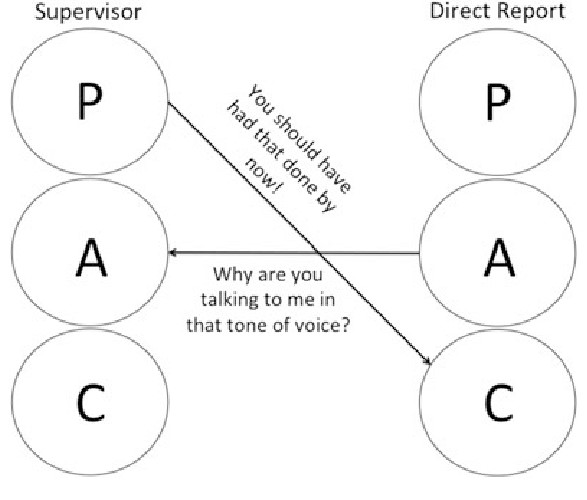
My colleagues were discussing corporate matters in an Adult manner. When this eruption happened, it cut right through a smooth Adult to Adult exchange. The effect was silence. That’s what happens when one has a crossed communication. A crossed communication is shown with this diagram:
There’s more. The fact that this colleague exploded in this context revealed something about was going on his mind. A Parent to Child communication, mature to immature, manifests at least a temporary belief that “I’m OK, you are Not OK.” Temporary and only in one context. Does the consistently manifests this sentiment? If consistent, we may call it a life position.
There are three other life positions: “I am OK, You’re OK” (considered the most mature); “I’m Not OK, You’re OK“, and “I’m Not OK, You’re Not OK.”
If my colleague were a true “I’m OK, You’re Not OK” he would regularly manifest blaming behavior, often spiteful, triumphant, euphoric or furious. Come to think of it, he’s often like that even in a subtle way. He may be a very different person at home.
A life position that was “I’m Not OK, You’re OK” would manifest as depressive, guilt-ridden, worried, blank, or easily confused. These do not describe him at all.
If it were “I’m Not OK, You’re Not OK“, this would appear as a sense of futility and despair. He would show signs of being unloved, worthless, hopeless. Not him.
And if his position was “I’m OK, You’re OK“, there would be no feelings to characterize that. Which suggests that feelings are in the other life positions, which also suggests that the other life positions are not intrinsically bad or definitive. We express feelings all the time, so we tend to go through these positions, sometimes through all of them several times in the course of the day, without most of them defining us.
I, therefore, don’t equate these life positions as personalities or character. They are not in themselves moral faults. I prefer to think of them as transitional states and to not judge people rashly on the basis of their behavior.
Nonetheless, if a person manifests a life position consistently, one cannot help but wonder why. It seems that people tend to “prefer” a specific ego state because it is comfortable. It is also possible that they “decided” this was going to be their preferred state and therefore the basis for their script in life.
Imagine going around life with the tag “I’m OK, You’re Not OK.” Because it is a life script, most of this person’s interactions will be based on that position. And, indeed, my colleague tends to look down on others. He may have decided this was going to be the theme of his life based on childhood experiences. But being very intelligent and experienced, he also often manifests emotionless rationality — “I’m OK, You’re OK“. The combo looks like a movie plot.
Does his life script betray anything about his self image? It’s hard to be more specific than the generic “I’m OK, You’re Not OK“. This life position comes with a spectrum of options, from nice, highly confident people to lethal psychopaths. I do not think my colleague is psychopathic. I think he’s just hyperintelligent with many accomplishments. He is difficult to work with — he violently berates his secretaries on the phone — but he seems to be best placed in his current job. I know I wouldn’t go out with him socially.
My colleague is a guy. If he were a woman, I probably would have had a harder time making sense of it all.
Fortunately I found a blog that helps us guys interpret what women really mean. This is Gentleman’s Journal’s “dictionary” of what a woman says and what she actually means.
1. I’M FINE I am most certainly not fine. I am upset/angry/annoyed or all of the above, but I’m not going to tell you why – you have to work it out for yourself.
2. WHATEVER, I’M OVER IT I am not over it – I just want you and the rest of the world to think that I am so I can wallow in self pity in solitude with a bottle of white and large box of chocolates.
3. FINE, JUST DO WHAT YOU WANT Not fine, don’t you dare do what you’re planning on doing. Or do… and suffer my wrath – your choice.
4. IT DOESN’T EVEN MATTER NOW ANYWAY It does matter, it really matters actually, it matters more now than it did when it first happened and it’s affecting every single facet of my day this week.
5. I’M ON MY WAY/JUST RUNNING OUT OF THE DOOR/STUCK IN TRAFFIC I’m currently sitting in my bath towel, with wet hair and no make-up and haven’t even chosen an outfit yet – see you in an hour… minimum.
6. I DON’T MIND I do mind, I mind very much actually. I know exactly what I do want to eat/do/watch, but I’m going to test you. How well do you really know me? Now is your chance to read my mind and you better get this right first time, or you can expect a flurry of ‘fines’ and ‘whatevers’ for the rest of the evening.
7. HOW DO YOU KNOW HER? What is your entire past history with that woman, sexual or otherwise? Should I be threatened and am I prettier than her?
8. I MEAN I COULD EAT I’m absolutely starving, but I don’t want to say I’m starving because this implies I’m greedy and fat, so I need you to take charge right now and find me a restaurant and a bread basket asap.
9. SORRY, WHAT? Oh I heard you, I heard you loud and clear, I’m just giving you a chance to change what you said.
10. I DIDN’T EVEN LIKE HIM THAT MUCH ANYWAY I really liked him, in fact I think I was falling for him, but he hurt me and my pride and now I’m trying to a put on a brave face – hand me the vodka!



 jaylazzo