Do I like Myself?

Do I like myself? That depends on which self we’re talking about.

In a previous blog I wrote about self (identity) being of two sides: private and public. The private self, or ego, is the subject who is aware of thinking, deciding, feeling, and who takes responsibility for these thoughts and actions, and their consequences. The public self is the brand, the experience others have of the person. Although it need not be the case, many people use the term self-esteem to refer to both.

Regardless, many people suffer from low self esteem.

How many people, we don’t really know for sure. One study on a subpopulation of girls aged 9-14 years (https://pubmed.ncbi.nlm.nih.gov/9648018/) found black girls’ had higher and more stable self-worth and experienced greater satisfaction with their physical appearance compared to white girls. This is not an estimate of the number of people who suffer, but does suggest — self esteem is a complex issue.

Noting that caveat, we can still guess people have low esteem when we see they exhibit the following behaviors:

  • They can’t take compliments: If you say something nice to them, they might shrug it off or straight up think you’re just being polite, instead of simply saying “Thank you.”
  • Negative Nancy alert: They keep talking trash about themselves, instead of working on solving their issues.
  • People-pleaser syndrome: They keep bending over backwards for others, thinking if they do enough favors, people will like them more.
  • Scared-cat mode: Try new things? Forget it. They’re scared of failing and everyone seeing it.
  • Super glued to social media likes: They keep checking if their posts are getting enough likes, or their likes getting liked.
  • The apology tour: Saying “sorry” like they have a quota for it, even for stuff that’s not their fault. They don’t want to ruffle any feathers.
  • Can’t decide on anything: Even choosing what to eat can be nerve-wracking. They don’t want to make choices because they’re scared of messing up.
  • Need a GPS for boundaries: They let people walk all over them. They don’t know how to say no or set boundaries.
  • Lonely island: They might avoid social situations because they think no one wants to hang with them. This is not to be confused with the introvert, who simply does not get his energy from being with other people.
  • Mirror, mirror not on the wall: They are critical of how they look and compare themselves to others all the time.

This is not an exhaustive list.

What are some reasons for people not liking themselves?

  • Poor mental health: People with depression, anxiety, or personality disorders often have a negative self-image and exhibit some of the above behaviors.
  • Social comparisons: Social media has worsened the epidemic of individuals comparing themselves to others. When they see acquaintances tanned on a beach they feel inadequate.
  • Bullying or abuse: Bullying, abuse, or other forms of trauma can create the habit of seeing nothing but evil and oppression where there in fact are none.
  • Body image and physical appearance: Society’s beauty standards can make individuals feel miserable they do not measure up. Adolescents and young adults are most prone, because they are at the stage where belonging is super important to them.
  • Academic or professional failures: Failing to meet personal, academic, or professional goals can discourage people to the point of giving up on themselves.
  • Cultural or societal expectations: Some cultures expect behavior, success, or appearance in given situations. Failing to meet them can lead to shame.
  • Family dynamics: Negative feedback or lack of support from family members can have the same effect as bullying.
  • Financial stress: Financial difficulties can lead to feelings of powerlessness.
  • Chronic illness or disability: Having a chronic illness or disability might make an individual feel different from others, and in some cases, this can lead to feeling outcast.

Ironically, people with low esteem can become tyrants obsessed with external success and all the marks of self importance to compensate. The flipside is an obsessive fear of failure such as betrayal, even death.

Such an ego may look strong, so powerful that it distorts reality, creating a fantasy world where one is the only hero. That kind of ego does not tolerate opposition, and it is obsessively scared of failure. But this kind of ego is not really strong. On the contrary, it is a prisoner trapped in its fantasies and fears.

Ryan Holiday wrote Ego is the Enemy as a guide to help you keep that kind of ego in check, pinpointing the problem as a disease. How do you treat that disease? Holiday breaks down his prescription into three parts – when you’re on the come up, when you’ve made it, and when you face a setback.
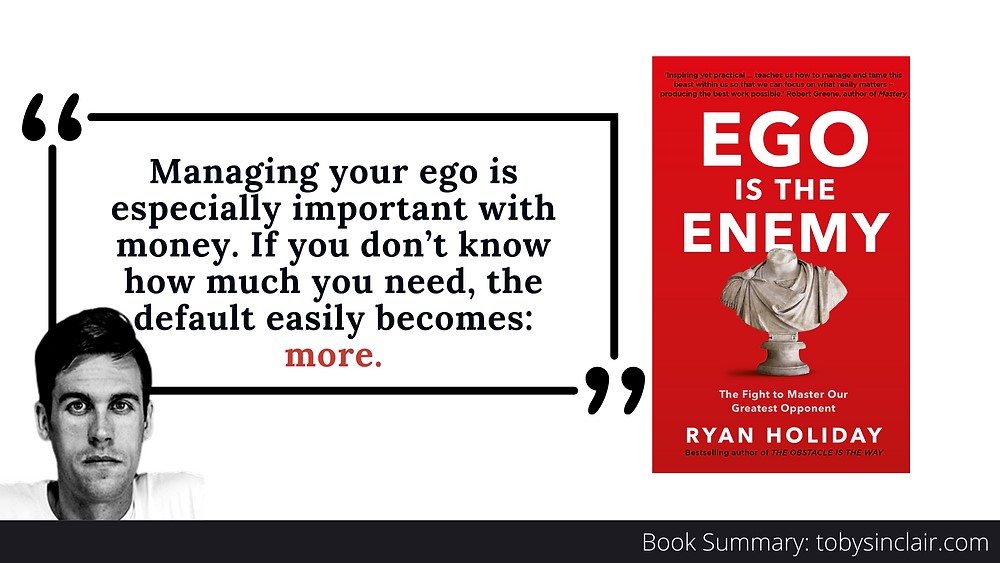
Image: https://static.wixstatic.com/media/67d4e8_fabe59e9486c425ea9b0080bb2e04761~mv2.png/v1/fill/w_1000,h_563,al_c,q_90,usm_0.66_1.00_0.01/67d4e8_fabe59e9486c425ea9b0080bb2e04761~mv2.png

In the first part, Holiday suggests you to always be a student – don’t think you know everything. When you’re getting successful, stay calm and humble. And when things go south, don’t let your ego make you act all bitter and delusional. Instead, learn from the hits, and bounce back. Life sucks, but the humble student will deal with it.

At the heart of Holiday’s philosophy is the idea that the cure for a dysfunctional self esteem is to strengthen the private self by wholeheartedly taking responsibility to think, act, and feel in a way that is health and consistent with reality, an ego that’s confident it will arrive at a place that draws security and happiness from no other. As St. Matthew wrote:

“Do not lay up for yourselves treasures on earth, where moth and rust destroy and where thieves break in and steal, but lay up for yourselves treasures in heaven, where neither moth nor rust destroys and where thieves do not break in and steal. For where your treasure is, there your heart will be also.”

Matthew 6:19-21

One of the many stories Holiday tells to illustrate his points is about businessman Howard Hughes (1905-1976).

Howard Hughes (1905-1976) as a young brilliant industrialist, and in his final days as a recluse.

Hughes was an insanely rich man who had his fingers in several pies – aviation, movies, business. But Hughes’s ego got out of control; it became hard to distinguish his real achievements from his own hype. Hughes was always craving for more – more money, more fame, more power – and this insatiable hunger led him to some bizarre behavior and shady business deals. Hughes eventually became a recluse and eccentric as his life went on.

The New York Times described his final days:

Naked, almost unable to hear, one leg atrophied, riddled with bedsores, unable to eliminate his own wastes, starving, Howard Hughes brought himself to his miserable end while worth more than a billion dollars and he died as he did surrounded by aides…

Lawrence Dietz, The New York Times, 23 Jan 1977

Hughes’s story shows that when you let your ego take the wheel, it can mess with your sense of reality. Instead of staying grounded, learning, and focusing on meaningful work, Hughes’s ego made his life a spectacle and prevented him from fulfilling his genius in a more positive way.

Do you like yourself? If yes comes from having a good brand and taking responsibility for one’s thoughts, desires, and feelings, that is a healthy “yes”. But if yes only comes from having money or likes, then find a better reason to like yourself. Start by having as your purpose to do that one thing you love, are good at, that others need, and that you get paid to do. Then build internal confidence by always being a student, taking responsibility for everything that you think, want, and feel.

(Q.C. 230608)

How can I stay true to myself? Lessons on Branding

I joined a discussion group last Sunday on Discord. It was put together by a friend, Movefast, who’s doing a PhD at the University of California in San Diego. I don’t know how he managed to bring 30 strangers together from around the world. I felt a little apprehensive.

People began to ease in. Some were just a little frustrated with the choppiness of the audio and the delayed chat updating. But otherwise we were all ready to talk.

The topic for discussion was this: Does Your Name Stand for You?

We kicked off with a game. The rules were:

1. A volunteer give his name in the form of NAME + “the” + profession or description; or NAME + “from” + city or birthplace.
2. All videos off.
3. For the others, describe that person solely from the name. Write it in the chatbox.
4. The volunteer then goes through the descriptions and says what are accurate.

Four volunteers came forward. I was one; I gave my name as “Jay from Quezon City“.

Their descriptions of me generally followed the stereotype of Quezon City people as chill, somewhat intellectual. One described me as a “womenizer”. I answered, “Wow, womEnizer, I’m flattered, but that’s absolutely not true”.

The results were a mix of accurate and not accurate. Those who knew the person had more to say. Strangers guessed based on stereotypes, the sound of the voice, accents. Some of us didn’t even dare to type their guesses, they just had too little to work on.

What did we learn? Names are stand-ins. Like brands or logos, meaningless at first, but with time identified with everything we could remember about the person and the experience we had of him. The person might think the name truly represents him. But to others, the name’s identification with the owner unfolds over time.

Now some cultures call their children Li Wei, meaning strong, or Eagle Hunter. People expect Li Wei to be strong or Eagle Hunter to be fast; the two of them will probably try to live up to these expectations. But these are accidental qualities as one participant pointed out. They might not even be true — Li Wei might be strong physically but not emotionally.

Perhaps we might find something more essential if we looked into the person’s purpose. After all, a brand connotes the business it’s in.

Movefast asked where purpose comes from. Can we find it through meeting the needs of others?

Some of us agreed that purpose lay in service. Others proposed that purpose lay in finding out what one liked and what one was good at, as this led to training, which led to service.

We then recalled that there was concept that put all these elements together: ikigai. Briefly, ikigai says that the ideal purpose of a person lies in the intersection of 1) what he is good at; 2) what he loves; 3) what needs he fulfills; and 4) what he gets paid to do. An Asian concept, said Vladym.

It was nevertheless clear we all agreed on #1 and #2. But what kinds of needs make for a good purpose? Movefast proposed that we find purpose in helping the least privileged. Smoke, a medical doctor training in the UK, said that system developed by the UK National Health Service could fill our country’s need for ways to bring health care to all especially the underprivileged.

One of the participants then posted Maslow’s hierarchy of needs.

Image: https://www.thoughtco.com/thmb/AjKcgMjVzPE4irF_ZrNlj2cozmc=/1500×0/filters:no_upscale():max_bytes(150000):strip_icc()/maslow-s-hierarchy-of-needs–scalable-vector-illustration-655400474-5c6a47f246e0fb000165cb0a.jpg

The hierarchy shows that people’s needs for food and shelter have to met first before they start to fulfill their need for safety, then for love and belonging, then for esteem, then for “self-actualization”. Maslow’s hierarchy shows the EVERYONE is in need of some thing. Even the most privileged will feel a need to be the best they can be. Is there anyone on earth who needs nothing?

No. There’s always someone out there who needs something, and someone who can supply it.

I laid it out this way. Say, you’re Dr. Smoke, you have a unique set of talents and interests. You can cure the sick, many among the poor. But you’re not Smoke; your talent is making lots of money. If your purpose was to do what he does, you wouldn’t be competent, and you’ll create more harm if you tried doctoring people. Better, give money to someone competent who needs it to run his medical mission.

Thus, everyone has a purpose or can define one.

Ok, so now I know my purpose.l What’s 20 years donna look like? Reality check: 9/10 of us will not be doing in 20 years what now we think we should do. The proper question is: what is it that I love, or want to love? What is it that I’m good at or want to be good at? With school, training, experience these things will change, and so will your purpose. And if we’re smart about it, we will be paid for it, too.

Changing purpose is a normal thing, although rarely will it change 180 degrees. So as not to look incoherent, write your purpose as you see it, and review it, say every year or 5 years. Ask: why did I take this turn? The answer might impress you. When you climb a mountain you rarely take the same route others did. Choosing where to put the next foot is the mountaineer’s key talent.

We left our meeting with a few actionable points to carry out. First, ask the 4 ikigai questions to define a (provisional) purpose. And second, practice an examination of conscience around that purpose. The questions in this examination are:

  1. What did I do today to further my purpose?
  2. What did I do today, or refused to do, that took me away from my purpose?
  3. What could I have done better to further my purpose?

In fulfilling one’s purpose, a kind of confidence surfaces. What happens on the outside affects the inside.

To put it another way, a person’s self has two sides: a private, and public side. The private self is the person in so far as he is thinking, and willing, and feeling. Some people may not be fully aware of their motives for thinking, willing, and feeling. They might be in denial, for instance. The public self, on the other hand, is the brand, i.e., the experience others have of the person. Private or public, although we can know a great deal, no one can know a person’s self with 100% accuracy, not even the person himself.

Besides, what your self is like now will not be exactly what it will be like tomorrow.

So how to be true to something that changes? Take responsibility for your thoughts, decisions, and feelings. In public, be consistent with your purpose. This consistency, maintained by an examination of conscience, ensures that memories others have of you will be highly accurate and reliable.

If we can’t trust our memory of someone, how can we rely on him? The unreliable person might not lose his private identity; he could even think of himself as a saint. Makes no difference to us: his public identity will be a brand no one will buy.

(Q.C. 230607)

On Movies and Drunk History

I just bought a copy of Trip to Quiapo: Scriptwriting Manual, by Ricky Lee. Lee, a recipient of the Order of National Artists of the Philippines, is one of the most successful screen writers in Philippine cinema today. His body of work spans over forty years; it includes short stories, plays, essays, novels, teleplays, and screenplays. He has written more than 150 produced scripts, earning for him more than 50 trophies from all the award-giving bodies in the Philippine movie industry. He only writes in Filipino.

Image: https://media.karousell.com/media/photos/products/2021/8/13/trip_to_quiapo_scriptwriting_m_1628863249_4cc512bd_progressive.jpg

The author was recommended to me when I asked who to read if I wanted to write well. Already into the first pages of Trip to Quiapo, I told myself this is the real deal, the kind of trip I was looking for. I have no plans to become a scriptwriter, but that point of view, a direct contact with the mind of the audience, is something I can learn from, to use and abuse, hope not, in any situation.

More to the point, I want to tell a good script from s**t.

Who cares? I do. I’ve seen Quantumania, 65, Dune, Avatar, Maverick, Megan, Smile, some film with Julia Barretto in it that I walked out of, Babae at Baril, and several others, just to mention the 2023 releases. Waste of time. The only one I thought good enough to watch again was M3gan.

I figured, it’s not worth watching if it’s not worth watching again.

So, first screening is for fun. Later, to see how the script was stitched, cinematography, the marketing, the acting, how the logistics were managed. I research. Found out that in Kill Bill (2003) the Asian and Caucasian fake blood were made of different recipes. In Shine (1996) actor Geoffrey Rush didn’t use a hand double. Learned about mortgage backed securities doing research after seeing Margin Call (2011).

Geoffrey Rush as virtuoso pianist David Helfgott in Shine (1996). Image: https://ichef.bbci.co.uk/images/ic/1200×675/p01gdlfy.jpg

I don’t need a whole movie again for all that. I’ve lost count of the number of clips I’ve watched of specific scenes from the Godfather I (1972). Each time, I see a detail in a new light, some inflection in the voice or combination of words that tells me Al Pacino is the greatest mafia boss in movie history. These same clips have been viewed millions of times over many years.

Time is in short supply. Why not spend it enjoying and finding out why a film worked?

I’ll get the most of both if I only watched good movies. The best judge for that is time: if after a year people are still talking about it, that’s minimum good. Watch movies that are at least a year old, or backed by real experts. Not Rotten Tomatoes. Experts. That’s my advice.

I’m no screenwriter, so what use do I have for all that? Secrets. The biggest secret is to make it real.

Take the plot device, a literary tool to advance the storyline. It helps drive the narrative forward or steer it in a new direction. The attempted assassination of Don Vito Corleone in the Godfather is a plot device.

Some suck, like the death trap. The villain puts the good guy in a room instead of whacking him like a smart criminal would. James Bond films are notorious for death traps. Why’s that bad? Death traps are unrealistic. The villain looks stupid, and the protagonist draws good luck like flies to poop.

Would I rather the protagonist die? No. Michael Corleone could have died with Apollonia in that Alpha Romeo in Sicily, but real assassination attempts aren’t always successful. But, since Apollonia’s vaporization, Michael deals with his enemies using cunning, acting at the right moment, quickly and ruthlessly. And he takes risks. There are no death traps in the Godfather.

Staying real persuades across contexts. Essay writers use something like the plot device, the “controversy”, the phrase in the intro that starts with “However”. However, imagine that your physics teacher did this:

Image by Sidney Harris (1933- )

Walk out.

Good stories are maps that help us navigate the mess of human thought and emotion; the lines on the map is language. The lines must be clear, no more or less than needed for the map to be useful. Good stories are all about clear and concise language. But recent trends are destroying language. I’m not convinced political correctness is better than what we’ve been using for hundreds of years. “Visually challenged” versus “blind”?

Inclusive language insists a straight line should be curved so as not to offend the visually challenged. To give an idea. This satirical lisot was lifted from http://www.back2stonewall.com/2022/07/what-if-we-changed-movie-titles-to-include-trans-inclusive-language.html entitled What if We Changed Movie Titles to Include Trans Inclusive Language.

  1. Vulva Carriers on the Verge of a Nervous Breakdown
  2. The Effect Of Gamma Rays On Person-In-The-Moon Marigolds
  3. 3 Penised Persons And A Baby Who Was Not Assigned A Gender At Birth In Order To Prevent Their Psychological Enslavement
  4. Call Me By My Correct Pronoun
  5. Birthing People (in Italian) Mia
  6. Ilsa: They/Them Wolf of the SS (1975)
  7. Person of Ever-Shifting Gender, Where’s My Car? (Sweet!)
  8. 12 Angry Non-Binaries
  9. Mx. and Mx. Smith
  10. Victor/Victoria/Victorx
  11. TERF Nazis Must Die
  12. Born Yesterday: Assigned Female
  13. Dressed to Affirm One’s Gender and Kill
  14. A Queer For All Seasons
  15. Mars (ha P. Johnson) Attacks!

Call this useful. But seriously, a Tower of Babel situation is in the making.

Here’s a clip that shows what a Tower of Babel looks like in real life: https://www.youtube.com/shorts/QmAJx1yg23o

Crafting clear, concise language is a skill. Why not take the chance to learn it while poppin’ popcorn on a couch?

But in valuing learning don’t I disparage the need to take a fun break from work?

We need enjoyment. I need enjoyment. I sometimes watch short videos to laugh, like the 8-minute film The Gunfighter (2014) or Drunk Historys 10-minute “Bad Blood” (2019). Or to feel good, like Phil’s (Bill Murray) solo in Groundhog Day (1993) and David Helfgott’s (Geoffrey Rush) “Flight of the Bumblebee” in Shine (1996). I just happen to also enjoy learning.

Shawn Parsons as The Gunfighter (2014). Image: https://i.ytimg.com/vi/cWs4WA–eKU/maxresdefault.jpg

I watch documentaries, mostly on Youtube. I used to like History Channel, but my enthusiasm got infected then fell off when they aired Ancient Aliens. Language isn’t of much use if it masquerades as true.

Mocumentaries? We know they’re half true. So, dude, I love Philomena Cunk (Diane Morgan)! She plays with language like a drunk dolphin. I love Drunk History, especially “Bad Blood” and Aubrey Plaza’s ridiculous portrayal of Cleopatra. Yet even in craziness, every episode of Drunk History is better researched than Netflix’s Queen Cleopatra, which was mauled even by Rotten Tomatoes.

Aubrey Plaza as Cleopatra. Image: https://i.ytimg.com/vi/5ab4rYDR0yY/maxresdefault.jpg

(Q.C., 230606)

What is something I’m proud of? Being part of a truly great team

een as fortunate to work as part of a truly great team. I had the chance to work for a team that was the first of its kind this country. And just as it was learning to walk, it had to face the COVID pandemic of 2020-22.

This team was the Health Technology Assessment Council. Specifically, the founding members. To celebrate the end of its pioneer 3-year tour, the HTAC held a final get-together at the Luxent Hotel in Quezon City last June 2, 2023. It was also the occasion to celebrate the birthday of our beloved leader, Dr. Marita V.T. Reyes, whom we fondly called Ma’m Marita.

What is the HTAC? And why is it important? The HTAC is an interdisciplinary government body tasked to assess health technologies and recommend them for government financing. The body consists of a Core of 9 members, 7 subcommittees with a total of 21 members, and the HTA Division (HTAD) acting as the secretariat. The head of HTAC is Dr. Marita V.T. Reyes. The HTAD is headed by Ms. Yen Genuino-Marfori. It is important because under the Universal Health Care Act of 2019 (which also created the HTAC), the government cannot purchase a health technology (e.g., vaccines, drugs) or reimburse a drug or procedure through the state’s health insurance system without a positive recommendation from the HTAC. Purchases in the private sector as well as donations, e.g., World Health Organization, are not covered by this requirement.

When we began our work in 2019. we believed it was a good way to serve the country. It was a also a new field for us, most of whom were clinicians. Aside from evaluating health and safety, we had to evaluate cost effectiveness and ethical-legal implications. This meant learning new techniques and concepts. Health economics, Markov models, willingness-to-pay, get it? Most of us didn’t.

At first. After our first big workshop in October 2019, it was all cute, we learned so much stuff, we were all excited. Little did we know that in less than 6 months we would be thrust into the biggest health crisis of the world in recent years: COVID.

The crisis required the HTAC to rapidly evaluate vaccines, drugs, test kits, and medical procedures such as the high-flow nasal canula, without sacrificing scientific rigor. The Subcommittee on Vaccines which included me from the University of the Philippines (UP) Diliman, Dr. Medy Saniel, former Director of the Research Institute for Tropical Medicine, Dr. MiAnne Castor of the UP Manila, Dr. Lims Abrogena of the Ateneo School of Medicine and Public Health, Dean Aleth Dacanay of the University of Santo Tomas, Prof. Luz Barbara Dones of the UP Manila, and Dr. Katherine Reyes of the UP Manila had to evaluate all the COVID vaccines handled by the government, and to recommend their use for various sectors of the population. Other Subcommittees went to full swing as well: public health isn’t just about COVID.

It was difficult work. Just one evaluation at the subcommittee level took more than an entire day of debating numbers, rerunning calculations, tweaking models, from a large number of scientific articles, regulatory documents, and confidential papers. Focused group discussion and stakeholder engagements were also run. It fell upon the HTAD to collect and vet references for quality, pull strings for data, and then summarize tons of information for the subcommittees to evaluate. The subcommittees then had to present their work to the whole HTAC body, another exercise in serious debate. The HTAC eventually made 92 evaluations of which 86 were completed, leading to recommendations, some negative.

Crisis frays nerves. We were vilified by some, praised by others, in public, on radio, in the legislature. At the beginning of the crisis we were criticized for our slow action on a Chinese vaccine, the first to arrive in the country, which under urgency we recommended with some strong caveats on account of its relatively low effectiveness compared to other brands. The government later had a hard time pushing the Chinese brand when the superior Western vaccines became available. Later on, we were blamed for being slow, leading to the wastage of 31M doses, mostly in private hands.

That’s wrong. First, we are not an approving body, that would be the Food and Drugs Administration (FDA). Second, our mandate only covers purchases by the government and does not cover the private sector, or donations — they can do whatever they want as long as the products are approved by the FDA. Third, HTAC may evaluate technologies without necessarily leading to a purchase, e.g., evaluate a vaccine that is still undergoing FDA evaluation. We have been criticized for not recommending products that had no FDA approval.

We defended our legal mandate and scientific methods, and the fact we were working overtime. We also defended the people. Unique among health technology assessment bodies in Asia, the Philippine HTAC also uses ethical criteria in its evaluations. We defended our work with clarity and determination, our position brilliantly articulated by Dr. Reyes and other HTAC members, in the legislature, in forums of various kinds, and on social and regular media.

Ma’m Marita interview with DZRH host Mr. Angelo Palmones, 29 Nov 2022.

I’ve never been part of such a large team of expert problem solvers from diverse fields pulling the cart in the same direction.

I told the group as representative of Vaccines:

Robert Ludlum, the novelist, once wrote: “Those who hesitated at the moment of trial, who did not act with clarity and determination when the moments of crisis were upon them, deserved the limitations to which their fears committed them.” It was with clarity and determination that we faced the crisis of the last three years, and we pulled through thanks to hard work, and to the leadership of Ma’m Marita.

The author delivering a message on behalf of Vaccines.

And now for many of us the pioneer batch was coming to its close. But certainly, it’s not an end to the many friendships made, the tons of knowledge and skills we acquired, and the pride of having served the country at this hour.

Our leader, Ma’m Marita V.T. Reyes blowing her cake. To her right is Department of Health Undersecretary Charade Grande
HTAC and HTAD. Not everyone was present at this event. One is Dr. Meme Guerrero, the first head of HTAD and now with the World Bank. Another is the late Dr. Noel Juban of the Subcommittee on Drugs, who passed away on 24 January 2022 at the age of 60.
LR: Dr. Martin Camara of Traditional Medicines; Ms. Yen Genuino-Marfori, head of HTAD; Dr. Marita V.T. Reyes, head of HTAC and the leader of everyone; Dr. Jay Lazaro of Vaccines.
The Joint Subcommittee of Vaccines and Preventive and Promotive Health. LR: Dr. Lims Abrogena, Ms. Yen Genuino-Marfori, Dr. Katherine Reyes, Dr. Marita Reyes, USec Charade Grande, Dr. Medy Saniel, Dr. MiAnne Castor, Dr. Jay Lazaro.
The Awesome Joint SC HTAD team! LR (front): Dr. Jay Lazaro (Vaccines), Dr. Martin Camara (Traditional Medicines), Ms. Jayne Yang (HTAD), Ms. Russell Cabus (HTAD), Mr. Josh Santillan (HTAD). LR (back): Ms. Lara Liban (HTAD), Ms. Agnette Peralta (Medical Devices), tall guy from HTAD, Dr. MiAnne Castor (Vaccines), and Dr. Medy Saniel (Vaccines).
Clockwise from 12 o’clock: Dr. Iris Tan (Other Health Technologies), Ms. Catherine Lee Ramos (Medical Equipment and Devices); Dr. Medy Saniel (Vaccines); Dr. Sid Sia (Traditional Medicines); USec Charade Grande; Dr. Jojo Mantaring (Core); Dr. MiAnne Castor (Vaccines); Dr. Jay Lazaro (Vaccines); Dr. Martin Camara (Traditional Medicines); Dr. Lims Abrogena (Preventive and Promotive Health); Dr. Catherine Reyes (Preventive and Promotive Health).

Until we meet again.

(Q.C. 230606)

Have I taken enough risks? Three authors weigh in

I attended at a series of talks yesterday at the World Trade Center on How to Write a Book. Each of the three speakers — Samantha Lucas, Kat Olana, and Anthony Shieh — talked about how they jumpstarted their writing careers through self-publishing. They offered insights on the opportunities and pitfalls, and encouraged aspiring writers to believe in their own message.

A self-published author is an entrepreneur. He or she makes the product, the book, and sells it. They might go door-to-door, but more than that, they use processes to identify their specific target audience, make them aware of and interested in the book, convert that interest to sales, and win loyal followers who will tell others to buy the book.

Writing, therefore, is much more than putting words into paper. It is a profession, different from regular jobs because it needs a lot of expertise in multiple skills, and education in and out of school.

Where do writers get their education? Shieh, Lucas, and Olan are college graduates. They then spent more than 10 years in marketing, advertising, sales and content generation for various companies. At the same time they worked on their own writing — Shieh on human interest and horror stories, Olan on sci-fi, and Lucas on self-help. They attended talks, workshops, and joined communities to sharpen their knowledge and skills in research, writing and editing.

They also found Central Books. Why was this important? Because, aside from publishing and marketing textbooks in the traditional manner, Central Books also provides production services such as editing, formatting, and printing for self-published authors. After they produce the book, the authors themselves sell it. This requires a totally different set of skills. We’re talking metrics, demographics, analytics, cold calls, optimizing search engines and platforms such as Facebook, Twitter, Tik Tok, Google, and Instagram.

Olan, a trained marketing professional, outlined a strategy that templates the process of marketing a book. The process consists of three steps: Know the Magic, Know the Reader, and Connect Those Two.

1. Know the Magic: This is the key step where the author articulates his or her Big Idea. What is your book about? Answer that in 2 or 3 sentences. What is your book’s Unique Selling Point, what makes it different from similar books? What are the events, characters, facts that make the story believable? What is your branding? We talk about color palettes, fonts, tonality, imagery. In short, why is the book worth buying?

2. Know the Reader: Authors write for a specific reader, so well defined one could describe him or her down to her shoes. You can’t sell to everyone; in fact, try to do that and you won’t sell. Testing that niche is a process of trial-and-error backed by calculated assessments of metrics. The author knows about the audience’s demographics: age, gender, where they live. The author knows their psychographics: hopes, dreams, fears, beliefs, likes, passions, hobbies. The audience’s attitude towards books, where and how they buy, in what platforms do they search, these an author researches.

3. Connect the Two. Olan presented a model called the “marketing funnel” (see below). It consists of 4 stages: Awareness (I learned about your book); Consideration (I’m interested); Conversion (I bought it); and Loyalty and Advocacy (I’ll recommend it). It’s a funnel, because out of 100 who are aware, 30 will check it out, 10 will buy, and 3 will tell their friends to buy it. The big insight is that those 3 friends? They’ll sell the book better than you will. Also, the funnel phenomenon means a writer must be constantly marketing and selling if he or she wants to sell a lot. The author will attend events: book launches, online and on-ground, partner with influencers, pen deals with bookstores. The author will see peaks and troughs in sales as with any business, and will monitor what readers are saying on social media. The author has about 2 or 3 years to maximize the book’s appeal, after which the product fizzles.

The Marketing Funnel. Image: https://media.sproutsocial.com/uploads/marketing-funnel.jpg

The speakers made it very clear that writing is just half the work; producing and marketing a book costs time and money.

The problem is: most writers don’t know this. Even if they did, such as our three successful writers, they must still take risks. That’s the nature of business. In fact, they all described themselves at some stage like standing at the edge of a cliff. Yet they insist: just jump. That’s when things really happen!

It’s not all flying and colors and what. The speakers did not talk much about their personal down moments. But their advice to find influencers who can sell the books better than they do, their insistence on never editing your own work, and their surprise at the kind of people who buy their work, indicate that they paid their dues in blood and sweat along the way.

To me, it seems that writing and selling gets easier as one learns to read the right metrics and click the right icons to increase the chances of selling the product. The risks themselves, however, are always there. A writer who has been through this will know that their belief in their own message gives them the clarity and determination needed to navigate the risks. As one of my favorite authors wrote, in a different context:

Those who hesitated at the moment of trial, who did not act with clarity and determination when the moments of crisis were upon them, deserved the limitations to which their fears committed them.

Robert Ludlum (1927-2001)

The more tries, the more sales. The more rejections, the more sales. The more fear, the more sales. Just believe in your work, all this throwing to the wind becomes just a thing you have to do.

So, to the question “Have I taken enough risks”, I echo the sentiment of those three writers and answer with another question: “Have I jumped off a cliff today?”

(Q.C. 230604)

What are some regrets I’ve had in my life?

I’ve researched what people often regret in life. Below is a non-comprehensive list. They probably get worse the older you get.

1. Not going after what truly excites you: It sucks when you look back and regret not pursuing your passions or taking a shot at what you really love. Yet, more than 90% of us are not making a living out of what we thought was our passion. So, for a lot of people it is “love what you do”, not “do what you love”. Since love is choice, we can love ANYTHING.

2. Neglecting quality time with loved ones: It’s a bummer when you realize you didn’t spend enough fun and meaningful moments with your family and friends. A cousin of mine who lost both parents way crying as she encouraged me and my other cousins to “PLEASE spend time with your parents.” Thank, forgive, apologize, before they die.

3. Not taking care of yourself: So, you’re 40, and you didn’t pay attention to your own health, both physically and mentally. Taking up jogging at 40 sounds exciting at first, but within 2 weeks you’ll regret it. I suggest don’t think about “run 1 km“; but “put on running shoes“, and let the run take its course. Two months of this and you won’t want to stop.

4. Not taking risks or grabbing opportunities: You might regret not having been bold enough to take risks, try new things, or jump on opportunities. So, you fell for a scam, you worked with people who betrayed you. Be glad, friend. It’s better to regret the things you did than the things you didn’t do. With what you learned, you can swim with sharks.

5. Not expressing your feelings: The elephant in the room can’t be tamed for long. Bottling up emotions can lead to unresolved issues destroying mental and physical health and personal relations. I recently heard a speech about missed opportunities delivered in a birthday party. But, the celebrant in fact appreciated it. The truth really does set you free.

6. Not investing in personal growth: For a guy in his 20’s, incompetence is excusable. But you’re in your 30’s and you’re not an expert in anything. It’s never too late to be good at something, anything. It’s also why I’m not in favor of early retirement, unless it’s to do something really challenging. And now that you’re at it, aim to be the BEST, or you won’t even be GOOD.

7. Not being smart with money: Money regrets are life threatening: overspending, debt, zero retirement funds. Most people do not plan because they don’t know how, or they don’t care. That street vendor is inspiring, but this guy Garfield — former head of a research unit in a university — has no job, no pension, no retirement. Poverty is tough, but laziness is demeaning.

8. Not standing up for yourself: Why do people let people walk all over them? If this is your problem, ask why you allow it. Because a childhood friend of mine, JC, would have none of it. He was constantly bullied because he was small, dark, and ugly. One day in 4th grade, as his mates were bullying him yet again, he pulled out a machete concealed in his bag, and brandished it. The bullying stopped. Forever. He also became a leader among those people, a competitive black belt karateka, and a successful owner of a logistics company.

9. Not enjoying the present moment: The past and the future do not exist. If you’re an absent-minded genius, find a friend who will anchor you to the present. Or a wife. David Helfgott is one of greatest concert pianists today; he was also treated for severe mental health issues over decades. But he found a loving and supportive wife in the late Gillian Murray Helfgott.

10. Not staying true to yourself: I love Aubrey Plaza, especially her Wood Milk commercial: she doesn’t give a s**t about being cancelled. Jordan Peterson, too, who has been cancelled many times and is still wildly influential. Minstrels in the Middle Ages played this role and were protected for it: to be the truth tellers in a court swimming in lies and wishful thinking.

Don’t get me wrong: “authentic”, “risk”, “expressing feelings” are double-edged swords. A more precise word would be PURPOSE: be true to your purpose.

Then you’ll always have something to be thankful for.

Image: https://images.squarespace-cdn.com/content/v1/59a739a97131a56e32c74f1f/1574363508474-065W6K1NO13V07Y97HJM/3-minutes-of-gratitude-idontmind.jpg?format=1000w

(Q.C. 230603)

On Kindness

Let’s talk about kindness, one of the most underrated but most powerful things in the world.

First, what is kindness? Simply put, it’s being nice. But dig a little deeper, you’ll see it’s more than that. It’s about empathy, compassion, and treating people with respect. It’s about the small things, like saying “please” and “thank you”, holding a door open for someone, or just giving a friendly smile to a stranger.

It’s also about the bigger things, like going out of your way to help someone who’s struggling, standing up for people who are being treated unfairly, or lending an ear to someone who just needs to vent. Kindness is a mindset, a lifestyle, a choice to put others before ourselves and make the world a little brighter.

Why is kindness so important? For one, it makes people feel good. I mean, how do you feel when someone is kind to you? Like sunshine on a cloudy day? That’s the power of kindness. It transforms moods, uplift spirits; it makes us feel valued and appreciated.

Kindness is also a moral duty. The Stoics, a school of philosophers from Ancient Greece and Rome, saw kindness as a part of justice, which means treating people the right way. The Roman Seneca (4 B.C. – A.D. 65) wrote loads about kindness. He believed that being kind is a win-win – it helps the person you’re being kind to, but it also helps you by building mutual respect. Showing kindness was about doing your part to make the world a better place.

Plus, kindness has a ripple effect, like throwing a pebble in a pond. One act of kindness can inspire others to do the same, creating a wave of positivity that can reach far and wide. Mother Teresa (1910-1997) once said:

“Kind words can be short and easy to speak, but their echoes are truly endless.”

Mother Teresa of Calcutta

And let’s not forget the benefits to ourselves. Studies have shown that being kind can reduce stress, increase happiness, and even make us live longer. So, in a way, kindness is like a magic potion for a healthier and happier life. It’s good for the soul.

When and how can we be kind? Anytime and anywhere. Kindness doesn’t have to be planned or staged. It can be spontaneous, instinctive, just a natural response to the situations and people around us.

But hold on, is there ever a time when we shouldn’t be kind? It’s not exactly black and white. Being kind doesn’t mean we should let people take advantage of us or cross our boundaries. Kindness isn’t about being a doormat.

Left to right: Jordan Peterson. Seneca. Marcus Aurelius. Mother Teresa of Calcutta.

Jordan Peterson, a Canadian clinical psychologist and professor, has talked a lot about being “nice.” He says there’s a big difference between being “nice” and just being “agreeable.” Agreeable people are super friendly, always looking for harmony, and don’t really like getting into fights or disagreements. But Peterson warns against being too agreeable because you might end up not standing up for yourself, letting people walk all over you, or avoiding arguments that need to happen.

He’s saying, don’t mistake being “nice” for being weak or letting people take you for a ride. It’s great to be kind, thoughtful, and respectful, but you also must stand up for yourself, set boundaries, and speak up about what you think and feel. A Stoic would say: walk away if you have to.

Stoics, however, wouldn’t be unkind on purpose; that would only show a lack of emotional control, a lack of maturity. Negative vibes can lead to being unkind and should be controlled. Marcus Aurelius (121-180), Roman Emperor and philosopher, wrote a lot about trying to understand people, even those who might have hurt us, and responding with reason and goodness and firmness, instead of anger.

You can totally be “nice” and still be strong and assertive.

How to be nice in the right way? Here’s what we can piece together from the writings of Peterson, the Stoics, and others:

1. Honest Self-Reflection: Understand yourself and your emotions. To manage negative emotions, you need to be aware of them first.

2. Responsibility: Take ownership of your emotions. Do not blame anyone for how you feel, and do not let anyone determine how you should feel.

3. Assertiveness, not Aggression: Assertive is not the same as aggressive. Express yourself and stand up for your needs without having to explain it to others, without resorting to aggression or unkindness. Being kind to others doesn’t mean to neglect being kind to yourself. Say “no” when you need to, set boundaries, negotiate to get what you want.

4. Purpose and Meaning: Have a purpose in life. A strong sense of purpose buffers against negative emotions, helps you assert yourself agreeably, and contributes to emotional regulation.

5. Truthful Speech: Favor honest and direct communication. By speaking truthfully about your feelings and needs, you handle conflicts better and avoid resentments, which can lead to unkind behavior.

6. Ordinary acts of kindness: Smile at people. Listen to them. Show empathy. Lend a helping hand. Stand up for those who can’t defend themselves. Be there for people in their time of need. Often, it’s the small acts of kindness that make the biggest impact.

In a nutshell, kindness is about balancing emotion and reason. It is an exercise in wisdom, rational thinking, and healthy self love. Be kind, but not at the cost of your own well-being or sense of what’s fair.

And, if it is no trouble to your larger goals, show others more kindness than they deserve.

Kindness is a bridge that connects people and invites them to put their best food forward. And if we could all just sprinkle a little more kindness in the world, who knows what kind of magic we could create. Let’s get out there and spread some kindness.

(Q.C. 230602)

Who are the people I value the most?

At the moment, that would be Dharius Daniels.

Image: https://i.ytimg.com/vi/Vz81X2iv_T8/maxresdefault.jpg

I’ve recently been watching videos by Dharius Daniels a pastor, author, and leadership coach known for his dynamic and inspiring approach to life and leadership. I read one book of his, Relational Intelligence: The People Skills You Need for the Life of Purpose You Want. From these, we can glean key practical elements:

  1. Relational Intelligence: Daniels places a high emphasis on relational intelligence, which he defines as the ability to understand, recognize, and utilize the power of relationships. He believes the quality of our lives is largely determined by the quality of our relationships. He also distinguishes between different types of relationships — friends, associates, and assignments — arguing for the need to understand and manage them accordingly.
  2. Purpose-Driven Life: Daniels advocates for a purpose-driven life. He often speaks about the importance of aligning one’s actions, decisions, and relationships with one’s life purpose. Understanding and living out one’s life purpose brings fulfillment and success.
  3. Self-awareness and Personal Growth: Daniels promotes personal growth and emphasizes the need for individuals to understand their strengths, weaknesses, passions, and motivations.
  4. Spiritual Growth: As a pastor, Daniels emphasizes spiritual growth and the role of faith in everyday life. He encourages people to nurture their relationship with God and let their faith guide their actions and decisions.
  5. Leadership: Daniels strongly believes in influential leadership. He often provides insights and advice on how to be a good leader, emphasizing integrity, relational intelligence, and a strong sense of purpose.
  6. Importance of Communication: He frequently talks about the power of words and the importance of effective and mindful communication in building strong relationships and leading effectively.

His philosophy is practical because he provides us with a simple model of how we make and manage relationships, an aspect of our lives that probably affects our happiness and fulfillment more than our hobbies, professions, and outreach work. He outlines this model in his book, Relational Intelligence.

Relational Intelligence argues the quality of our lives is largely determined by the quality of our relationships.

Daniels explains that relational intelligence is the ability to understand, recognize, and utilize the power of relationships. The book explains that every relationship is not designed for the same depth or commitment, and knowing how to adjust expectations is crucial. For example, don’t treat everyone as a friend. Mismanaging these distinctions can lead to unnecessary emotional trauma, misguided expectations, and distraction from one’s purpose.

He identifies two types of relationships: purpose partners and purpose projects. Neither type is “bad” or “good,” but understanding their difference is key to managing expectations and investments in relationships.

Purpose partners are individuals who align with and contribute to your life’s purpose or mission. They are supportive, understanding, and share a mutual give-and-take relationship with you. They are constructive; they aid in personal growth and the realization of your goals. They can be mentors, close friends, family members, or even colleagues—anyone who positively influences your life and helps you move forward on your life journey.

Purpose projects, unlike partners, are individuals that require more energy and effort on your part, often without reciprocal benefit. These relationships can be challenging, as they frequently involve helping the other person grow, change, or overcome obstacles. The goal of these relationships isn’t mutual growth but rather the growth of the other person. While they may not contribute directly to your life’s purpose, they offer opportunities for personal growth in patience, understanding, and empathy.

Knowing there are these difference, we can proceed to managing our relationships. Management revolves around a few key concepts:

  1. Differentiating Relationship Types: According to Daniels, we need to identify the roles that different relationships play in our lives. The bottom line is to understand that not all relationships are meant to be mutually beneficial in the same way. Even within purpose partners and purpose projects there will be different expectations. For example, among many associates with whom we share work outputs, not all, maybe even none, will we treat as friends with whom we share our very lives.
  2. Setting Boundaries: Healthy relationships require clear boundaries to prevent mistreatment or exploitation. This may involve defining what behaviors are acceptable and what aren’t, as well as understanding what emotional, physical, and time resources you are able or willing to invest in a relationship. There is no shame in telling an associate that even though you will be working very closely on a project, you are not willing to have social relations with him or her after work.
  3. Recognizing Safe People: Identifying individuals who have earned our trust and are beneficial to our life’s purpose is a crucial relational skill. There is no shame in distancing ourselves from people we do not trust or who contribute nothing to our life, not even the feeling that we have been a help to them in some way. A total cut-off is not, however, always the right thing to do with people we consider unsafe.
  4. Purpose Partner Attraction: Cultivating qualities that attract purpose partners and learning to serve others’ purposes can enrich our relational experiences. You don’t want to make a bad first impression at any time. This involves being supportive, reliable, and showing that you are able and willing to add value to the lives of others. It is all right not display parts of our lives that are irrelevant or even distracting to a work relationship, such as, say, our penchant for wild parties, our love for jazz, or our religious practices, interests that contribute nothing to the team.
  5. Strategic Investment: Every relationship doesn’t deserve the same investment. Relationships should be prioritized based on their importance and purpose in our lives. This involves being intentional about who we spend our time with and who we share different aspects of our lives with. There is not shame in saying NO to one who asks for your time.

What got me into Daniels’ thinking was the observation that in certain cultures, everyone is expected to be friends. Say, the office would have “karaoke” regularly so that people will “bond”. Very popular, too, is “team building”, where we expect people to become “close”.

Team members, however, are supposed to be reliable, not close. I find most team building activities to be a waste of time and resources, sit-downs being the more effective way of setting boundaries and expectations in most cases. Even what we sometimes call “user friendly” relations — where people kiss each others’ asses, have the merit of at least being based on a clear rule: self interest. I also find the idea of wanting to befriend everyone as doomed a project as trying to please everyone.

Some colleagues may become your friends, and that helps make everyone better professionals and better people.

Daniels also got me interested in the idea that one-way relationships are not all bad. Mothers, for example. Professors teaching a class that’s 80% ingrates. It can be a priceless life changing adventure for a parent or teacher to see a child grow and bring honor to itself and to others. But there are relationships that one must get out of: “parasitic” relationships, where one party benefits — in the sense of “gets its drugs”, etc. — and the other is harmed. Or “predatory”, where one party benefits and the other is destroyed.

Knowing how to set boundaries serves to manage all relationships. Even work spouses who are truly close friends, draw the line at romance. A potentially parasitic or predatory relationship does not have to involve a total cutting of ties if the parties can respect boundaries.

Just the same, friends — “the same soul in different bodies” — are wonderful people to have. It’s almost like, you’ll live a longer, happier life if you had at least one in your life you can call a true friend. I’d like to think that with friends, mutual benefits are neither measured nor calculated because they are always at max.

Would I lay down my life for my friend? For the right reasons, yes. Many of us risked death to help out during the pandemic. But getting yourself dead is generally not a good act without a good purpose. Doing everything for everybody is not a good act, spoon-feeding ingrates is not a good act.

The key is to have a good purpose and to act accordingly.

(Q.C. 230601)

When was the last time I learned something new?

Early this year I learned about Scrivener and Obsidian. I also learned about ChatGPT and Microsoft Keep. I’ve been integrating these into my writing discipline.

Around April and May I started on network analysis and about different aspects of mine tailing remediation: electrokinetics, community engagement. We set up a micro-leaching experiment. And I learned about Theory of Change, which I contributed to the NGO Kabunyan.

The Theory of Change is perhaps the most significant.

First of all, what is the Theory of Change?

A Theory of Change is a specific type of methodology for planning, participation, and evaluation that is used in the philanthropy, not-for-profit and government sectors to promote social change. It defines long-term goals and then maps backward to identify necessary preconditions. We used it to map out a research program on mine tailings remediation.

In other words, a Theory of Change is a comprehensive description and illustration of how and why a desired change is expected to happen in a particular context. It focuses on mapping out or “filling in” what has been described as the “missing middle” between what a program or change initiative does (its activities or interventions) and how these lead to desired goals being achieved.

It does this by first identifying the desired long-term goals and then works back to identify all the conditions (outcomes) that must be in place for the goals to occur. These outcomes are then linked to explain the pathways of change. Outcomes are then further analyzed to identify the interventions that will lead to them.

The Theory of Change not only shows the desired change but also includes the steps to achieving the change and the assumptions that underpin these steps.

Below is an example of a ToC I made for an NGO that advocates measures to address climate change.

This is how the table was constructed:

Instructions:

  1. Write the long term goal(s) in column 7. Identify the Stakeholders.
  2. In column 1 write the current issues that triggered us to think that way.
  3. In column 6, write the key outcomes, which are preconditions for achieving the long term goals.
  4. In column 5, write the measurable outputs that produce the outcomes.
  5. In column 4, write down activities to bring about the outputs.
  6. In column 3, where do we look for stakeholders?
  7. In column 2, Stakeholders. Identify the specific people who are most affected by the issue, and who would be most helpful to our work. These are the people we need to influence to achieve our goals.
  8. Write down all the assumptions.
  9. Validate all these items, with the aid of an external participant if needed:
    1. Plausibility
      1. Does the logic make sense?
      1. Are the outcomes in the right order?
      1. Are the preconditions in Col 6 real preconditions for Col 7?
      1. Are there gaps in this logic?
    1. Feasibility
      1. How realistic?
      1. Do we have the resources to implement?
      1. Do we need to bring in additional partners?
      1. Do we need to adjust scope, timelines, expectations?
    1. Testability
      1. How well have we crafted our indicators in Col 5?
      1. Are these goals SMART: specific, measurable, attainable, relevant, timely?
  10. Facilitation: We can use a wall, paper and tape as shown in the attached reference.
  11. Translate the whole into a narrative. The narrative may contain some information that is additional to what is in your theory, such as your overall vision, the history of how your initiative came to be, and some community context. The purpose of the narrative is twofold: (1) to convey the major elements of your theory easily and quickly to others; (2) to better understand how the elements of the theory work as a whole. Narratives should be kept to one or two pages.
  12. Draft an executive summary, in plain English, that describes the highlights of your ToC. Then, have the group review it to see if it does capture key elements and explanations of the theory that are enough to make a compelling case without all the details

The ToC can be used for personal planning. This does not have to involve personal finance. Any area in life where we want to effect change can be more effectively implemented when we go through the logic of ToC.

Here is an example for someone who is also interested in having a wider impact other than fixing his life:

A ToC like this depends on the values of the person concerned. An external reviewer like a trusted, competent friend can help the concerned person see things with objectivity and perspective.

A later iteration of this ToC may include details such as the nature of the jobs sought, the projects to be proposed and avoided, etc. A Gantt chart may or may not follow the short narrative that will come out of this table.

(Q.C. 230531)