Bury your baggage under a barbell

I came down last week with an allergic attack brought on I think by a combination of heavy lifting, not taking beer afterwards, and some unknown factor. A form of bronchitis that can last for a week. It’s inconvenient, especially just before an out-of-town trip whose purpose was precisely to energize before the school year starts. So, no gym this week.

It matters somewhat, not going to gym. Why? Because it’s part of how I solve my problems. I’m not here referring to “What will I take up in college?” or “Should I move to another country?”.

I’m referring to worries, anxieties, and guilts. Like, I was anxious about my Mazda last week and how it would be inconvenient to bring it to the shop now because I needed it for this and for that, and it’s expensive, and what, and then solved half the problem by writing a short paragraph about it.

“If you write the problem down clearly, then the matter is half solved.”

Kidlin’s Law

For a big chunk of what remains, my go-to approach is to pray and to lift heavy. Praying is to tell God how much we love and trust Him. Weightlifting is to tell the world how we f*****g don’t give a s**t how anything else turns out. And it works: 9 times out of 10 my personal problems become personal opportunities after a few powerlifts. The other 1% always resolves with time, patience and cheerfulness.

Write. Pray. Lift.

Image: https://media.istockphoto.com/id/1304733510/video/silhouette-of-sportsman-lifting-barbell-in-darkness.jpg?s=640×640&k=20&c=5cGLXeHycyIcw2N9SjFU7k_er_chhyn_XKSvlcTbYOQ=

There’s this game, however, that doesn’t help. Stephen B. Karpman in his book A Game Free Life called it the drama triangle. It has the characteristics of a psychological game: roles, duplicitous communications and a payoff that’s negative. It’s a fascinating study in misery and manipulation.

The roles played out in the Karpman triangle are the Persecutor, the Rescuer, and the Victim. In a psychological game all players discount themselves and/or the others.

The Persecutor discounts others’ sense of Worth. The Rescuer discounts others’ ability to think for themselves and to act on their own resources. And the Victim discounts his own ability to think and to solve problems.

The Persecutor says “I told you so“. He’s the one with the conditionals, the judgments, and the analysis that explains what’s wrong with you and why IF you did what he told you, you would be a better person. He provides the proverbs.

The Rescuer provides the medicine. “You have a problem, HE is the solution“. Just open up to him and everything will be fine. Rescuers aren’t really interested in rescuing, but in finding sick satisfaction in knowing the Victim is really miserable.

The Victim is the one who needs rescuing (from the Rescuer) and judgment (from the Persecutor). He signals these needs through self pity and deprecation, to which the other two respond.

The three roles SWITCH. Say, two people are playing the game. It starts with one playing Victim and the other Rescuer. Somewhere in the dialogue the Victim becomes, say, the Rescuer (“No, it’s you who needs healing!”) or the Persecutor (“What qualifies you?”); the Rescuer also shifts a role.

The communication is duplicitous in the sense that they use words that of objective, rational adults, but at the back of their minds they are thinking of you as helpless or tyrannical. This is sometimes called the subtext. “What qualifies you?” sounds rational, but at the back of the Persecutor’s mind he’s really questioning your abilities, not asking for information. The real messages are hidden under some veneer of acceptability. Why? Because it is too risky to express honestly what one feels, and could cut the game and therefore the fun.

Which is ironic, because the results in a psychological game are negative outcomes or payoffs for all players. Within a few minutes or even days, a drama triangle concludes with each player getting something that validates a generally false belief about himself, others, or life. Persecutor’s payoff is “All men are idiots“, Rescuer’s is “All men are sick“, and Victim’s is “I’m sick, you’re all sick“. It’s not that we play these games to feel bad, but to validate why we feel bad.

Because a game is ultimately negative, it is best to cut it if recognized. One does this in a number of ways. Simply don’t respond to a move. Or, change the direction of negativity to positivity, e.g., “You need help“. “Yes, I think you’re right. Do you know the cellphone number of a doctor I can consult?”. Or, call it out: “I don’t know why you think I have the problems you say I have.”

Game’s over before ‘fore it even starts. Which really sucks, because those who want to play will not get the validation and attention they seek.

Let’s be clear: we all have problems. A friend of mine said that if we used the DSM-5 definitions many of us would have some mental disease or pre-mental disease at some level of virulence or another. I don’t believe there’s such a thing as mental disease, however: tell, what’s the organic lesion in bipolar disorder? I do think there are such things as BRAIN or NERVE or SPINAL cord lesions. Still, people get depressed and anxious. And everyone falls for a cognitive bias even hundreds of times a day. These aren’t diseases: they are cognitive and behavioral lapses.

But most “personal” problems, the ones we idiomatically refer to as “issues” that cause worry, guilt, or anxiety can be addressed with a change in thinking or behavior. Most are not solved by talking about them; even thinking about them often leads to overthinking about them. And if we’re not thinking about them, what do we do? Lift weights, play golf, run, make wooden toys, paint, whatever you love. I think that the rise in mental health issues over the last few years correlates with stricter laws on smoking.

A friend and I were talking about this recently. We both came from all-male elementary and high schools. Our experience was that when we had issues we resolved our differences through a fist fight, sports or, as we got older, direct confrontation while sharing an ashtray. Then it was business as usual. Another friend who was in on the conversation shared that the situation in all-female schools is different. There, girls settle their issues through psychological violence, then through secret Post-It allegations and now through cyberbullying. Best girl friends have been separated for life because of their drama.

Finally, what about problems like “Should I move to another country?”, or in the case of a friend “Should I join the Jesuits now or get my PhD first?”. These are complex problems that sports and smoking cannot resolve. Various approaches and techniques are available, including seeking the opinion of experts.

Nonetheless, even problems like these become easier and more fun to solve when we are calm. As someone I know once quipped, smoking may have actually saved millions of lives by calming the nerves of the guys who had their fingers on the nuclear button.
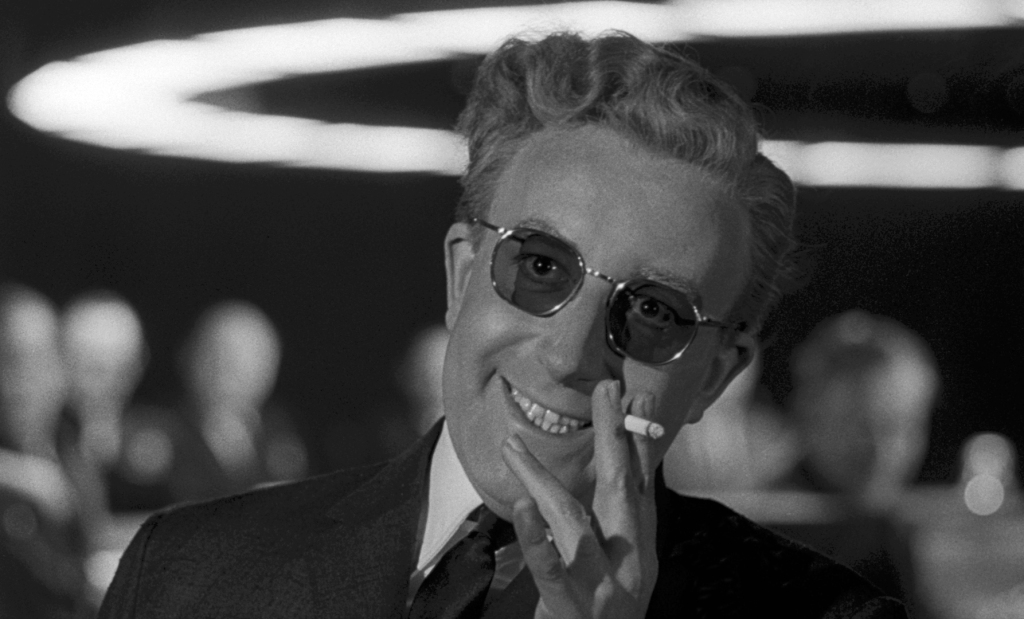
Peter O’Toole in Dr. Strangelove (1964), in a military conference discussing nuclear tactics. Image: https://s3.amazonaws.com/criterion-production/images/7303-6b96c31f78b7ab81c3bb7802e3655903/dr4_original.jpg

(Q.C., 230907)

Mas Que Nada, Travessia

Mas Que Nada (Jorge Ben Jor 1963) and Travessia (Milton Nascimento 1970).

Perhaps the most well known Brazilian export after fashion models is bossa nova. Sometimes called Braziian Jazz, bossa nova is a mix of samba rhythms and jazz harmonies. It covers many themes. Slower than samba and differing slightly in the rhythmic accent, bossa nova differs in not having a dance it can call its own.

Bossa nova burst into the international scene in 1959 with the film Orfeu Negro (Black Orpheus), which featured several songs that have since become jazz standards like Manha de Carnaval and A Felicidade. As more and more songs were covered by non-Brazilian artists like Stan Getz and US-based Brazilian musician Sergio Mendes, bossa nova became an international sensation, many of its songs entering into the roster of jazz standards. Garota de Ipanema or The Girl From Ipanema (Moraes and Jobim 1962) is reputedly the second most recorded song in history after Yesterday (Lennon and McCartney 1971).

Jorge Ben Jor. Image: https://i0.wp.com/www.djdmac.com/blog/wp-content/uploads/2018/05/06012018_jorgeben_cadeopenalty.jpg?w=1280

Mas Que Nada is very recognizable. More samba than bossa nova, it was first composed, performed and recorded by Jorge Ben Jor (1939 – ) in 1963. It became internationally famous with Sergio Mendez (1941 – ) and Brasil 66’s cover version that appeared on their debut album, Herb Alpert Presents Sergio Mendes & Brasil ’66 (1966). In the United States, the single reached number 47 on the US Billboard Hot 100, and number four on the Billboard Easy Listening chart. Outside Brazil, this 1966 version (in Portuguese) is better known than Jorge Ben’s original and, to many, the definitive version of the song.

Image: https://i.ytimg.com/vi/05w5ch9l6zI/maxresdefault.jpg

It was the first song in Portuguese to become an international hit. It was voted by the Brazilian edition of Rolling Stone as the 5th greatest Brazilian song, and was inducted into the Latin Grammy Hall of Fame in 2013.

The iconic performance of Brasil 66 has Lani Hall (1945 – ) and Bibi Vogel (1942-2004) lending their unique vocals; it can be viewed in https://www.youtube.com/watch?v=BrZBiqK0p9E.

Mas Que Nada means “Whatever!” The lyrics go:

“Mas que nada,
Sai da minha frente
Eu quero passar
Pois o samba está animado
O que eu quero é sambar.

Este samba
Que é misto de maracatu
É samba de preto velho,
Samba de preto tu.

Mas que nada,
Um samba como esse tão legal
Você não vai querer
Que eu chegue no final.”

[“Whatever
Get out of my way
I wanna pass
Because samba is really exciting
And I wanna dance samb]

This samba
That is mixxed with maracatu*
And old black samba
Black samba you

Whatever
A samba like this is so nice
You don’t me to get to the end.”]

The Jorge Ben version is in the key of Bb and that of Sergio Mendez in Ab. I play this in G and use a capo to get the voicing in the Brasil 66 version. Faster, rock versions include that of French group Nossa (2012), https://www.youtube.com/watch?v=DWh-gwLHtSI and Black Eyed Peas with Sergio Mendes, https://www.youtube.com/watch?v=PpIUQ5jwJqM. The latter is famous but I don’t like the rap.

I like Mas Que Nada as a warm-up song because it is easy to play. I played this last week before a small audience, then did Travessia.

Travessia (English version “Bridges”) was first composed, performed and recorded by Milton Nascimento (1942 – ) and Braziian poet Fernando Brant (1946-2015) in 1967, with English lyrics added by Canadian Gene Lees (1928-2010) in 1969. It was covered in 1978 by Sergio Mendes and Brasil 88. The 1978 version, in English, is the most well known outside of Brazil. It is not a direct translation of original Portuguese song.

Milton Nascimento. Image: https://cdn.brasildefato.com.br/media/992509b1ae06de3d2675b44462062428.jpg

The lyrics go

“Travessia”

Quando você foi embora
Fez-se noite em meu viver
Forte eu sou, mas não tem jeito
Hoje eu tenho que chorar

Minha casa não é minha
E nem é meu este lugar
Estou só e não resisto
Muito tenho pra falar

Solto a voz nas estradas
Já não quero parar
Meu caminho é de pedra
Como posso sonhar?

Sonho feito de brisa
Vento, vem terminar
Vou fechar o meu pranto
Vou querer me matar

Vou seguindo pela vida
Me esquecendo de você
Eu não quero mais a morte
Tenho muito o que viver

Vou querer amar de novo
E se não der, não vou sofrer
Já não sonho, hoje faço
Com meu braço o meu viver

Solto a voz nas estradas
Já não quero parar
Meu caminho é de pedra
Como posso sonhar?

Sonho feito de brisa
Vento, vem terminar
Vou fechar o meu pranto
Vou querer me matar

Vou seguindo pela vida
Me esquecendo de você
Eu não quero mais a morte
Tenho muito o que viver

Vou querer amar de novo
E se não der, não vou sofrer
Já não sonho, hoje faço
Com meu braço o meu viver

Marietta Waters, vocalist of Bridges, with Sergio Mendes. Image: https://i.ytimg.com/vi/0D1todk_c78/maxresdefault.jpg

“Bridges”

I have crossed a thousand bridges
In my search for something real
There were great suspension bridges
Made like spiderwebs of steel
There were tiny wooden trestles
And there were bridges made of stone
I have always been a stranger
And I’ve always been alone

There’s a bridge to tomorrow
There’s a bridge from the past
There’s a bridge made of sorrow
That I pray will not last
There’s a bridge made of coulors
In the sky high above
And I think that there must be
Bridges made out of love

I can see him in the distance
On the river’s other shore
An his hands reach out in longing
As my own have done before
And I call across to tell him
Where I believe the bridge must lie
And I’ll find it, yes I’ll find it!
If I search until I die

When the bridge is between us
We’ll have nothing to say
We will run through the sunlight
And he’ll meet me halfway
There’s a bridge made of coulors
In the sky high above
And I’m certain that somewhere
There’s a bridge made of love

Travessia is actually in a style called “Musica Brasileira Popular” or MPB. But it’s not difficult to make Brazilian popular songs sound bossa nova.

Travessia is in the key of A and Bridges in G. I play this in A on standard tuning; the sung notes I can’t reach. When we performed this last week a friend who is an excellent singer did the vocals. Perfectly rendered.

Trivia: Nascimento, who is almost 90, recently announced he was going to retire. Mendes at 83 is still active.

(Cebu, 230906)

Just think of the next step

Excited and enthused by life? You bet. Because the sun is out in Cebu. Soon the clouds will cover it and the rains will come, and it’ll be just like in torrential Manila.

Still excited? There’ll be accidents, people will get tired and will be betrayed. Windows will update when they shouldn’t. But those are givens! Between me and the Cebu IT Park is a landscape of buildings and strange streets. There’s gonna be a suspicious stray dog somewhere. But my immediate concern is finding a solid spot to land my next step, and the next, and until I reach the famous Good Cup coffee shop on Ramos street.

Image: https://sugbo.ph/wp-content/uploads/2023/01/1-Good-Cup-Coffee.jpg

Near my hotel is the Cebu I.T. Park. It’s like another universe. There’s even a portal. On a street there’s this iron bar that separates this first world business center from what some might call a slum. It’s like crossing a thermocline, except that it’s a freaking parallel universe. There are many of that in this country.

I used to live in this subdivision in Quezon City. Our street was wide, asphalted and lined on both sides by upper middle class houses. Running parallel to it and separated from our side by a wall as tall as a house was a much smaller street, barely the width of car, and lined on both sides by squatters. You could see none of that from our side. We had a church, they had a makeshift chapel. We had a proper basketball court, they had the street. They filled their street with all sorts of people, especially kids. We stayed indoors all the time.

In 2009 a typhoon struck Manila that caused the worst flooding seen in this city in years. A posh subdivision in Marikina went under water, many of its inhabitants — old people especially — drowned or succumbed to disease. Flooding also struck the poorer side of our subdivision as it was lower in elevation. The wall was breached and not by water. All across its length poor people climbed the roofs of their flimsy houses and crossed over, helped and sheltered by the richer ones on our side.

That was 14 years ago. Not one person at that time could have imagined he or she would be where he or she is right now. Not possible. You can’t foresee a life 14 years in the future! Ric or poor the real challenge is and always will be “Where’s a solid spot to land my next step?” At the end of a journey one looks back and makes up some fake story about how “destiny” played out in their life.

We speak of destiny as something that we were meant to do or was meant to happen to us. Is it my destiny to go to Good Cup? No. Right now it is my intention. When I DO get there, then I might say it was my destiny. When the US invaded Afghanistan some said it was the destiny of that powerful nation to do so. When the US retreated no one called it destiny anymore.

Humans can with certainly speak of “something we were meant to do or was meant to happen to us” only in the case of death (aside from the body functions, which by the way can be cut at any time by a coronary or a stray bullet). This doesn’t mean there is no such plan. God has “assigned” a purpose to every human being in this world, a part he or she has in the history of our race. But only God can speak of destiny in this sense because God alone has eternal hindsight. What? Yes, He has a complete view of history from past to future. History will unfold not because He scripted it. He knows what our choices will be. He knows most of us will f**k up, and many will never fulfill the roles He assigned them. Yet He gives each of us a purpose, and to that purpose he has assigned a reward. If I get to Good Cup, I enjoy the benefits of excellent coffee AND the benefit of getting what makes me happy. If instead I deviate, I get a different consequence, possibly one I will regret, possibly one that I might enjoy more.

Of course, my business here involves more than going to a coffee shop I did have the good “fortune” to discover. See? For me it was an illusion of fortune, but to my friends it was just part of the itinerary.

As for today, I’ll just leave most of it unplanned and see what unfolds if I just put one foot over the other.

It will be fun.

(Cebu, 230905)

And give silence a sound

I had found an excellent deal: airplane and hotel for 2 nights at P4,200.00. My friends said this was a really good one. Never mind if it’s Air Asia, never mind if you can’t pick the flight schedules, or that the late night flight was delayed twice. I arrived at the hotel at about 2 am. Good, Cebu Grab is efficient: got a ride immediately.

I didn’t expect much from the hotel. I picked one close to the city center. Within a 15-min walking distance from ALLSon’s Inn on Gen. Echavez are several malls, including the Ayala Center Cebu, the Archbishop’s palace, and some schools like the University of San Carlos. (That’s a mosque over there). I decided the room smelled like my dad’s pomade, but it was clean; the room. Only one channel was working on the TV, and I was far from the router. But reception and food were OK. The al fresco 6th floor dining area was a pleasant of surprise. Great for working. And for writing blogs.

A good place to disappear, all amenities intact. Let’s be clear: I love nature. But I also love human nature especially: love for work, for malls, and for sometimes resting in some place absolutely no one knows where you are. Then to meet up with some great friends to spend a day in conversation, coffee and lunch. We had cocktails at the new Lasa Resto in Busay, more coffee, ending with supper at the High Blood Station in Mabolo famous for its chicharon bulaklak and other dishes to pop your arteries. I ended the day with a movie on Youtube, Er Ist Wieder Da, “Look Who’s Back”, a 2015 comedy about Adolf Hitler waking up in 2014 to a Germany that quickly finds him hilarious and charming, while he makes some serious observations about modern society.

Oliver Masucci as Adolf Hitler. Image: https://m.media-amazon.com/images/M/MV5BMmZlZDRkZjEtMTMyMC00YmRmLTliYjEtZGIzYThhNDE5N2Q0XkEyXkFqcGdeQXVyNDE5MTU2MDE@.V1.jpg

I will be clear. Though I detest his politics and philosophy, I think Hitler was and remains the greatest orator of modern times. Through will power, cunning, and speech he turned Germany from a devastated loser of a first world war into the engine of a second. I have always wondered what the world would have been like if Hitler had retained his skills but dumped his beliefs. That’s hard: oratorical and political success is driven by belief. But it is also conditioned by circumstances.

I love the way Oliver Masucci portrayed Hitler. Hitler is quirky — he shoots a little dog dead — but he’s highly perceptive, convincing, and charming. Couldn’t have done what he actually did without skill and intelligence. If the premise had been true, Hitler would be the equivalent of a misunderstood but vital part of modern society: the truth teller, represented by the Court Jester.

Also known as fools or “mad men”, jesters were entertainers and comedic performers who played a distinctive role in the medieval courts of Europe. Their primary function was to amuse and entertain, but they often served additional roles and functions within the court.

Jesters were skilled entertainers who used humor, wit, and physical comedy to entertain the court. They would perform a variety of acts, including juggling, acrobatics, storytelling, singing, dancing, and playing musical instruments. They typically dressed in distinctive and colorful attire, often adorned with bells, baubles, and other attention-grabbing decorations. Their eccentric clothing and appearance were part of their performance, and they were easily recognizable by their outfits. Their performances were meant to provide amusement and diversion to the nobility, especially during banquets and gatherings.

They used humor and satire to comment on the social and political issues of their time. They could speak candidly about matters that others in the court might be afraid to address directly. Through humor and satire, they could provide veiled criticism or commentary on the actions and decisions of their rulers.

Paradoxically, court jesters were sometimes seen as sources of wisdom and insight. Their humorous and unconventional perspectives on life could serve as a foil to the seriousness of the court, offering a different way of viewing the world. Some rulers valued their jesters’ counsel precisely because it was unconventional and could offer unique insights.

Despite their often sharp wit and ability to critique, jesters enjoyed a special status in medieval courts. They were usually exempt from the rigid social norms and protocols that governed the behavior of other courtiers. This allowed them to speak more freely, though they still had to be cautious not to go too far in their jests.

The presence of jesters provided psychological relief to the nobility. Court life could be highly formal and stressful, with political intrigues and power struggles. Jesters offered a release valve for tension and stress through their humor and antics.

Harsh truths don’t need to be bitter. And mental health could use a court jester’s gifts. Truth and humor will set you free.

Here’s a trailer of one of my favorite movies of all time, The Court Jester (1955): https://www.youtube.com/watch?v=Pt37TRvU_Mw

LR Angela Lansbury (1925-2022), Danny Kaye (1911-1987), and Glynnis Johns (1923- ) in The Court Jester. Image: https://spaces.filmstories.co.uk/uploads/2021/01/Court-Jester-header.jpg

I could watch Look Who’s Back (and The Court Jester) over and over again if only to analyze HItler’s method. I look forward to an appropriate occasion to start a speech with 3 minutes of just gazing at the audience and letting them simmer in their unease. A clip of that: https://www.youtube.com/watch?v=Vupzqjo1QrA. The man doesn’t even shake the host’s hand.

“Witzigman doesn’t understand the power of silence; he feared it…I let the air flow into my lungs…and give the silence…a sound.”

“Adolf Hitler” (Oliver Masucci, in Look Who’s Back, 2015)

Silence, a potent force often overlooked. In a pause understanding is born, connections deepened. Silence carries the power to mend wounds, amplify emotions, and convey truths more profound than words can ever express. In solitude and amidst the noise of the world silence is a potent tool that speaks volumes without uttering a single sound.

(Cebu, 230906)

The feeling that one’s life is scripted

Image: https://i.pinimg.com/originals/d7/e8/c7/d7e8c7f153d02b89c695ab398864589b.jpg

A powerful concept I learned in In Transactional Analysis (TA), is that of “scripts”, which refers to the life plans individuals unconsciously develop in childhood, influenced by parental messages, experiences, and societal expectations. These scripts dictate how people live their lives, make decisions, and interact with others.

Here’s an example.

In Transactional Analysis (TA), scripts are unconscious life plans or patterns that individuals develop early in life, often influenced by their upbringing and experiences. These scripts can influence a person’s behavior and decision-making throughout their life. Here’s an example of a script in a dialogue form:

Scenario: Two colleagues, Alex and Bo, are discussing their career choices.

Alex: You know, Bo, I’ve always felt like I had to be perfect in everything I do. My parents had really high expectations, and I grew up thinking that I had to excel in everything to be loved and accepted.

Bo: I can relate to that, Alex. I’ve always had this feeling that I’m never good enough, no matter how hard I try. My family always emphasized that success was the only path to happiness.

In this dialogue, both Alex and Sam are revealing elements of their life scripts:

  1. Alex’s Script: Alex’s script suggests a “Perfectionist” or “I must excel to be loved” script. This script may lead to a pattern of overachievement, setting unrealistically high standards, and struggling with self-criticism and anxiety.
  2. Bo’s Script: Bo’s script appears to be a “Never good enough” or “I must prove myself to be worthy” script. This script often leads to a continuous pursuit of validation, self-doubt, and a sense of inadequacy despite external success.

Notice the conditional IF statements. They are of the form “If I do (good) I will not be (bad)”. Where did these statements come from?

From Alex and Bo. Most scripts are formed in childhood. They are decisions about a life plan made by that person and influenced by early life experiences and messages received from parents and significant others. Why is it useful to know this? Because identifying and understanding these scripts and their influences can help individuals recognize and challenge unhelpful patterns of behavior and beliefs. First of all, understanding scripts helps us realize that we can always go against our upbringing and “traditions” if they were no longer relevant to the present circumstances.

There are several fundamental drivers that cause individuals to live according to their scripts instead of pursuing a more autonomous mode of being:

Parental imprints. Children internalize messages from their caregivers, especially during their formative years. These messages become part of their scripts. Even if these messages are limiting or negative, individuals might unconsciously seek to prove or live up to these early imprints, perpetuating patterns that align with their parents’ expectations.

5 commands commonly received explicitly or inferred by children from their parents:

be perfect.

be strong.

try hard.

please others.

hurry up.

Comfort zone and familiarity. Scripts, despite their limitations, offer a sense of familiarity and security. People are naturally drawn to what they know, even if it’s not serving them well. Stepping out of the script requires facing the discomfort of the unknown, which can be daunting.

Fear of rejection or abandonment.
Many scripts are rooted in the fear of rejection or abandonment. People may conform to their scripts to gain approval, avoid conflict, or maintain relationships, even if it means sacrificing their authentic desires. The conditional IF statements above refer to actions that people decided they would take, based on explicit or inferred parental messages, that will counteract the negative messages they also received, such as:

don’t exist, “We hoped you were born male,” “I could’ve had a career if you were not born.”

don’t be yourself, “Couldn’t you be just like your older brother?”

don’t be a child, “Don’t cry!”

don’t be important, “Just do what we tell you.”

don’t think, “Don’t answer back!”

and others.

Cognitive dissonance. People often rationalize their actions to align with their scripts. This leads to cognitive dissonance, where individuals ignore or downplay information that contradicts their existing beliefs. Accepting a more autonomous mode of being might require confronting these inconsistencies.

Identity and self-concept. Scripts become intertwined with one’s identity and self-concept. Even if a script is causing distress, individuals may hesitate to change because it challenges how they view themselves.

Reinforcement and validation. People seek validation from others. When actions align with their scripts, they might receive validation from those who share similar beliefs or expectations. This reinforcement can perpetuate the script-driven behavior.

Social and cultural conditioning. Societal norms and cultural expectations play a significant role in shaping scripts. Individuals might resist pursuing autonomy if it goes against these external influences.

An understanding of scripts encourages individuals to become more aware of their limiting beliefs and to make conscious choices rather than to automatically follow them. Pursuing a more autonomous mode of being involves challenging and revising these scripts through self-awareness, self-acceptance, and intentional decision-making. It requires recognizing that living within a script can limit growth, happiness, and authenticity. With the support of therapy, self-reflection, and supportive relationships, individuals can work towards aligning their actions with their genuine desires, values, and aspirations.

(Cebu, 230905)

Is low self-esteem dangerous?

Is our society largely driven by people’s futile attempts to gain a sense of worth from other people?

“Insecurity breeds treachery: if you’re kind to people who hate themselves, they’ll love you, but they’ll betray you, too.” – Eleanor Roosevelt

Eleanor Roosevelt (1884-1962)

The idea that many of the problems in the world are driven by people with low self-esteem is a concept that has been discussed and proposed by various psychologists and authors over the years.

The concept suggests that individuals with low self-esteem may engage in various problematic behaviors or attitudes as a way to compensate for their feelings of inadequacy. These behaviors can range from seeking power and control over others to engaging in aggressive or harmful actions to boost their self-esteem. However, it’s important to note that this is a simplified perspective, and the relationship between self-esteem and behavior is complex and multifaceted.

Psychologists like Nathaniel Branden (1930-2014) and Albert Ellis (1913-2007) have written extensively about the role of self-esteem in human behavior and well-being, and they have discussed how low self-esteem can contribute to various personal and societal problems. Additionally, self-help authors and motivational speakers often address this idea as part of their work on personal development and self-improvement.

There is ongoing debate within the field of psychology about the precise nature and influence of self-esteem on behavior and societal issues. It may be easier to see how this plays out in individuals.

Adolf Hitler (1885-1949) is a case in point.

Hitler’s meteoric and ultimately tragic rise to power and leadership of Nazi Germany in the first half of the 20th century is a complex historical event influenced by a myriad of factors. Did he have low self esteem?

There is no definitive evidence to conclusively prove it. Some historians and scholars who have analyzed his behavior and background suggest that he may have exhibited signs of insecurity. Here are some points that have been raised in discussions about Hitler’s self-esteem:

  1. Early life and rejection: Hitler faced several significant rejections and failures in his early life. He twice failed to gain admission to the Academy of Fine Arts Vienna, which was a source of frustration and disappointment for him. These early setbacks could have contributed to feelings of inadequacy.
  2. Ruthlessness and need for control: Some argue that Hitler’s extreme ruthlessness, desire for control, and obsession with power could be indicative of compensatory behavior rooted in insecurity. The need to exert dominance and control over others can sometimes stem from underlying feelings of vulnerability.
  3. Narcissistic traits: Some psychologists have suggested that Hitler exhibited traits associated with narcissistic personality disorder. Narcissism often involves a fragile self-esteem masked by grandiosity and a need for admiration.
  4. Fear of betrayal: Hitler’s regime was characterized by extreme paranoia, with frequent purges and executions of those he perceived as disloyal. This fear of betrayal and the need to eliminate potential rivals may be seen as signs of insecurity.
  5. Body language and expressions: Analyzing historical footage and photographs, some experts have attempted to discern signs of low self-esteem in Hitler’s body language, facial expressions, and posture. However, such analyses are subjective and speculative.
  6. Psychohistorical interpretations: Psychohistorians, a controversial field within history and psychology, have attempted to analyze Hitler’s behavior through a psychological lens. These interpretations often rely on conjecture.

Making psychological diagnoses posthumously is challenging and speculative. Hitler’s life and actions are better understood through the extensive historical record of his speeches, writings, and the actions of the Nazi regime. The question of his psychology remains a subject of debate and speculation rather than a matter of established fact.

But did his hatred of the Jews reveal his own insecurity? Feelings of hatred or hostility towards large groups of people can be rooted in various factors and motivations. However, while low self-esteem can sometimes contribute to negative attitudes or prejudices, it’s not the sole determinant.

Thus, whether Hitler had low self-esteem or not, his path to leadership was not solely determined by his personal psychology. Here are some key factors that contributed to Hitler’s rise:

  1. Political Climate: Germany was in a state of political turmoil in the aftermath of World War I. The Treaty of Versailles imposed heavy economic and territorial burdens on the country, leading to widespread discontent and a longing for a strong leader who could restore national pride.
  2. Economic Crisis: The Great Depression of the 1930s hit Germany hard, resulting in mass unemployment and economic suffering. People were desperate for solutions, and this desperation fueled support for extremist parties like the Nazis. Critical to his success was the support of the Army and of powerful industrialists.
  3. Political Skill: Hitler was a skilled orator and propagandist. His ability to rally crowds and communicate effectively helped him gain a following. He knew how to tap into the fears and desires of the German people, promising to restore their nation’s greatness.
  4. Use of Propaganda: The Nazi Party employed extensive propaganda campaigns that included the use of newspapers, radio, and mass rallies. This propaganda effectively spread their ideologies and swayed public opinion.
  5. Weak Opposition: The political opposition in Germany was fragmented and often failed to unite against the Nazi Party. This disarray allowed Hitler to come to power through legal means.
  6. Manipulation of Legal System: Once in power, Hitler and the Nazi Party exploited the legal and political systems to consolidate their control. The Reichstag Fire in 1933, for example, was used as a pretext to pass the Reichstag Fire Decree, which allowed the Nazis to arrest political opponents and curtail civil liberties.
  7. Repression and Fear: Hitler’s regime used intimidation, violence, and persecution to suppress dissent and opposition. Many Germans were afraid to speak out against the regime for fear of retribution.
  8. Nationalism and Racial Ideology: Hitler’s extreme nationalist and racist ideology resonated with some segments of the population. He promoted the idea of a racially pure Aryan state and blamed various groups, such as Jews and Communists, for Germany’s problems.

Thus, while Hitler’s personal psychology may have played a role in his leadership style, the broader context of historical, economic, and political factors was instrumental in his rise to power. His ability to exploit these circumstances and the weaknesses of the Weimar Republic allowed him to become the dictator of Nazi Germany.

Nonetheless, low self-esteem, though often seen as a negative trait, however, might drive success in some individuals. Here’s how insecurity can potentially fuel success:

  1. Desire for Improvement: Insecure individuals may have a strong desire to prove themselves and overcome their self-perceived limitations. This drive to improve and excel can push them to work harder and strive for success in their chosen fields. On the other hand, if their low self esteem extends to others — “I’m surrounded by idiots” said Scar in the Lion King –, it can cause them to abuse other people or resort to dishonest means to get ahead. Sociopaths are like this.
  2. Fear of Failure: Fear of failure can be a powerful motivator. Insecure individuals may fear the consequences of not succeeding, and this fear can push them to put in extra effort, be more cautious, and pay attention to detail in their endeavors. It can also cause them to break down if they failed.
  3. Competitiveness: Insecurity can fuel a competitive spirit. Some insecure individuals might constantly compare themselves to others and feel the need to outperform their peers. This competitive drive can lead to higher levels of achievement. It can also lead to unethical behavior, such as the numerous data fabrication allegations that are now plaguing some well-published scientists in the US.
  4. Constant Self-Reflection: Insecure individuals may engage in continuous self-reflection and self-evaluation. While this can be mentally taxing, it can also lead to a deeper understanding of one’s strengths and weaknesses, ultimately helping in personal and professional development. It can also lead to a rupture with reality if one focuses only on a few traits one has, and usually the negative ones.
  5. Resilience: Insecure individuals may develop a high degree of resilience because they are accustomed to facing self-doubt and criticism. This resilience can be a valuable asset in handling setbacks and persevering through challenges.
  6. Seeking Validation: Some insecure individuals may seek external validation to compensate for their internal doubts. While this isn’t necessarily healthy, it can lead them to achieve recognition and success in their pursuits as they strive for external affirmation. But if one only felt good when others paid attention or said nice things and then felt bad otherwise, then what would it feel like when one was not longer doing the things people pay attention to?
  7. Overcoming Adversity: Insecure individuals may have a history of facing adversity or obstacles. This can build character and provide them with the determination to succeed against the odds. It may be, however, that some whom we admire for their calm and relentless lock themselves in their rooms at the end of the day feeling numb.

It may be the case that much progress has been driven by fear and insecurity, also by courage and perseverance. In any case, by ordinary people doing extraordinary things.

Image: https://blogs.glowscotland.org.uk/glowblogs/public/kaylansjourneythroughuni/uploads/sites/3016/2015/11/self-esteem-1.jpg

I think that everyone has at least one corner of the soul where he or she is not the confident Master, but the scared Child. Perhaps the successful people we know have learned either to silence that Child or have penetrated into its fears to convert them into creative possibilities.

“Great is the human who has not lost his childlike heart”.

Mencius (372-289 B.C.)

It’s too much to ask that everyone feel good about themselves at all times. Even those who have achieved something in life and felt they could just sit back may find themselves living a renewed life by going back to their inner Child.

(Cebu, 230904)

Mini scripts

I found the four life positions as too static initially. The miniscript model put in a little perspective. To recall, a person’s life has a theme, which then plays out with sub plots, games, rackets. And the mini-script.

What is a mini-script?

In the context of Transactional Analysis (TA), a mini-script refers to a specific recurring pattern of behavior or interaction that an individual engages in. It’s a smaller, more focused version of the broader life script that encompasses a person’s overall life patterns and decisions.

Mini-scripts can be thought of as repetitive scripts that individuals enact in their daily lives, often in response to specific triggers or situations. These mini-scripts are shaped by a person’s deeper beliefs and early life experiences, much like the larger life script. However, they are narrower in scope and may apply to particular situations, relationships, or contexts.

For example, someone may have a mini-script that involves withdrawing and becoming passive-aggressive whenever their partner criticizes them. This mini-script might stem from childhood experiences or early relationships where they learned to respond this way to criticism.

Understanding these mini-scripts is important because it allows individuals to become aware of their recurring patterns and make conscious choices to change them if they are no longer serving their well-being. By recognizing and modifying these mini-scripts, individuals can improve their communication, relationships, and overall life satisfaction.

What insight did I get out of this? Most people go through life with the position “I am Not OK, You’re OK“. To feel OK, most will adopt a conditional OK, e.g., “I am OK if I work hard, hurry up, please people, am strong, or am perfect.” Each one of those conditionals is called a driver. They act as counter-injunctions to injunctions that we internalized from seeing and hearing our parents when we were little children. Some of these injunctions include:

  1. Don’t exist. “These kids drive me crazy.”
  2. Don’t be yourself. Your parents preferred a boy rather than a girl, or vice versa.
  3. Don’t be a child. Be a big brother and take care of your younger siblings.
  4. Don’t grow up. This is sometimes manifested as the Peter Pan Syndrome: permanent immaturity.
  5. Don’t be close. “You’re too old for that now.”
  6. Don’t belong. “Stay away from your poor classmates.”
  7. Don’t be important. “Don’t stand out.”
  8. Don’t be healthy. Some children only received attention when they were sick.
  9. Don’t succeed. “There’s no point in trying; the system’s rigged.”
  10. Don’t think. “Just do as I say.”
  11. Don’t feel. “Boys don’t cry.”
  12. Don’t have needs. “Your younger siblings first.”

We take that first driver, say “I am OK if I work hard“, and reword it as “If I work hard then I can be myself” to better show the pairing between injunction (all different ways of saying “You’re not OK“) and the counter-injunction.

The problem with a conditional OK, however, is that, well, I will not always be able to work hard. Or having worked hard I will not always win. With no counter-injunction I go back to feeling that I have no right to be myself; this part of the mini-script is called the dropper. My confidence evaporates with my self esteem.

Conditional OK ness is itself a script, a life them. This is one way people set themselves up for failure. Not only might our friend go back to feeling that he has no right to be himself, he might then shift to blaming other people (I’m actually OK, but everyone else is mean!), and then later end up in despair (Everyone is a loser!). Thus a mini-script plays out in this typical fashion: driver –> dropper –> blame –> despair. Each of these acts in the mini-script comes with typical racket feelings, or fake feelings, the ones we show if we are not allowed to express the genuine feelings.

Image: https://2.bp.blogspot.com/-oxfcX5KpYAY/WshslQgz7ZI/AAAAAAAAORs/t2eL_U_rg0wLhwizzzmriDgkrIe4s1mygCLcBGAs/s1600/Miniscript%2BPositions.png

The solution out of this unstable life position is to feel oneself unconditionally OK. Coming from a position of Not OK, such a shift in the life position is called a redecision: I do NOT need to be in control to feel I am OK. I do NOT need to be the best, to be applauded, to get published, to get all of those kicks.

Where does that unconditional OK ness come from? The fact that I am alive proves that I can solve problems in the here and now. Whatever failures I might have felt I committed, or whatever weaknesses and losses of strength that I now experience, I am here right now solving my f*****g problems the best way I know how!

It would be tempting to recommend people to get rid of their drivers and just be unconditionally OK. Apparently this is not as easy as it sounds. Drivers keep people afloat. If they are carelessly removed without building a support in good habits, the injunctions could step in and drown the person, sometimes with fatal consequences.

(Tagaytay, 230903)

Transactional Analysis: When does “I’m OK, You’re OK” begin?

I started writing about Transactional Analysis (TA) last August 11, 2023 (https://wordpress.com/post/jaylazzo.home.blog/2983). In a general sense, I find this approach to be a fairly consistent model with applications in improving mental health, communications, and relationships. In that blog, I specifically used TA to explain the tendency of people to wear masks.

This next series of blogs will focus more on my reflections about Transactional Analysis itself. These will not so much be about the approach — a Google search will easily bring out many sites that are dedicated to explaining the science — but rather about my personal experiences and reflections.

In this blog I try to answer the question: In real terms, is it possible for an individual to conclude I+U+ by the end of their childhood.

The answer introduces the central concept of OKness.

What does it mean in Transactional Analysis for a person to conclude “I’m OK, You’re OK“?

First of all, OKness, the state of being OK, doesn’t mean feelings. Nor is it simple self-esteem. OKness is an “existential” judgment about one’s worth. Am I worthy as a person? That’s pretty loaded stuff, hard to define. It suffices at this point to say that if you’re OK, you have high self-esteem. This is not the same as self-confidence, which is worthiness on the basis of some status, knowledge, special skill, academic degree. Self esteem is simply the sense that one is worthy to even be, unconditionally.

Before the age of reason a child only feels in response to actual stimuli. And most of what it feels gives it a SENSE of itself as not being OK. The child is small, defenseless, doesn’t know how to operate the electric fan, doesn’t know when to share or not to share, etc. It takes an adult, an all-knowing, all-powerful, 6-foot tall adult to put things in order. That adult is OK; the child is the very opposite of that. And the child feels it. I said “feels”, because the child is unable to articulate or explain its NotOKness outside of crying or whimpering.

Image: https://2.bp.blogspot.com/-DrEOF5a3Pps/WOfgchE4aCI/AAAAAAAADag/VUohfglfvH4yVLAWyprTdSZD2DTIO39jgCLcB/s1600/age%2Bof%2Breason.jpg

Then comes the age of reason. The “age of reason” is considered to be around the age of 7, maybe less. Prior to this age, a child is a “feeling” creature. The most advanced thinking skill it has is intuition, a kind of felt thought.

These feelings are responses to how the child is treated. The child doesn’t explain why it feels terrible about itself when it is violently abused by its parents, nor good about itself when it is showered with love. It’s sense of OKness depends on strokes.

All humans have a need for recognition, called strokes in TA. Children, particularly so. In fact, if an infant doesn’t receive enough physical contact in its first few hours or days it will die. Based on the strokes it receives, the child makes a judgment that grown ups are OK. Also, the child concludes that it is OK “IF”. IF I eat my cereals, mommy gives me a kiss and I feel good; otherwise she gets angry and I feel bad. It’s OKness is conditional.

This conditional feeling of worth may be based on positive strokes, but it is still conditional. An adult who retains a conditional OKness depends on what people say or do to him in order to feel good about himself. A child is like this by nature.

When the child reaches the age of reason, it may realize that it has worth regardless of how others treat it. The child makes an abstraction; that is what makes it a creature of reason. Mom is not here right now, but I KNOW she loves me. Another way of saying it is that the child’s OKness is no longer conditional on some actual condition. Detached from specifics, the child truly senses it is OK, unconditionally. It is an existential conclusion. That is, for a child that grows up without abuse and with the right stroking.

And what it has is a sense of OKness that, like the conditional one, can improve, become more rich, more stable. Its interactions with adults and other kids expose the child to information in the form of words, behaviors, and its own thoughts. Not only does mom NOT have to be present for me to feel good. I don’t need money, fame, good looks, millions of friends, to feel good. The child also makes moral conclusions, that lying is essentially wrong even when I don’t need to refer to a specific case of lying.

But things don’t always work this way.

Some children who have been deprived of strokes before the age of reason “feel” they are not OK and continue to feel this way, even think that way until adulthood, even for the rest of their life. The child may continue to see the grown ups and everyone else as OK or Not OK, particularly if the child has experienced only neglect and the bad feelings that went with it. Many mental health problems such as depression, psychosis, suicidal tendencies, actual suicides, and many others may have their roots in adults who continue to see themselves as NotOK.

Criminality may also arise in this manner. Some children, especially those who have been victims of the most violent abuse, will carry with them the experience of healing their wounds by themselves, and exit the childhood phase convinced that they can stand on their own while everyone is evil. The child has concluded, “I’m OK, You’re Not OK.” I’m right, you’re wrong. I’m human, you’re subhuman. The manifestation in an adult includes antisocial behavior, the extreme of which is murder and genocide.

Hence, although a precocious child might start to reason at a very early age, it doesn’t seem possible prior to the age of reason to conclude that it is OK (in the unconditional sense) and others are OK.

(Q.C. 230830)

The Laws of Human nature: Putting things in the perspective of Virtue

Below we list the “point” of each of the Laws of Human Nature as described by Robert Greene in The Laws of Human Nature, and a representative virtue.

Master your emotional self: The law of irrationality. The virtue of reasonableness.
Transform self-love into empathy: The law of narcissism. The virtue of self-love.
See through people’s masks: The law of role-playing. The virtue of empathy.
Determine the strength of people’s character: The law of compulsive behavior. The virtue of temperance.
Become an elusive object of desire, but beware the fragile ego: The law of covetousness. The virtue of generosity.
Elevate your perspective: The law of shortsightedness. The virtue of prudence.
Soften people’s resistance by confirming their self-opinion: The law of defensiveness. The virtue of justice.
Change your circumstances by changing your attitude: The law of self-sabotage. The virtue of diligence.
Confront your dark side: The law of repression. The virtue of meekness.
Know your limits: The law of grandiosity. The virtue of humility.
Reconnect to the masculine or feminine within you: The law of gender rigidity. The virtue of flexibility.
Advance with a sense of purpose: The law of aimlessness. The virtue of having goals.
Resist the downward pull of the group: The law of conformity. The virtue of originality.
Make them want to follow you: The law of fickleness. The virtue of steadfastness.
See the hostility behind the friendly façade: The law of aggression. The virtue of fortitude.
Seize the historical moment: The law of generational myopia. The virtue of science.
Mediate on our common morality: The law of death denial. The virtue of joy.

These are not “laws” in the same manner that we apply the term to the laws of nature. With a law of nature such as gravity, we are saying that if you do this, you will inevitably get that: if you release an object, it falls to the ground. The Laws of Human Nature are not like that.

For one, these laws don’t apply to everyone in the same way. For example, the way the law of death denial affects a person depends on his cultural and religious. In general, Christians and samurai have a “friendlier” view of death than most other people, allowing for numerous exceptions even among the most fervent. Sensitivity to a law will also depend on circumstances, moods, personal state of health and many other factors.

Second, even a person who is by nature and experience deeply affected by a law, that person still has the choice how to respond. Thus, in the face of peer pressure and the law of conformity one can ALWAYS choose NOT to conform. It will be difficult where behavior according to the law is habitual, but behavior can always change.

And third, there is an optimal response to every law under every circumstance. Thus, it is ALWAYS desirable to be long sighted rather than short-sighted, to be independent rather than conformist, and to not fear death rather than to fear it. But when we say optimal we do not point to any extreme attitude. We go back to the Golden Mean: there must be an attitude between two extremes that is “best”. That point between two extremes might change according to the circumstances, but it is clear that neither extreme is desirable.

Image: https://www.fajarmag.com/wp-content/uploads/2020/04/VIRTUESwordpictures.jpg

Navigating the Golden Mean is essentially a question of virtue, and so every Law of Human Nature points to a virtue, i.e., a habitual behavior, generally a response to some stimulus. A behavior that is performed by habit is easy and often pleasurable, and if it is a good habit, will more likely bring happiness than otherwise. Therefore, according to Aristotle, it ought to be the aim of every human to seek virtue, to seek to acquire positive habits.

That, in the end, is what the Laws of Human Nature are about. They are, indeed, about getting ahead in life.

By which we mean, happy in life.

(Q.C. 230829)