The Law of Irrationality

Robert Greene‘s The Laws of Human Nature delves into human behavior and the underlying motivations and drives that influence it. Understanding these laws can help people navigate interpersonal situations.

The Law of Irrationality as described by Greene refers to the idea that humans often act based on emotions, biases, and other factors that aren’t necessarily logical or rational.

We illustrate this law with three examples.

First, financial bubbles. There have been numerous financial bubbles throughout history driven by irrational exuberance, where the value of an asset or market sector rises way beyond its intrinsic value. The Dot-Com Bubble of the late 1990s is a prime example. In 1990 Investors poured money into internet-based startups expecting these companies would be very profitable. Stock prices soared, despite many of these companies having no clear business model or even any revenue. The behavior of investors during this period was strongly influenced by herd mentality, over-optimism, and fear of missing out. The bubble burst in the early 2000s, leading to significant financial losses.

I clearly remember a friend of mine saying in 2000 that the many Dot-Coms then proliferating like fungi on damp dung will undergo a period of consolidation leading to a few strong ones; he named Amazon as one. No one realized that the consolidation came with a crash.

Second, the placebo effect. In medical trials, patients sometimes show improvement or even full recovery when given a placebo (a treatment with no therapeutic effect) simply because they believe they’re receiving an actual treatment. This belief can lead to real physiological changes in the body. The placebo effect shows how belief and expectation, rather than logical reasoning, can influence outcomes. It’s not rational for a sugar pill to cure a disease, but the mind’s power can lead to perceived or actual improvements in health.

The popularity of certain drugs like ivermectin during the COVID pandemic of 2020-22 was fueled by numerous stories of people being “cured” of this drug. The stories were fueled by a curious mix of hope and desperation. As more data came in, it became clear that ivermectin had no appreciable effect on COVID symptoms. The large number of “positive” anecdotes stem from the fact that most people who were infected experienced relatively mild to zero symptoms, and that more than 97% survived at worst. This is not an example of the placebo effect, but a market driven by hopeful but wrong interpretation of data.

Second, behavior in crowds. Events like the Tulip Mania in the 17th century Netherlands showcase irrational behavior on a large scale. At the height of this craze, prices for tulip bulbs reached extraordinarily high levels, and a single bulb could sell for more than ten times the annual income of a skilled craftsman. Eventually, the market crashed, leaving many in financial ruin. The collective behavior during the Tulip Mania wasn’t based on the intrinsic value of tulips but rather on speculative greed and the fear of missing out.

The collapse of the housing market in 2008 happened in a similar way.

Here’s another interesting story about fads.

Once upon a time, in the groovy and psychedelic era of the 1970s, amidst bell-bottoms, disco balls, and the sweet tunes of ABBA, there emerged a pet unlike any other. A pet that wouldn’t bark, bite, or even breathe – the legendary Pet Rock!

Gary Dahl and his Pet Rocks (1975). Each Pet Rock, sourced from a beach in Mexico, sold for $4. In the course of 6 months, Dahl made over $1.5M from his “invention”. Dahl, who died in 2015 at the age of 78, was also the author of Advertising for Dummies, first published in 2001. Image: https://static01.nyt.com/images/2015/04/01/us/01dahl-1-obit/01dahl-1-obit-superJumbo-v2.jpg

In a bar in California, Gary Dahl, an advertising executive, listened to his friends complain about their pets – the mess, the expenses, the time. Inspired by this symphony of whines and a good dose of liquid creativity, Gary thought, “Why not have a pet that demands nothing?” What started as a joke became one of the most successful marketing stories of all time.

Housed in a cozy box, complete with straw (a rock’s preferred bedding, obviously) and a tongue-in-cheek instruction manual, the Pet Rock became an overnight sensation. People just couldn’t resist! It was the ideal pet. No feeding, no walking, no vet bills. Plus, it was the only pet that would (quite literally) never roll over.

Parents adored it (no mess!). Kids loved it (a rock to call their own!). And introverts? They finally had the perfect companion, quiet and unjudgmental. Pet Rocks were the ultimate low-maintenance companion, and they promised to “stay” and “sit” better than any dog.

Everywhere you looked, people were proudly showing off their “pets,” naming them, and some even painting and accessorizing them. Rock puns were all the rage: “You rock!”, “Rock on!”, and “This pet rocks!” echoed everywhere.

But as with most fads, the world eventually took this pet for granite. The initial boulder of excitement began to erode, and the pet sensation soon found itself between a rock and a hard place.

Yet, while their time in the limelight was brief, Pet Rocks left an indelible mark (but not on your carpet!) in the annals of pop culture. Today, they stand as a testament to the quirky, whimsical, and sometimes outright bizarre trends of yesteryears.

All of these examples underscore the fact that humans, individually and collectively, often act based on emotions, biases, or perceptions rather than pure rationality.

Here are some ways to manage and navigate the Law of Irrationality.

Be self-aware. Recognize that you, like all humans, are prone to irrationality. Accept that you have biases and emotional triggers; this is the first and most important step.

Pause before reacting. When faced with decisions, especially emotional ones, take a step back. Allow yourself time to cool off to ensure your decisions aren’t just impulsive reactions.

Reconnect with the rational self. practice activities that center and ground you, such as meditation, journaling, or simply taking walks in nature.

Seek feedback. Others can often see what you can’t. Trusted friends, mentors, or colleagues can offer valuable insights into your blind spots and alert you to when you’re behaving irrationally.

Expose yourself to different perspectives. Broaden your horizons by reading widely, talking to diverse groups of people, and exposing yourself to different ways of thinking. This can help reduce the strength of your biases.

Be aware of your emotional triggers. Understand what makes you tick, what angers you, or what makes you anxious. Identifying them when they happen is the first stem to controlling them.

Reframe the narrative. Learn to see things from a different light. For instance, if someone upsets you, instead of instantly reacting, try to understand where they might be coming from or consider the external pressures they might be under.

Limit exposure to emotional contagion. We tend to absorb the emotions of those around us. If you’re constantly surrounded by negativity or drama, it’ll be harder to stay rational. Seek environments that promote calmness and clarity.

Always be learning. The more you know about a subject, the more likely you are to make rational decisions concerning it. If you’re entering unfamiliar territory, take time to educate yourself.

Practice gratitude and perspective. Keep a gratitude journal or just take moments to appreciate what you have.

See what everyone is thinking, and think the opposite.

Next up: The Law of Narcissism.

(Q.C. 230809)

Two beautiful films from Japan: Suzume, and The Last Recipe

These two films are worth entering into the Japanese canon: Suzume (2022) and The Last Recipe (2017).

Suzume (Suzume no Tojimari) is a 2022 Japanese animated coming-of-age fantasy adventure film written and directed by Makoto Shinkai. The film follows 17-year-old high school girl who teams up with a young stranger to prevent a series of disasters across Japan by sealing doors from the colossal, supernatural worm that causes earthquakes after being released.

Image: https://www.spieltimes.com/wp-content/uploads/2023/02/Suzume-Claims-Spot-in-list-of-Highest-Grossing-Films-in-Japan-Philippines-India-Singapore-and-Malaysia-is-next-1.jpg

Suzume, a girl from Kyushu, meets a young man, Souta Munakata, who is searching for special doors that lead to an otherworldly realm. After an incident at an abandoned resort, Suzume learns that Souta is a “Closer” who locks these doors to prevent a supernatural “worm” from causing earthquakes. During their journey to secure these doors, Souta becomes trapped in the Ever-After, a place where souls reside after death, due to the actions of a “keystone” cat named Daijin, whose job it is to guard the doors.

In her quest to rescue Souta, Suzume discovers she has a connection to the Ever-After because of a traumatic event during her childhood in the Tōhoku region. With the help of various allies, including her aunt Tamaki and Souta’s friend Serizawa, Suzume finds the door she needs to enter the Ever-After in the ruins of her childhood home. Inside, they manage to save Souta, but at the cost of Daijin’s sacrifice.

In a twist, Suzume meets her younger self and provides comfort, altering her past and giving her strength to face her future. The story concludes with Suzume and Souta reuniting in Kyushu, hinting at new beginnings.

What I think the story is about. Suzume represents a reversal of the traditional Japanese hero-cult, where the hero is a kamikaze who is either killed or kills himself. In this movie, Souta unwillingly takes on the role of the “killed” hero and acquires glory as an immobile but basically dead guardian of the Ever-After. But Suzume “rescues” him from that role, which is taken over by Daijin whose job it was in the first place to be guardian. Daijin temporarily left his job to enjoy life. But after a short vacation that put various cities at serious risk of earthquakes, he takes on his job again. Heroism, therefore, is not about killing or getting killed, but doing one’s job faithfully. Although temporary breaks are not bad.

The Last Recipe” (Kirin no Shita no Kioku) is a 2017 Japanese live action film film directed by Yojiro Takita. It’s based on the novel “Kirin no Shita wo Motsu Otoko” by Keiichi Tanaka.

Image: https://d1nslcd7m2225b.cloudfront.net/Pictures/1024×536/3/8/8/1274388_lastrecipe_218224.jpg

The story revolves around Mitsuru Sasaki, a talented chef who possesses an exceptional talent: the ability to remember every taste he has ever experienced. However, his own restaurant goes bankrupt because he pays too much attention to the taste rather than the profitability of his dishes. To earn a living after the bankruptcy, he starts to recreate dishes from restaurants, old recipes, and even personal memories if given the ingredients and basic information about the dish.

However, his unique talent comes at a cost. Every time he uses his memory to recreate these tastes, he loses a piece of his own passion.

Sasaki is then approached with a unique request. A wealthy client wants him to recreate a royal feast dating back to the 1930s Imperial Japan, which was made by the legendary chef Naotaro Yamagata in Manchuria. As Sasaki delves deep into the mystery of Yamagata and the royal feast, he embarks on a journey that takes him through the tumultuous history of Japan and the intricacies of Japanese cuisine. The culinary journey, perseverance, experience of loss, and the healing power of food reignite his passion.

What I think the story is about. The Last Recipe is built around a progression: from craft, to art, to sacrament. Mitsuru is an expert craftsman with talent and technique to prove it. He is famous for his creativity. But his obsession for perfection and inability to be pleased by anything less alienated his closest friends (save for one) and sapped his soul. His journey involved his reliving in his mind the creation of the mystery dishes as if he were making them himself. He gradually learns that the recipes were more than a technique: they incarnated the experiences, the feelings, and the relationships joyful and tragic, of all those who were involved. At this point art became sacrament, and he found his soul.

Suzume” and “The Last Recipe” are masterworks of visual storytelling. Suzume’s animation represents the best of what animators can do. The Last Recipe is a visually stunning film with its detailed culinary creations. I know food shots are extremely difficult to do well.

Both films are heartwarming stories that transcend time and borders.

(Q.C. 230807)

Is it ethical to call someone out on Viber?

Some time ago, a friend sought advice from me regarding a Viber exchange. The facts:

Person A learned that the head of a religious organization to which he belonged took a private plane courtesy of a member of the organization who offered it voluntarily. He then posted details of the plane and the flight on a Viber group chat consisting of some 12 members of that organization including himself. Person B, a member, responded that it was not appropriate to post such details on the group chat because, among other things, the information could be misinterpreted if it got out. Person C, another member, commented that calling out the first poster was better not done in public as it humiliated Person A. Person D, the ethics consultant, that’s me, is writing this post about the matter on WordPress.

What are the ethics here? The ethical considerations of calling someone out publicly over a Viber post, or any other form of online communication, can be complex. They generally involve balancing respect for personal dignity and privacy, against the need for accountability, particularly when harmful behavior is involved.

Some ethical considerations: Privacy, accuracy, intent, proportionality, and potential harm.

Is a Viber group private? That is, is sharing private information within a private group a publication and therefore a violation of privacy?

The National Privacy Commission of the Philippines advised that

“[P]osting or sharing a screenshot of a private conversation involving personal information without the consent of the parties involved may be punishable under the Data Privacy Act of 2012. … The disclosure of a private conversation involving personal data without the consent of the parties involved, or without some other lawful basis for the processing of personal data under the Data Privacy Act, may be construed as unauthorized processing.”

National Privacy Commission

This implies that information shared within the Viber chat is private.

The matter being shared is important. In calling Person A out, Person B implied that the religious head in question could not have approved of this information being shared.

Sharing the information to third parties without the consent of the members of the group chat can be a violation of privacy. We have no evidence such consent was given, either by the head or by the one who shared that information with Person A. Therefore, what Person A did is potentially illegal and, therefore, unethical.

And the trip’s organizers acted in a way that showed they meant it to be private. Using a private plane involved a suite of “private” arrangements: using separate entrances and exits at the airport, a hangar, and a special part of the runway. No private or official photographers were around, at least no pictures were ever posted. Had this been a regular commercial flight there would have been no problems even if he was given special treatment as this befitted his position.

Besides, the information was also useless to everyone in the chat group.

Was it ethical to call Person A out in public? Generally, it would have been respectful to address such concerns privately before making them public. This approach would have given Person A an opportunity to respond or correct his behavior without unnecessary public embarrassment. However, if his behavior was harmful to others, there may be a need to protect others by making it public.

By calling Person A out in public within minutes after the posting Person B was issuing a warning to other members of the Viber group not to repost because of potential scandal. Travelling by private plane in a country with many poor people like the Philippines is seen as an exceptional privilege enjoyed by the very rich. Scandal: there would be no control over further spread of a post.

I know these people; I don’t think they needed a warning. But, that’s wishful thinking. In situations like this I first ask “whose responsibility is it if Murphy’s Law strikes?” before asking “what’s the risk?

Was the information accurate? Probably. The information was obtained by Person A from a trusted source. Nonetheless, the info is hearsay, and therefore questionable.

Was the call out meant to harm Person A? If Person B intended to humiliate, degrade, or harm, this would be unethical. Person B told me that his motive was to immediately stop any further possibility of reposting. There was no intent to harm Person A.

Public shaming can lead to significant emotional distress and may not be the most effective or ethical way to address the problem. Person A has said that he was shamed by the “public correction”. This is understandable and regrettable, but neither can it be helped.

Here’s why. Someone posting in a “public” (I am using “public” broadly) tacitly accepts the possibility of public comment or criticism. This, of course, doesn’t negate the need for respect and fairness in responses. But respect and fairness are not feelings. One who must act quickly can’t be paralyzed by thoughts of “what another might feel“. Better to ask for forgiveness, though, rather than permission.

We assumed that:

  1. There was a risk that some members of the group chat would have reposted soon after.
  2. The issue could lead to scandal.
  3. The organization had meant the flight to be a private affair and not part of the regular news.

Given these assumptions, Person B did right to respond to the post as a warning. It would be good to explain to Person A why the action taken and to express regret for any ill feelings that resulted.

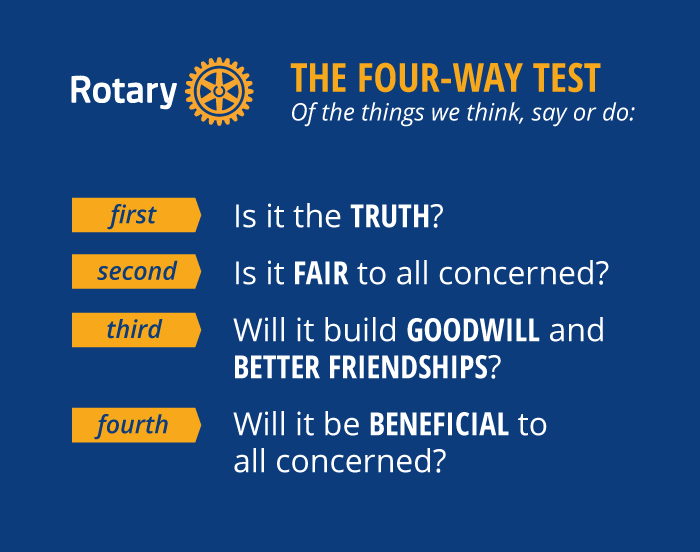
Moving forward, I recommend the Rotary Club’s 4-way test before posting.

Image: https://clubrunner.blob.core.windows.net/00000002423/Images/pages/4-way-test.png

The 4-way test is prominently displayed in all major roads in the Philippines.

(Q.C. 230807)

An introduction to the philosophy of Julian Marias

I recently shared a ride (actually, I drove) with Prof. Paul Dumol. Dumol is best known for his masterpiece, Ang Paglilitis ni Mang Serapyo (1968), which he wrote as a high school sophomore at the Ateneo de Manila University, a play that is still widely performed today. Prof. Dumol is also an expert in medieval history and philosophy, and one of the Philippines’ best resources on the life and works of Jose Rizal.

He’s also my most trusted source of book and movie recommendations.

Back to the ride. We conversed about Julian Marias, to whose works he was recently introduced. I was intrigued by Marias’ “filling in a gap” in Aristotelian philosophy, a gap that was already hinted into by my favorite philosopher, Robert Pirsig.

Julian Marias (1914-2005) was a Spanish philosopher and pupil of Jose Ortega y Gasset (1883-1955). Between the late 1940s and the 1970s, being unable to teach in Spain (he was critical of the Franco regime), Marías taught at numerous institutions in the United States, including Harvard University, Yale University, Wellesley College, the University of Oklahoma, and UCLA.

Image: https://www.michaelthallium.com/wp-content/uploads/2018/10/AntropoInsta-1024×681.jpg

The gap hinted above refers to the act of being.

In metaphysics, the “act of being” refers to the fact or state of existence, and it’s a concept that delves into the nature of existence itself. This is an idea that has been explored by numerous philosophers and theologians over the centuries.

Knowledge of a few key points about the “act of being” in metaphysical thought are helpful.

  1. Existence vs. Essence: Classical metaphysicians often make a distinction between the existence of a thing and its essence. While the essence of a thing describes what that thing is, the act of being or existence refers to the fact that it is. For instance, the essence of a triangle is that it’s a three-sided figure. Its existence, however, is a separate consideration: whether or not such a figure is actually found in reality.
  2. Pure Act: In the philosophy of Thomas Aquinas, God is described as “pure act” (actus purus), meaning He is fully actualized with no potentialities. Everything else in existence has a mixture of potentiality and actuality — e.g., I’m not yet a grown up at 17 — but only God is pure actuality or pure being.
  3. Existentialism: The 20th-century philosophical movement called existentialism put a significant emphasis on the individual’s existence, or act of being, and the inherent meaning (or lack thereof) that comes with it. Notable figures such as Jean-Paul Sartre and Martin Heidegger grappled with questions about the nature and significance of human existence.
  4. Heidegger and Dasein: Martin Heidegger, a German philosopher, presented a significant reinterpretation of the concept of being. He introduced the term “Dasein,” which can be translated as “being-there” or “existence,” to explore the unique way humans engage with the world. For Heidegger, understanding the nature of Dasein is central to understanding the question of Being itself.
  5. Ontology: This is the branch of metaphysics concerned specifically with the nature of being or existence. When philosophers undertake an ontological investigation, they’re trying to understand what it means for something to exist and the various modes or grades of existence.

The “act of being” is a foundational concern in metaphysics, and discussions surrounding it touch on many deep questions about reality, identity, God, and the nature of existence itself.

The gap, as I understand it, is this: all the above concepts are static. A spade is a spade is a spade. But that is not how we experience spades. I have a favorite spade, and I will argue that it’s not the same as any other spade even if they all looked exactly alike, were made by the same company, and were made of the same materials. Why is mine different? It’s because of my experience of it.

Julián Marías, particularly in his work “Metaphysical Anthropology: The Science of the Act of Being“, places a strong emphasis on the act of being as it relates to human existence and individuality. Aristotle and Aquinas I think are the starting point, and these three philosophers grappled with the concept of being in ways we shall now enumerate.

Julián Marías:

  • Marías’ philosophy is deeply rooted in personalism, and he is greatly influenced by his mentor José Ortega y Gasset.
  • For Marías, the act of being is closely tied to human reality and existence. He emphasizes individuality and sees the act of being as an unfolding reality, contingent on time and circumstance.
  • In his metaphysical anthropology, Marías insists that humans cannot be understood without considering their temporal nature and individuality. The act of being, therefore, is intrinsically linked to one’s history, choices, and personal development.

Aristotle:

  • Aristotle’s concept of being is foundational to his metaphysics. He introduces the distinction between potentiality (dynamis) and actuality (entelecheia).
  • For Aristotle, everything that exists has a purpose and is moving from a state of potentiality to actuality. This progression defines its act of being.
  • Aristotle also categorizes being into various categories, like substance, quantity, quality, etc. The primary substance, for Aristotle, is the individual entity.
  • While Marías is concerned with the temporal and historical nature of being, Aristotle is more focused on the static categories and the transformation of entities from potentiality to actuality.

Aquinas:

  • Thomas Aquinas synthesizes Aristotelian philosophy with Christian theology. Thus, his understanding of the act of being (actus essendi) is deeply tied to his theological beliefs.
  • Aquinas believes that the act of being is what gives existence to a thing. Essence (what a thing is) is distinct from existence (that a thing is). In God alone, essence and existence are identical.
  • Aquinas, like Aristotle, discusses potentiality and actuality but ties it more directly to a theological understanding of God as the Prime Mover and the pure act of being with no potentiality.
  • While Marías emphasizes individuality in the act of being, Aquinas, though recognizing individual existences, places a more substantial emphasis on the universal essence that individuals partake in, especially within the context of his theological views. In other words, the act of being in all other realities are a participation in the act of being of God.

In other words, to Marías the act of being, especially of the person (he is primarily anthropological in focus) is closely tied to individuality, time, and personal history. His concept is dynamic in contrast to Aristotle’s static, and humanly personal in contrast to participation in God’s. The three conceptions are not incompatible.

So, how does this tie in with Robert Pirsig (1928-2017)?

First of all, Marías and Pirsig come from very different traditions and backgrounds. But though their concepts are not directly comparable in a strict sense, both attempt to delve into profound aspects of existence.

We said that Marías’ philosophy emphasizes the “act of being” as a dynamic reality in the object: existential, personal, and historical. A person’s “I” is always in the act of being, unfolding over time in a history and within the context of circumstances. In other words, the act of being is intrinsically tied to one’s biography and is inherently dynamic.

Pirsig introduces the metaphysics of Quality. For him, quality is an experience. But it is not merely something the subject attributes to objects or experiences; it’s the very fabric of reality. Pirsig emphasizes the relation between the object (known) and the subject (knower). It’s not just about aesthetic or functional appreciation but rather the underlying reality from which both subjects and objects arise.

Comparison of Marias and Pirsig:

  1. Dynamic Reality: Both thinkers emphasize a dynamic reality over static existence. Marías’ “act of being” unfolds over time, while Pirsig’s concept of quality is about the unfolding experience.
  2. Prior to Subject-Object Division: Both philosophers hint at something that comes before the division of subject and object. Marías sees the act of being as an intimate part of object and subject, while Pirsig views quality as the pre-conceptual experience before we divide the world into subjects and objects.
  3. Context and Experience: Both Marías and Pirsig emphasize the importance of context and experience. Marías sees one’s existence in particular as shaped by circumstances and biography, while Pirsig believes quality is an experience that can’t be strictly defined but can be understood contextually.
  4. Interrelation of Individual and World: Both seem to suggest a deep interrelation between the individual and the world. Marías’ act of being emphasizes the interconnectedness of individual existence with the world, while Pirsig’s Quality is about the relationship between the observer and the observed.

It’s essential to recognize a further difference in focus: Marías is rooted in existential and personalist philosophy with a strong focus on the individual’s unfolding existence, Pirsig is trying to bridge Eastern and Western thought, using Quality as a central concept to weave together ideas from both.

Marías and Pirsig focus on different aspects of existence and reality; both offer profound insights into the nature of being and our relationship with the world.

I find these two philosophies (and Arsitotle’s and Aquinas’ as well) useful in explaining why my spade is different. It also adds this practical aspect: that I can increase the act of being and the quality of my spade by adding my own experience and circumstance to it. If I treated my spade as a sacred tool of work, wrapping it in velvet and keeping it in an ancient box the way master chefs keep their knives, then everyone will see that my spade is special.

Treat your tools as if they were sacred.

Aside from these philosophers, I also delivered a talk on contrasts in the idea of work as experienced by the Japanese and other people. Then, Prof. Dumol, myself, and other friends savored two Japanese films — Suzume (2022) and The Last Recipe (2013). All these experiences made for a coherent, intellectually and aesthetically satisfying out-of-town vacation over the last few days.

(Calamba and Q.C. 230807)

On adopting a Growth Mindset

In an ever-evolving world characterized by rapid technological progress, the way we approach challenges and learning plays a pivotal role in determining our success. The concept of a growth mindset, popularized by psychologist Dr. Carol Dweck offers a framework to understand this approach.

Image: https://vital180.com/wp-content/uploads/2021/01/mindset.jpg

Dweck presents decades of her research on achievement and success in her book Mindset: The New Psychology of Success, boiling achievement down to a simple yet powerful idea: the power of our mindset. She describes how these mindsets shape our lives, from our relationships, education, and work to our ability to achieve our potential. She provides evidence that embracing the growth mindset can lead to greater success, resilience, and satisfaction in various areas of life.

We summarize her views on the essence of a growth mindset, its benefits, and data that underscore the advantages of the mindset. We conclude with recommendations on how to nurture the growth mindset.

First, definitions.

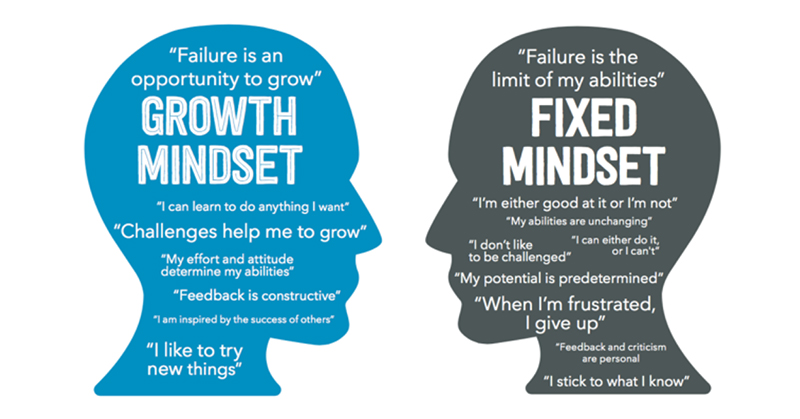
Dweck contrasts two mindsets:

Fixed Mindset: People with this mindset believe that their talents and abilities are set in stone – either you have them or you don’t. They believe that talent alone, without effort, will lead to success.

Growth Mindset: People with this mindset believe that talents and abilities can be developed through dedication, effort, and hard work. They see failures and challenges as opportunities to learn and grow. A growth mindset thrives on challenge and sees failures not as evidence of unintelligence, but as springboards for growth and stretching existing abilities.

Why is a Growth Mindset Beneficial?

Enhanced motivation and persistence: With a growth mindset, setbacks are viewed as opportunities for development. This perspective can lead to increased motivation, as individuals are less likely to give up when they face challenges.

Greater resilience: Those with a growth mindset tend to bounce back from failures more quickly because they understand that failure is a part of the learning process.

Continuous learning: A growth mindset fosters a love for learning. Individuals are more likely to seek out new experiences and knowledge, positioning themselves for ongoing personal and professional development.

What evidences were presented by Dweck?

Academic achievement: In a study with hundreds of students, Dweck found that those who believed that intelligence could be developed outperformed those who believed that intelligence was fixed. This was true even when they had the same initial levels of ability. For example, in one study, students who demonstrated a growth mindset showed a sharp upward trajectory in their mathematics grades over two years, whereas those with a fixed mindset remained stagnant.

Response to failure: In various experiments, after facing a failure, those with a growth mindset were more likely to persist and put in more effort on subsequent tasks, while those with a fixed mindset often didn’t try as hard or gave up.

Praise and motivation: Dweck’s research also explored how praise impacts children’s mindsets. In one study, children who were praised for their intelligence (fixed mindset praise) were more likely to choose easier tasks in the future to ensure success. In contrast, children praised for their effort (growth mindset praise) embraced more challenging tasks and showed greater resilience.

Brain plasticity: Although not solely from Dweck’s book, related research supports the growth mindset by demonstrating that the brain is malleable and can change, grow, and adapt throughout life. Dweck references these findings to solidify the idea that abilities and intelligence can indeed be developed.

Mindset interventions: In another study, students who participated in a growth mindset workshop, where they learned about the malleability of the brain and the importance of effort, showed significant improvements in their grades and motivation compared to peers who did not participate.

Organizational success: In corporate settings, entities that foster a growth mindset among employees have reported higher levels of performance, innovation, and job satisfaction. A study from Harvard Business Review found that organizations endorsing a growth mindset had employees who felt 47% more committed and 34% more likely to view risk as an opportunity.

Enhanced well-being: Psychological studies have linked a growth mindset to higher levels of well-being, suggesting that accepting challenges and seeing growth in adversity can contribute to overall mental health.

How can one achieve and cultivate a growth mindset?

Here are some strategies for nurturing a growth mindset.

  1. Create a new compelling belief: Create a new compelling belief by believing your talents and skills can be honed by applying oneself. Replace negative self-talk with constructive statements like, “I can learn from this,” or “Challenges help me grow.” Praise yourself and others for the hard work and determination rather than only for the results achieved. It is your consistent effort and enjoyment of one’s chosen path in life that illuminates the road to mastery.
  2. View failure in a different light: Failures show the way by not being the way; recognize that failure is important. Failure is the time to apply extra effort to significantly improve your results. Failure is what you do and understanding what you can learn from it. Analyze what went wrong and how you can approach similar situations differently in the future. Jackie Joyner-Kersee, a track and field Olympic gold medalist, explains: “I derive just as much happiness from the process as from the results. I don’t mind losing as long as I see improvement…If I lose, I just back to the track and work some more“.
  3. Sky rocket your self-awareness: Become acutely aware of your many gifts and talents. Ask others for feedback such as your closest friends, family members, boss and colleagues as they can offer slightly different views and give you an overall perspective on what to focus on and areas for development.
  4. Become a curious learner: Act like a child does on a daily basis, live in wonderment and discover the beauty of life. Decide today, to continually focus on learning and growing. Begin by asking more questions and being more curious about everyone you meet, the journey they have been on and what they can teach you. Cultivate a love for learning. Ask questions, seek feedback, and remain open to new ideas and perspectives.
  5. Challenges are your new best friend: When one chooses to climb a mountain, one must overcome the challenges in order to get to the top. Mountaineers choose to risk their life, help others in their journey, and become indestructible in body and mind. Be a mountaineer in spirit. Start by moving out of your comfort zone. Choose tasks that are slightly beyond your current abilities to foster growth. Those with a growth mindset excel with challenges. Challenges propel them forward towards their goals, it is the fuel that inevitably helps them rise to the top.
  6. Love takes you to the top: Those with a growth mindset who naturally love what they do, rise to the top more organically. For some, success and achievement are purely a spin-off from doing what they absolutely love and continuing to do so with all of their heart and soul even when faced with adversity and challenges.
  7. Tenacity that ignites: Tenacity is an essential ingredient in becoming unstoppable; without it one will falter, slip and inevitably fall to the lowest levels.This is what separates a novice from a champion. Remember: great work is rare not because genius is rare, but because tenacity is. Be relentless when you have nothing left but relentlessness.
  8. Massively inspired by others: Those with a growth mindset love to see others succeed. Watching others succeed liberates their soul as to the possibilities of life. Their genuine happiness and excitement for others unwittingly attracts and returns success back to them. For one can never receive what one resents.

Achieving a growth mindset requires effort. Several obstacles can make it challenging to develop and maintain a growth mindset. Recognize these obstacles because this is the first step to overcoming them.

  1. Deep-rooted beliefs from childhood: Our early experiences can shape our beliefs about our abilities. Consistently being labeled as ‘talented’ or ‘not good enough’ in childhood can lead to a fixed mindset, where one believes capabilities are innate and unchangeable.
  2. Fear of failure: Society, especially schools, often stigmatizes failure, which can discourage risk-taking or trying new things. If individuals are conditioned to avoid failure, they may not embrace challenges or opportunities to learn, which are essential aspects of a growth mindset.
  3. Overemphasis on natural talent: In many cultures and fields, natural talent is celebrated over effort. When individuals believe success only comes from inherent skills and not from hard work, they may resist efforts to improve or grow. A more recent trend — celebrating lack of talent by giving awards to everybody — has a similar effect.
  4. Avoidance of feedback: Constructive criticism is essential for growth. However, if individuals take feedback personally or view it as an attack on their competence, they might avoid it, thereby missing out on opportunities to learn and improve.
  5. Fixed mindset environment: Being in an environment (like certain schools, workplaces, or homes) that rewards only results and not the effort can discourage the development of a growth mindset. In such settings, mistakes might be penalized, and there’s less encouragement to learn from them.
  6. Stereotypes and bias: Certain societal stereotypes, such as gender biases regarding ability, can hinder individuals from those groups from believing in their potential to grow and achieve.
  7. Perceived threats to self-esteem: For those with a fixed mindset, challenges can be seen as threats to their self-worth, leading to avoidance of situations where they might not excel.
  8. Impatience: A growth mindset requires patience, as growth and development often take time. Those looking for quick results may become discouraged if they don’t see immediate improvements.
  9. Lack of awareness: Many people aren’t aware of the distinction between fixed and growth mindsets. Without this awareness, they might not recognize the need to shift their perspective.
  10. Setbacks and disappointments: Experiencing repeated failures or setbacks can sometimes make it hard to maintain a growth perspective. It takes resilience to see these events as opportunities rather than confirmations of one’s limitations.

Achieving a growth mindset, while challenging, is not insurmountable. Conquering a mountain ultimately boils down to putting one foot in front of the other, baby steps made everyday do lead to false routes sometimes, but the same steps bring you to your destination.

A growth mindset is more than just a buzzword in the realm of personal development; it’s a philosophy that champions adaptability, resilience, and continuous learning. The data overwhelmingly suggests its numerous advantages in both personal and professional settings. By actively adopting strategies that foster this mindset, we not only equip ourselves to navigate the challenges of today’s dynamic world but also set the stage for consistent growth and transformation.

(Q.C., 230807)

Economic pressure and creativity

I’ve been watching a number of very good movies lately: The Last Recipe (2017), Suzume (2022), and Still Life (2013). None of those three are from traditional Hollywood.

It seems Hollywood isn’t as creative as it used to be. What some call the “Golden Age of Hollywood,” spanning from the late 1920s to the early 1960s, is remembered for its creative vigor and innovation. This was a period characterized by high production quality, immense creativity, and the creation of many of the industry’s classic films. This translated to massive growth and a clear dominance on the world’s cultural stage.

However, as the Hollywood system grew and became more commercialized, economic pressures started to significantly influence the nature of film production. Beginning in the 1980s, film production companies became part of larger corporate entities. These corporations were more focused on generating profit than on nurturing creativity, leading to a shift in the type of films produced. Increasingly, the focus turned towards surefire blockbusters and films that could generate substantial merchandising and product tie-ins.

As these economic pressures mounted, many filmmakers and artists felt that creativity was being stifled. The emphasis was placed on financial success rather than artistic merit, leading to a proliferation of sequels, remakes, and adaptations of successful properties. The growing focus on international box office potential also led to a decrease in films dealing with culturally specific or challenging topics, as these were seen as less likely to appeal to a broad global audience.

Although we still see creativity through independent films and streaming platforms, the blockbuster franchises and tentpole movies in traditional Hollywood production are likely to lose ground to non-traditional content producers who can generate good business by addressing specific niches. Technology will enable high quality productions on low budgets.

The connection between economic pressure and productivity is nothing new, though. Artists through the ages have had to face this problem.

A poignant example of an artist feeling pressure to prioritize income over creativity is Vincent Van Gogh (1853-1890). Despite being one of the most famous painters in history, Van Gogh’s talent was largely unappreciated during his lifetime, and he struggled with financial hardship, mental illness, and a lack of commercial success.

V. Van Gogh, Wheatfield with crows (1890). Image: Van Gogh Museum

Van Gogh’s brother, Theo, provided him with financial support, allowing him to pursue his artistic endeavors. But the constant worry of being a financial burden to his brother, combined with the pressure to sell his works, often led Van Gogh to compromise on his artistic vision.

In a letter to his brother Theo, Van Gogh once expressed his dilemma:

“I am always doing what I can’t do yet in order to learn how to do it.”

Vincent Van Gogh

This sentiment reflects Van Gogh’s struggle to balance the pressure to produce commercially successful art with his desire to push the boundaries of his craft.

Despite the commercial pressures, Van Gogh never truly succumbed to them. He continued to push the boundaries of his craft, leading to the creation of some of the most iconic artworks in history, such as “The Starry Night” and “Sunflowers.” However, the lack of recognition and financial success during his lifetime led to a life marked by hardship, and he died largely unrecognized.

In retrospect, Van Gogh’s story illustrates the potential stifling impact of economic pressures on creative freedom. However, it also serves as a powerful testament to the enduring power of artistic integrity and the pursuit of one’s unique creative vision, even in the face of significant adversity.

T.S. Eliot (1888-1965) is another notable example of an artist who experienced economic pressures that initially constrained his creativity. Eliot, one of the 20th century’s major poets, is best known for works like the poem “The Waste Land” and the novel “Murder in the Cathedral“. He was not always able to dedicate his full attention to his craft, primarily due to economic concerns.

Eliot was born in the United States but moved to England in 1914. At the time, he worked in various roles, including as a teacher and a bank clerk at Lloyds Bank in London, a role he held for nearly a decade. While these jobs provided him with the financial stability he needed, they also limited the time he had to write.

During this period, Eliot’s health suffered due to overwork, which also impacted his creativity. His situation began to change in 1922, primarily due to the intervention of his friends and patrons. The Dial, a literary magazine, awarded him the inaugural Dial Award along with a handsome monetary prize, recognizing his contribution to literature. This recognition helped bolster Eliot’s standing in the literary world.

In 1925, Eliot was offered a position at the publishing firm Faber and Gwyer (later Faber and Faber). This position was facilitated by Geoffrey Faber, one of the firm’s directors and an admirer of Eliot’s work. This role provided Eliot with a more stable income and a work environment that was more conducive to his writing.

Another significant patron and friend was Virginia Woolf, who had her own publishing house, Hogarth Press. Woolf published Eliot’s works, including “The Waste Land,” providing him with both financial support and artistic freedom.

Finally, the Russell family, particularly Bertrand Russell and his wife, were close friends and patrons who provided both financial and emotional support.

Thanks to this combination of patronage and a more creatively fulfilling work environment, Eliot was able to shift his focus more towards his poetry and literary criticism, leading to some of his most prolific and influential periods. His situation demonstrates the significant impact that economic pressures can have on an artist’s creativity and the importance of support networks in helping artists overcome these challenges.

(Calamba, 230805)

From Craft to Art to Sacrament

Or: An Exploration of Work and Morals

Ask a Japanese to describe his ethics and he will describe to you a samurai.

Japanese society is quite unique. Here is a nation that is one big institution, where everyone shares the same national aspirations and values — represented by the image of the samurai — and a consistent method for transmitting them.

Allowing for individual differences and dynamism, the aspirations and values of the Japanese can be seen as a complex blend of economic ambition, cultural pride, social harmony, global responsibility, environmental awareness, and educational excellence. These aspirations are shaped by Japan’s history, geography, and cultural values and continue to evolve in response to global and domestic challenges and opportunities.

These aspirations are transmitted formally through schools and various religious rites, and informally through traditional arts. The more familiar ones to Western audiences are the martial art of karate, ikebana (flower arrangement), chanoyu (tea ceremony), origami (paper folding), and many others. Precision, decisiveness, mindfulness, combined with a high degree of skill and a commitment to mastery under the guidance of expert sensei, are learned and imbibed through years of practice.

Katsushita Hokusai (1760-1849), “The Great Wave Off Kanagawa” (1829). Woodblock print. Image: https://artincontext.org/wp-content/uploads/2021/08/Famous-Japanese-Art.avif

What interested me in particular was the connection between the arts and the transmission of values. As I delved into the subject, it became clear that art transformed the artist, and not just in an intellectual or practical sense. The moral and spiritual transformation of the artist is, in fact, the objective of all serious art. This would be the ideal for all work as well.

In contemporary society, work is often seen primarily as a means of earning a living. However, when we delve deeper into the nature of work and its relationship to human morality, we find a progression from craft to art to sacrament. Each stage of this progression reveals a deeper layer of significance about the moral dimensions of work.

The first stage of this progression, craft, represents work as a skill or trade. Craftsmanship embodies the virtue of diligence and the moral value of commitment to a task. A craftsman applies knowledge, skill, and dedicated effort to produce something useful, typically demonstrating a high level of proficiency and attention to detail. Through craft, we see the moral principle of responsibility coming to the fore – the craftsman is accountable for the quality of their work, and the craft itself requires dedication and consistency. In practicing a craft, one also learns patience, humility, and respect for the materials and tools one works with, further reinforcing the connection between work and moral values.

The next stage in the progression is art. If craft involves skills employed in a trade, art elevates these skills to a higher level of creativity and self-expression. Artists pour their thoughts, feelings, and perceptions of the world into their work, bringing an element of the subjective into the objective reality of the physical artwork. The act of creating art instills the virtues of imagination, empathy, courage, and authenticity. The artist needs to be brave enough to reveal their inner world and authentic enough to stay true to their vision, even in the face of potential criticism. Through the creation and appreciation of art, we grapple with questions about truth, beauty, and the human condition – inherently moral considerations.

The final stage is sacrament, where work becomes a spiritual endeavor. In religious traditions, a sacrament is a physical act that signifies a spiritual reality. When work is seen as a sacrament, it is viewed not only as a way to make a living or create something beautiful, but also as a path to spiritual development and self-transcendence. Work done in the spirit of sacrament is imbued with a sense of purpose and vocation, transcending the mundane and reaching towards the divine. This understanding of work nurtures virtues like compassion, self-sacrifice, and reverence. Work becomes a means of serving others, contributing to the community, and participating in the broader cosmic order. The moral values associated with work at this level are about fostering unity, harmony, and love.

From craft to art to sacrament, we can see a deepening relationship between work and morals. At each stage, work fosters certain virtues and moral principles, shaping not just what we produce, but also who we become in the process. Ultimately, the progression from craft to art to sacrament invites us to view work not merely as a job or career, but as a craft that hones our skills, an art that expresses our unique selves, and a sacrament that connects us with a higher purpose.

I assume that this ultimate outcome may be described as good and, therefore, beneficial. However, not every individual enjoys the benefits of this progression.

The progression from craft to art to sacrament in the context of work can be obstructed by several factors. These barriers can hinder an individual’s or a society’s ability to move from seeing work merely as a trade or skill (craft) to a form of self-expression and creativity (art) and finally to a spiritual or higher calling (sacrament).

  1. Economic Pressures: In a society (and here we speak of “society” at any level, from family to state) highly focused on economic gain, work can be reduced to a means of survival rather than a vocation or spiritual endeavor. The pressure to maximize profits and efficiency can lead to a devaluation of artistic creativity and spiritual connectedness.
  2. Educational Limitations: Lack of education or training that fosters creativity, ethics, and critical thinking can hinder the movement from craft to art. A narrow focus on technical skills without nurturing creativity and moral values can stifle artistic and spiritual development in work.
  3. Cultural Values and Social Norms: If a culture places little value on artistic expression or spiritual pursuits in work, this can hinder the progression from craft to art to sacrament. Societal norms and values play a significant role in shaping how work is perceived and what is considered valuable or worthy of pursuit.
  4. Institutional Barriers: Organizations and industries that have rigid hierarchies, inflexible rules, and a lack of support for innovation and creativity can inhibit the growth and development of individuals in their work. This can stop the transition from seeing work merely as a skill to seeing it as a form of art or even a spiritual calling.
  5. Psychological Factors: An individual’s mindset and attitudes toward work, creativity, and spirituality will play a significant role in this progression. Fear of failure, lack of self-awareness, or a reluctance to explore one’s inner life can all act as barriers.
  6. Technological Overemphasis: While technology can enhance creativity and connection, an overemphasis on technology at the expense of human interaction and reflection can hinder the development of work as an art or spiritual practice.
  7. Political and Regulatory Environment: Government policies and regulations that don’t support or actively hinder artistic expression, entrepreneurship, and spiritual pursuits can also be significant obstacles.
  8. Lack of Mentors and Role Models: Without guidance from individuals who have successfully navigated the path from craft to art to sacrament, it can be challenging for others to see how to walk this path themselves.
  9. Poor Work-Life Balance: An excessive workload and the inability to balance work with other aspects of life can lead to burnout, reducing the capacity to see work as anything more than a means to an end.
  10. Materialism and Consumerism: In a society heavily influenced by consumerism and materialistic values, the intrinsic value of work may be overlooked, focusing more on what can be gained materially rather than spiritually or artistically.

I am especially cautious of the dangers of artificial intelligence and social media, of how they make it easy for a person to become an “expert” overnight. That is, without having passed through the repetitive acts and multiple failures required to develop solid virtues. In many cases, people are even becoming their own instructors and don’t develop the humility to seek feedback. I am not critical about the technologies themselves, as I also use them. But the high incidence of burnout and quitting among young professionals might indicate that they are not acquiring strength of character in their work.

As an educator, I’m interested in encouraging this progression. I must, therefore, consider these influences and work to cultivate an environment where creativity, self-expression, and spiritual connection are nurtured and valued.

Let me take this opportunity of ending to recommend a personal practice that I consider to be formative for many reasons: writing longhand on real paper, everyday. I always carry a bound notebook and fountain pen with me at all times, often writing in restaurants or in airports — any occasion, that is. By doing this I remind myself that writing is a craft, not just a process. The benefits, I can’t deny. When I have a problem, technical or moral, much of the conundrum becomes significantly clearer after I’ve described it and my spilled my thoughts on paper.

(Calamba, 230805)

On finding the will to cut clean

I recently read about the legal battle between singers Rihanna and Chris Brown. Their relationship made headlines when Brown physically assaulted Rihanna in 2009, an incident for which he later pleaded guilty.

But despite the assault and the legal proceedings that led to a restraining order, Rihanna went back to Chris Brown on several occasions. This isn’t uncommon in abusive relationships due to the cycle of abuse and violence. In interviews, she said she was “that girl” who believed that her love could change the abusive partner.

They later permanently split in 2013. Still, they had a reunion in a mutual friend’s yacht. Rihanna told Oprah:

“It’s awkward because I still love him. My stomach drops. I have to maintain this poker face and not let it get to the outer part of me. I have to maintain that and suppress it and interpret it and understand it and understand that it’s not going to go away. That is peaceful. If you don’t understand those feelings, you can make a lot of mistakes.”

Rihanna, 2013

The decision to leave an abusive relationship is extremely difficult and often dangerous, and individuals in such situations need understanding, support, and access to resources.

What really interested me were her statements. She certainly is not to blame for the blows, but having the power to leave, she didn’t. Why? We can’t judge. But my thesis is that it took time for her to definitively will the separation. But prior to that she continued to want it.

Free will, that mysterious faculty of humans. At the same time powerful and weak. How do we dissect that?

St. Augustine (354-430), one of the most influential philosophers and theologians in the history of the Church, made significant contributions to the understanding of free will. He argued that the capacity to choose is an essential part of our human nature. However, due to original sin, our will is weakened and predisposed to sin.

Image: https://i.ytimg.com/vi/uRsjaBTphVM/maxresdefault.jpg

In regards to the perfection of the will, he argued that the will is not lacking power in itself: that there’s no such thing as a weak will. Rather, the power of the will becomes fragmented and weak when it is divided and pulled towards different goals or objects of desire.

My interpretation is that Rihanna may wanted to leave; but she also wanted love, and probably, safety. If she didn’t give a f**k about either, she might have just shot Chris Brown.

Thus, a lack of will power is not necessarily a deficiency in the will itself, but a consequence of the being drawn towards various, often conflicting, objects of desire. The will’s focus is diluted, resulting in a state where one might say they have a “lack of will power”.

Now, if the will was indeed capable of only one thing — to drive you towards your desires — then it follows that whatever situation you put yourself in is the situation you wanted. You can indeed want something you don’t like, even detest.

In other words, we’re wired to win. You’re winning at whatever situation you’re in right now. If you don’t like it, then change what you want.

It’s not easy to direct the will in a new direction. To do that, you may need to first create the conditions to unwant what you wish to reject.

Benjamin Hardy, author of Willpower Doesn’t Work: Discover the Hidden Keys to Success, argues that relying solely on willpower to achieve goals is ineffective. Instead, Hardy advocates for changing one’s environment in ways that support the achievement of those goals.

Environment is stronger than willpower. Our behaviors, beliefs, and attitudes are shaped by the contexts in which we live and work. If the environment is not conducive to success, no amount of willpower will overcome it. For example, if you want to be really productive, don’t work at home. Cal Newport, in Deep Work, suggests to go to a “secret” hideout where no one can interrupt you. A friend of mine finished writing his PhD dissertation by hiding in a monastery for a month.

We must make decisions about what to include or exclude from our environments. Once those decisions are made, they eliminate the need for willpower because the environment itself guides behavior. Remove your internet connection for an hour or two and there’ll be no need to decide whether to surf. Hide in a monastery, and there’ll be no need to decide whether to watch a movie.

We can also set up consistent and visible cues in our environment that reinforce desired behaviors. Thus, a working table, simple but with all your writing implements, is like an altar where nothing but work gets done.

Moving to a new city or starting a new job can lead to dramatic improvements in behavior and lifestyle. That’s the dream when exiting an abusive relationship.

Having changed the environment, your interest will now be to maintain your resolve. How can one stop wanting what led to the abusive relationship? One must consider that such desire is the result of a habit that now must be changed.

Charles Duhigg, in The Power of Habit, proposed the habit loop model. It suggests habits are composed of three elements: a cue, a routine, and a reward. Changing a habit, according to this model, is not about just applying willpower to the routine (the behavioral aspect), but also involves understanding and modifying the cue (what triggers the habit) and the reward (what benefit is gained from the habit).

Cue: This is the trigger that initiates the behavior. It could be an emotion, a time of day, a location, or any number of other triggers. Understanding what prompts the habit is the first step in changing it. Thus, if a habit like loneliness is cued by the sight of specific wine bottles, then throw all such bottles that are still at home.

Routine: This is the actual behavior that we usually think of as the habit. This is what we often try to change with willpower alone. If you’re addicted to seeking validation through looks, you can make the ritual more difficult to carry out in a social event by choosing more conservative clothing.

Reward: This is the benefit or positive feeling gained from doing the behavior. The reward is important because it helps your brain decide if this particular habit loop is worth remembering for the future. If the habits that keep you in an abusive relationship are rewarded by validation, then decide not to give a f**k about validation.

Duhigg says it much less costly to change cues and rewards than to change rituals. Willpower is expensive and a focus on rituals will tire you out fast. Too may decision guarantees failure.

Another model of will power is the COM-B model. COM-B stands for “capability“, “opportunity“, “motivation” and “behavior“. For a behavior to occur, one must have the capability, the opportunity and the motivation to perform it. Addressing only one aspect (for instance, using willpower to address motivation) without considering the others (like capability and opportunity) may not lead to sustainable behavior change.

Thus, to escape an abusive relationship, one will have to focus on:

1. Building the capacity for emotional and financial independence, by prioritizing professional growth.
2. Seek, create or maximize opportunities to network, particularly with highly productive individuals and support groups.
3. Increase motivation by improving one’s skill sets and reminding oneself everyday about what one stands for.
4. Cultivating productive behaviors like following a routine of work, exercise, sleep, and making good friends.

The help of well meaning friends and consultants may be needed, especially in the early stages of habit change.

So, Rihanna’s will power eventually won, and it looks like she’s maintaining her victorious state with respect to her old life. It’s not happily ever after, and she will continue to fight.

Let me end with St. Augustine. This great saint was once a captive of habits that enslave many today: lust, pleasure, vanity. Even after his conversion he continued to feel strong temptations. He fought these temptations by writing. The fact that he produced a stupendous amount of work is probably an indication of how much he had to fight his demons.

That’s how you win this game.

(Q.C. 230802)

On overthinking

I have to get export permits. The thought intimidates me.

What about this intimidates? Legally? No problem. The object is covered by application procedures that are at least clear.

Tedious? Maybe. Most procedures like this involve getting only one or two signatures, with one supporting document (already prepared), and a fee. One week and I’m done.

So, what intimidates is not the problem outside, but the anxiety inside. The problem in my thinking. I’m intimately familiar with at least one of the culprits: the Zeigarnik Effect.

Image: https://media.licdn.com/dms/image/D5612AQGewbUOpw11kQ/article-cover_image-shrink_600_2000/0/1678543047834?e=2147483647&v=beta&t=uipMDhPQ4slYLSe3vBpXZcyf82neKTXd-TRLqHBCboY

The Zeigarnik Effect is a psychological phenomenon named after its discoverer, Russian psychologist Bluma Zeigarnik (1901-1988). She noticed that waiters were better at remembering uncompleted orders than completed ones. She confirmed the phenomenon through studies she conducted in the 1920s.

Cognitive psychology suggests an explanation.

The brain’s cognitive tension system is aroused when a task is started but not finished. This tension creates a mental preoccupation with the uncompleted task, resulting in the task being more readily recalled. Once completed, the tension is relieved, and the brain is less likely to recall the details of the task, as it is no longer a matter of concern.

Although the neurobiology is unclear, it’s reasonable to associate the Effect with the activation of brain regions related to attention and memory. These hypotheses are based on the broader understanding of memory, attention, and motivation systems in the brain.

We begin with the prefrontal cortex, site of attention, working memory, and decision-making. The hippocampus, crucial for memory consolidation and retrieval, might be engaged differently for completed and uncompleted tasks due to the tension difference.

The amygdala might play a role. A key part of the brain’s limbic system, the amygdala plays a crucial role in processing emotions, including fear and anxiety. It also contributes to the emotional aspect of pain. When the thought of long bureaucratic procedures makes one anxious, the amygdala goes hyperactive, making the pain feel worse. Signals from the amygdala feed back into the prefrontal cortex giving it a kind of tunnel vision. As a result, one might make decisions with too little information and too much emotion.

If one doesn’t procrastinate by ignoring the problem, one might still paralyze oneself through overthinking. Focusing on only a few aspects of the problem could kill a course of action that could otherwise have proceeded had key information not been ignored. One can fixate on the worst case scenario. I prefer paralysis in this case over an ill considered course of action.

But one will still have to face the issue. Therefore, beat overthinking.

The first step is to know that 99% of a problem lies in one’s thinking, and 1% in reality. How we gather and verify facts, from whom we seek advice, our attitude towards risk and failure have a greater bearing on the outcome of our struggle with problems than the actual dangers.

At this point I suggest three strategems.

First, Time and Silence. There MAY be good reasons not to take action, and being emotional is one of them. If the situation allows it, let that emotion pass before you study your options. If you only have seconds to decide — which happens rarely — then go where your gut leads you and hope for the best.

Second, Fact Check Your Thinking. It may look tedious to check one’s facts, so let’s put the costs in perspective. Use the 1-10-100 Rule. It costs $1 to validate one’s facts, $10 to correct wrong facts, and $100 to reverse a bad decision. Be aware also of the fact that the Zeigarnik Effect is a psychological phenomenon, an illusion.

And third, Live in the Present because only the present is real. The outcomes of your scenarios, none of them are actually disastrous because they haven’t actually happened. All Worry and anxiety are about the future, guilt is about the past, and both past and future are UNREAL. Focus on the now and put one foot over the other.

Climbing a mountain involves occasionally checking for coordinates or the weather. And it’s also about stopping and enjoying the scenery. But do be relentless.

And you may well fail. Then think of failure as showing the way by NOT being the way. Use it. Double back. Then keep at it.

(Q.C., 230801)