On adopting a Growth Mindset

In an ever-evolving world characterized by rapid technological progress, the way we approach challenges and learning plays a pivotal role in determining our success. The concept of a growth mindset, popularized by psychologist Dr. Carol Dweck offers a framework to understand this approach.

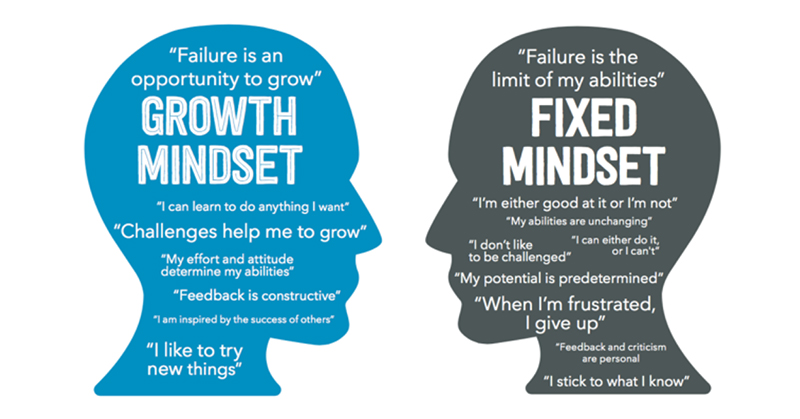
Image: https://vital180.com/wp-content/uploads/2021/01/mindset.jpg

Dweck presents decades of her research on achievement and success in her book Mindset: The New Psychology of Success, boiling achievement down to a simple yet powerful idea: the power of our mindset. She describes how these mindsets shape our lives, from our relationships, education, and work to our ability to achieve our potential. She provides evidence that embracing the growth mindset can lead to greater success, resilience, and satisfaction in various areas of life.

We summarize her views on the essence of a growth mindset, its benefits, and data that underscore the advantages of the mindset. We conclude with recommendations on how to nurture the growth mindset.

First, definitions.

Dweck contrasts two mindsets:

Fixed Mindset: People with this mindset believe that their talents and abilities are set in stone – either you have them or you don’t. They believe that talent alone, without effort, will lead to success.

Growth Mindset: People with this mindset believe that talents and abilities can be developed through dedication, effort, and hard work. They see failures and challenges as opportunities to learn and grow. A growth mindset thrives on challenge and sees failures not as evidence of unintelligence, but as springboards for growth and stretching existing abilities.

Why is a Growth Mindset Beneficial?

Enhanced motivation and persistence: With a growth mindset, setbacks are viewed as opportunities for development. This perspective can lead to increased motivation, as individuals are less likely to give up when they face challenges.

Greater resilience: Those with a growth mindset tend to bounce back from failures more quickly because they understand that failure is a part of the learning process.

Continuous learning: A growth mindset fosters a love for learning. Individuals are more likely to seek out new experiences and knowledge, positioning themselves for ongoing personal and professional development.

What evidences were presented by Dweck?

Academic achievement: In a study with hundreds of students, Dweck found that those who believed that intelligence could be developed outperformed those who believed that intelligence was fixed. This was true even when they had the same initial levels of ability. For example, in one study, students who demonstrated a growth mindset showed a sharp upward trajectory in their mathematics grades over two years, whereas those with a fixed mindset remained stagnant.

Response to failure: In various experiments, after facing a failure, those with a growth mindset were more likely to persist and put in more effort on subsequent tasks, while those with a fixed mindset often didn’t try as hard or gave up.

Praise and motivation: Dweck’s research also explored how praise impacts children’s mindsets. In one study, children who were praised for their intelligence (fixed mindset praise) were more likely to choose easier tasks in the future to ensure success. In contrast, children praised for their effort (growth mindset praise) embraced more challenging tasks and showed greater resilience.

Brain plasticity: Although not solely from Dweck’s book, related research supports the growth mindset by demonstrating that the brain is malleable and can change, grow, and adapt throughout life. Dweck references these findings to solidify the idea that abilities and intelligence can indeed be developed.

Mindset interventions: In another study, students who participated in a growth mindset workshop, where they learned about the malleability of the brain and the importance of effort, showed significant improvements in their grades and motivation compared to peers who did not participate.

Organizational success: In corporate settings, entities that foster a growth mindset among employees have reported higher levels of performance, innovation, and job satisfaction. A study from Harvard Business Review found that organizations endorsing a growth mindset had employees who felt 47% more committed and 34% more likely to view risk as an opportunity.

Enhanced well-being: Psychological studies have linked a growth mindset to higher levels of well-being, suggesting that accepting challenges and seeing growth in adversity can contribute to overall mental health.

How can one achieve and cultivate a growth mindset?

Here are some strategies for nurturing a growth mindset.

  1. Create a new compelling belief: Create a new compelling belief by believing your talents and skills can be honed by applying oneself. Replace negative self-talk with constructive statements like, “I can learn from this,” or “Challenges help me grow.” Praise yourself and others for the hard work and determination rather than only for the results achieved. It is your consistent effort and enjoyment of one’s chosen path in life that illuminates the road to mastery.
  2. View failure in a different light: Failures show the way by not being the way; recognize that failure is important. Failure is the time to apply extra effort to significantly improve your results. Failure is what you do and understanding what you can learn from it. Analyze what went wrong and how you can approach similar situations differently in the future. Jackie Joyner-Kersee, a track and field Olympic gold medalist, explains: “I derive just as much happiness from the process as from the results. I don’t mind losing as long as I see improvement…If I lose, I just back to the track and work some more“.
  3. Sky rocket your self-awareness: Become acutely aware of your many gifts and talents. Ask others for feedback such as your closest friends, family members, boss and colleagues as they can offer slightly different views and give you an overall perspective on what to focus on and areas for development.
  4. Become a curious learner: Act like a child does on a daily basis, live in wonderment and discover the beauty of life. Decide today, to continually focus on learning and growing. Begin by asking more questions and being more curious about everyone you meet, the journey they have been on and what they can teach you. Cultivate a love for learning. Ask questions, seek feedback, and remain open to new ideas and perspectives.
  5. Challenges are your new best friend: When one chooses to climb a mountain, one must overcome the challenges in order to get to the top. Mountaineers choose to risk their life, help others in their journey, and become indestructible in body and mind. Be a mountaineer in spirit. Start by moving out of your comfort zone. Choose tasks that are slightly beyond your current abilities to foster growth. Those with a growth mindset excel with challenges. Challenges propel them forward towards their goals, it is the fuel that inevitably helps them rise to the top.
  6. Love takes you to the top: Those with a growth mindset who naturally love what they do, rise to the top more organically. For some, success and achievement are purely a spin-off from doing what they absolutely love and continuing to do so with all of their heart and soul even when faced with adversity and challenges.
  7. Tenacity that ignites: Tenacity is an essential ingredient in becoming unstoppable; without it one will falter, slip and inevitably fall to the lowest levels.This is what separates a novice from a champion. Remember: great work is rare not because genius is rare, but because tenacity is. Be relentless when you have nothing left but relentlessness.
  8. Massively inspired by others: Those with a growth mindset love to see others succeed. Watching others succeed liberates their soul as to the possibilities of life. Their genuine happiness and excitement for others unwittingly attracts and returns success back to them. For one can never receive what one resents.

Achieving a growth mindset requires effort. Several obstacles can make it challenging to develop and maintain a growth mindset. Recognize these obstacles because this is the first step to overcoming them.

  1. Deep-rooted beliefs from childhood: Our early experiences can shape our beliefs about our abilities. Consistently being labeled as ‘talented’ or ‘not good enough’ in childhood can lead to a fixed mindset, where one believes capabilities are innate and unchangeable.
  2. Fear of failure: Society, especially schools, often stigmatizes failure, which can discourage risk-taking or trying new things. If individuals are conditioned to avoid failure, they may not embrace challenges or opportunities to learn, which are essential aspects of a growth mindset.
  3. Overemphasis on natural talent: In many cultures and fields, natural talent is celebrated over effort. When individuals believe success only comes from inherent skills and not from hard work, they may resist efforts to improve or grow. A more recent trend — celebrating lack of talent by giving awards to everybody — has a similar effect.
  4. Avoidance of feedback: Constructive criticism is essential for growth. However, if individuals take feedback personally or view it as an attack on their competence, they might avoid it, thereby missing out on opportunities to learn and improve.
  5. Fixed mindset environment: Being in an environment (like certain schools, workplaces, or homes) that rewards only results and not the effort can discourage the development of a growth mindset. In such settings, mistakes might be penalized, and there’s less encouragement to learn from them.
  6. Stereotypes and bias: Certain societal stereotypes, such as gender biases regarding ability, can hinder individuals from those groups from believing in their potential to grow and achieve.
  7. Perceived threats to self-esteem: For those with a fixed mindset, challenges can be seen as threats to their self-worth, leading to avoidance of situations where they might not excel.
  8. Impatience: A growth mindset requires patience, as growth and development often take time. Those looking for quick results may become discouraged if they don’t see immediate improvements.
  9. Lack of awareness: Many people aren’t aware of the distinction between fixed and growth mindsets. Without this awareness, they might not recognize the need to shift their perspective.
  10. Setbacks and disappointments: Experiencing repeated failures or setbacks can sometimes make it hard to maintain a growth perspective. It takes resilience to see these events as opportunities rather than confirmations of one’s limitations.

Achieving a growth mindset, while challenging, is not insurmountable. Conquering a mountain ultimately boils down to putting one foot in front of the other, baby steps made everyday do lead to false routes sometimes, but the same steps bring you to your destination.

A growth mindset is more than just a buzzword in the realm of personal development; it’s a philosophy that champions adaptability, resilience, and continuous learning. The data overwhelmingly suggests its numerous advantages in both personal and professional settings. By actively adopting strategies that foster this mindset, we not only equip ourselves to navigate the challenges of today’s dynamic world but also set the stage for consistent growth and transformation.

(Q.C., 230807)

From Craft to Art to Sacrament

Or: An Exploration of Work and Morals

Ask a Japanese to describe his ethics and he will describe to you a samurai.

Japanese society is quite unique. Here is a nation that is one big institution, where everyone shares the same national aspirations and values — represented by the image of the samurai — and a consistent method for transmitting them.

Allowing for individual differences and dynamism, the aspirations and values of the Japanese can be seen as a complex blend of economic ambition, cultural pride, social harmony, global responsibility, environmental awareness, and educational excellence. These aspirations are shaped by Japan’s history, geography, and cultural values and continue to evolve in response to global and domestic challenges and opportunities.

These aspirations are transmitted formally through schools and various religious rites, and informally through traditional arts. The more familiar ones to Western audiences are the martial art of karate, ikebana (flower arrangement), chanoyu (tea ceremony), origami (paper folding), and many others. Precision, decisiveness, mindfulness, combined with a high degree of skill and a commitment to mastery under the guidance of expert sensei, are learned and imbibed through years of practice.

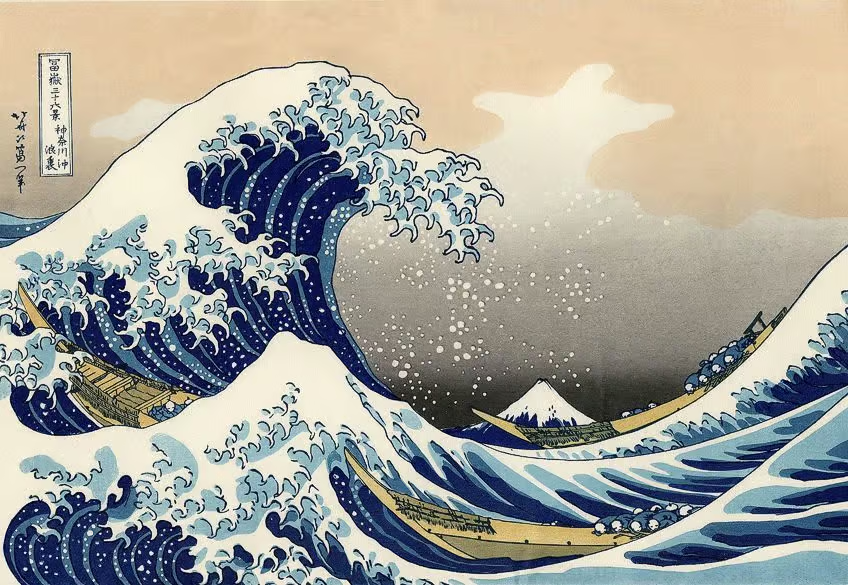
Katsushita Hokusai (1760-1849), “The Great Wave Off Kanagawa” (1829). Woodblock print. Image: https://artincontext.org/wp-content/uploads/2021/08/Famous-Japanese-Art.avif

What interested me in particular was the connection between the arts and the transmission of values. As I delved into the subject, it became clear that art transformed the artist, and not just in an intellectual or practical sense. The moral and spiritual transformation of the artist is, in fact, the objective of all serious art. This would be the ideal for all work as well.

In contemporary society, work is often seen primarily as a means of earning a living. However, when we delve deeper into the nature of work and its relationship to human morality, we find a progression from craft to art to sacrament. Each stage of this progression reveals a deeper layer of significance about the moral dimensions of work.

The first stage of this progression, craft, represents work as a skill or trade. Craftsmanship embodies the virtue of diligence and the moral value of commitment to a task. A craftsman applies knowledge, skill, and dedicated effort to produce something useful, typically demonstrating a high level of proficiency and attention to detail. Through craft, we see the moral principle of responsibility coming to the fore – the craftsman is accountable for the quality of their work, and the craft itself requires dedication and consistency. In practicing a craft, one also learns patience, humility, and respect for the materials and tools one works with, further reinforcing the connection between work and moral values.

The next stage in the progression is art. If craft involves skills employed in a trade, art elevates these skills to a higher level of creativity and self-expression. Artists pour their thoughts, feelings, and perceptions of the world into their work, bringing an element of the subjective into the objective reality of the physical artwork. The act of creating art instills the virtues of imagination, empathy, courage, and authenticity. The artist needs to be brave enough to reveal their inner world and authentic enough to stay true to their vision, even in the face of potential criticism. Through the creation and appreciation of art, we grapple with questions about truth, beauty, and the human condition – inherently moral considerations.

The final stage is sacrament, where work becomes a spiritual endeavor. In religious traditions, a sacrament is a physical act that signifies a spiritual reality. When work is seen as a sacrament, it is viewed not only as a way to make a living or create something beautiful, but also as a path to spiritual development and self-transcendence. Work done in the spirit of sacrament is imbued with a sense of purpose and vocation, transcending the mundane and reaching towards the divine. This understanding of work nurtures virtues like compassion, self-sacrifice, and reverence. Work becomes a means of serving others, contributing to the community, and participating in the broader cosmic order. The moral values associated with work at this level are about fostering unity, harmony, and love.

From craft to art to sacrament, we can see a deepening relationship between work and morals. At each stage, work fosters certain virtues and moral principles, shaping not just what we produce, but also who we become in the process. Ultimately, the progression from craft to art to sacrament invites us to view work not merely as a job or career, but as a craft that hones our skills, an art that expresses our unique selves, and a sacrament that connects us with a higher purpose.

I assume that this ultimate outcome may be described as good and, therefore, beneficial. However, not every individual enjoys the benefits of this progression.

The progression from craft to art to sacrament in the context of work can be obstructed by several factors. These barriers can hinder an individual’s or a society’s ability to move from seeing work merely as a trade or skill (craft) to a form of self-expression and creativity (art) and finally to a spiritual or higher calling (sacrament).

  1. Economic Pressures: In a society (and here we speak of “society” at any level, from family to state) highly focused on economic gain, work can be reduced to a means of survival rather than a vocation or spiritual endeavor. The pressure to maximize profits and efficiency can lead to a devaluation of artistic creativity and spiritual connectedness.
  2. Educational Limitations: Lack of education or training that fosters creativity, ethics, and critical thinking can hinder the movement from craft to art. A narrow focus on technical skills without nurturing creativity and moral values can stifle artistic and spiritual development in work.
  3. Cultural Values and Social Norms: If a culture places little value on artistic expression or spiritual pursuits in work, this can hinder the progression from craft to art to sacrament. Societal norms and values play a significant role in shaping how work is perceived and what is considered valuable or worthy of pursuit.
  4. Institutional Barriers: Organizations and industries that have rigid hierarchies, inflexible rules, and a lack of support for innovation and creativity can inhibit the growth and development of individuals in their work. This can stop the transition from seeing work merely as a skill to seeing it as a form of art or even a spiritual calling.
  5. Psychological Factors: An individual’s mindset and attitudes toward work, creativity, and spirituality will play a significant role in this progression. Fear of failure, lack of self-awareness, or a reluctance to explore one’s inner life can all act as barriers.
  6. Technological Overemphasis: While technology can enhance creativity and connection, an overemphasis on technology at the expense of human interaction and reflection can hinder the development of work as an art or spiritual practice.
  7. Political and Regulatory Environment: Government policies and regulations that don’t support or actively hinder artistic expression, entrepreneurship, and spiritual pursuits can also be significant obstacles.
  8. Lack of Mentors and Role Models: Without guidance from individuals who have successfully navigated the path from craft to art to sacrament, it can be challenging for others to see how to walk this path themselves.
  9. Poor Work-Life Balance: An excessive workload and the inability to balance work with other aspects of life can lead to burnout, reducing the capacity to see work as anything more than a means to an end.
  10. Materialism and Consumerism: In a society heavily influenced by consumerism and materialistic values, the intrinsic value of work may be overlooked, focusing more on what can be gained materially rather than spiritually or artistically.

I am especially cautious of the dangers of artificial intelligence and social media, of how they make it easy for a person to become an “expert” overnight. That is, without having passed through the repetitive acts and multiple failures required to develop solid virtues. In many cases, people are even becoming their own instructors and don’t develop the humility to seek feedback. I am not critical about the technologies themselves, as I also use them. But the high incidence of burnout and quitting among young professionals might indicate that they are not acquiring strength of character in their work.

As an educator, I’m interested in encouraging this progression. I must, therefore, consider these influences and work to cultivate an environment where creativity, self-expression, and spiritual connection are nurtured and valued.

Let me take this opportunity of ending to recommend a personal practice that I consider to be formative for many reasons: writing longhand on real paper, everyday. I always carry a bound notebook and fountain pen with me at all times, often writing in restaurants or in airports — any occasion, that is. By doing this I remind myself that writing is a craft, not just a process. The benefits, I can’t deny. When I have a problem, technical or moral, much of the conundrum becomes significantly clearer after I’ve described it and my spilled my thoughts on paper.

(Calamba, 230805)

On finding the will to cut clean

I recently read about the legal battle between singers Rihanna and Chris Brown. Their relationship made headlines when Brown physically assaulted Rihanna in 2009, an incident for which he later pleaded guilty.

But despite the assault and the legal proceedings that led to a restraining order, Rihanna went back to Chris Brown on several occasions. This isn’t uncommon in abusive relationships due to the cycle of abuse and violence. In interviews, she said she was “that girl” who believed that her love could change the abusive partner.

They later permanently split in 2013. Still, they had a reunion in a mutual friend’s yacht. Rihanna told Oprah:

“It’s awkward because I still love him. My stomach drops. I have to maintain this poker face and not let it get to the outer part of me. I have to maintain that and suppress it and interpret it and understand it and understand that it’s not going to go away. That is peaceful. If you don’t understand those feelings, you can make a lot of mistakes.”

Rihanna, 2013

The decision to leave an abusive relationship is extremely difficult and often dangerous, and individuals in such situations need understanding, support, and access to resources.

What really interested me were her statements. She certainly is not to blame for the blows, but having the power to leave, she didn’t. Why? We can’t judge. But my thesis is that it took time for her to definitively will the separation. But prior to that she continued to want it.

Free will, that mysterious faculty of humans. At the same time powerful and weak. How do we dissect that?

St. Augustine (354-430), one of the most influential philosophers and theologians in the history of the Church, made significant contributions to the understanding of free will. He argued that the capacity to choose is an essential part of our human nature. However, due to original sin, our will is weakened and predisposed to sin.

Image: https://i.ytimg.com/vi/uRsjaBTphVM/maxresdefault.jpg

In regards to the perfection of the will, he argued that the will is not lacking power in itself: that there’s no such thing as a weak will. Rather, the power of the will becomes fragmented and weak when it is divided and pulled towards different goals or objects of desire.

My interpretation is that Rihanna may wanted to leave; but she also wanted love, and probably, safety. If she didn’t give a f**k about either, she might have just shot Chris Brown.

Thus, a lack of will power is not necessarily a deficiency in the will itself, but a consequence of the being drawn towards various, often conflicting, objects of desire. The will’s focus is diluted, resulting in a state where one might say they have a “lack of will power”.

Now, if the will was indeed capable of only one thing — to drive you towards your desires — then it follows that whatever situation you put yourself in is the situation you wanted. You can indeed want something you don’t like, even detest.

In other words, we’re wired to win. You’re winning at whatever situation you’re in right now. If you don’t like it, then change what you want.

It’s not easy to direct the will in a new direction. To do that, you may need to first create the conditions to unwant what you wish to reject.

Benjamin Hardy, author of Willpower Doesn’t Work: Discover the Hidden Keys to Success, argues that relying solely on willpower to achieve goals is ineffective. Instead, Hardy advocates for changing one’s environment in ways that support the achievement of those goals.

Environment is stronger than willpower. Our behaviors, beliefs, and attitudes are shaped by the contexts in which we live and work. If the environment is not conducive to success, no amount of willpower will overcome it. For example, if you want to be really productive, don’t work at home. Cal Newport, in Deep Work, suggests to go to a “secret” hideout where no one can interrupt you. A friend of mine finished writing his PhD dissertation by hiding in a monastery for a month.

We must make decisions about what to include or exclude from our environments. Once those decisions are made, they eliminate the need for willpower because the environment itself guides behavior. Remove your internet connection for an hour or two and there’ll be no need to decide whether to surf. Hide in a monastery, and there’ll be no need to decide whether to watch a movie.

We can also set up consistent and visible cues in our environment that reinforce desired behaviors. Thus, a working table, simple but with all your writing implements, is like an altar where nothing but work gets done.

Moving to a new city or starting a new job can lead to dramatic improvements in behavior and lifestyle. That’s the dream when exiting an abusive relationship.

Having changed the environment, your interest will now be to maintain your resolve. How can one stop wanting what led to the abusive relationship? One must consider that such desire is the result of a habit that now must be changed.

Charles Duhigg, in The Power of Habit, proposed the habit loop model. It suggests habits are composed of three elements: a cue, a routine, and a reward. Changing a habit, according to this model, is not about just applying willpower to the routine (the behavioral aspect), but also involves understanding and modifying the cue (what triggers the habit) and the reward (what benefit is gained from the habit).

Cue: This is the trigger that initiates the behavior. It could be an emotion, a time of day, a location, or any number of other triggers. Understanding what prompts the habit is the first step in changing it. Thus, if a habit like loneliness is cued by the sight of specific wine bottles, then throw all such bottles that are still at home.

Routine: This is the actual behavior that we usually think of as the habit. This is what we often try to change with willpower alone. If you’re addicted to seeking validation through looks, you can make the ritual more difficult to carry out in a social event by choosing more conservative clothing.

Reward: This is the benefit or positive feeling gained from doing the behavior. The reward is important because it helps your brain decide if this particular habit loop is worth remembering for the future. If the habits that keep you in an abusive relationship are rewarded by validation, then decide not to give a f**k about validation.

Duhigg says it much less costly to change cues and rewards than to change rituals. Willpower is expensive and a focus on rituals will tire you out fast. Too may decision guarantees failure.

Another model of will power is the COM-B model. COM-B stands for “capability“, “opportunity“, “motivation” and “behavior“. For a behavior to occur, one must have the capability, the opportunity and the motivation to perform it. Addressing only one aspect (for instance, using willpower to address motivation) without considering the others (like capability and opportunity) may not lead to sustainable behavior change.

Thus, to escape an abusive relationship, one will have to focus on:

1. Building the capacity for emotional and financial independence, by prioritizing professional growth.
2. Seek, create or maximize opportunities to network, particularly with highly productive individuals and support groups.
3. Increase motivation by improving one’s skill sets and reminding oneself everyday about what one stands for.
4. Cultivating productive behaviors like following a routine of work, exercise, sleep, and making good friends.

The help of well meaning friends and consultants may be needed, especially in the early stages of habit change.

So, Rihanna’s will power eventually won, and it looks like she’s maintaining her victorious state with respect to her old life. It’s not happily ever after, and she will continue to fight.

Let me end with St. Augustine. This great saint was once a captive of habits that enslave many today: lust, pleasure, vanity. Even after his conversion he continued to feel strong temptations. He fought these temptations by writing. The fact that he produced a stupendous amount of work is probably an indication of how much he had to fight his demons.

That’s how you win this game.

(Q.C. 230802)

On The Tower of Babylon by Ted Chiang

A movie I loved a lot is Arrival (2016). It is an exploration of the idea of what happens when we try to communicate with aliens. Our languages may have nothing at all in common; they might not use “words” as we do. The difference highlighted in the movie is how we express time. We communicate essentially in 1 dimension. A sentence in our languages would use words like later or yesterday to refer to some event behind or forward on a linear time scale. The past is a remembered fact, and the future is an imagined possibility. Time in the language of the Hexapods, however, is not linear but circular — past, present, and future are all there. In their language, the aliens remember the future.

This is, of course, in incomprehensible to us. But it does gives an idea why I love Ted Chiang who wrote the short story that provided the basic plot of Arrival: The Story of Your Life. Chiang is not only extremely talented. He is philosopher who combines a rich imagination and a mastery of the language that makes for great and thought-provoking reading.

Among the several stories in the collection Stories of Your Life and Others was one that intrigued me from the beginning: The Tower of Babylon. It is a speculative retelling of the Biblical story of the Tower of Babel.

In Chiang’s story, the world is envisioned as a closed system: a set of nested earth and heavens; literally the dome of the heavens is a physical vault. The Babylonians, being expert builders and miners, embark on an audacious project to build a tower tall enough to reach the vault of heaven, using brick and bitumen. It took 4 months for a worker to climb it.

The protagonist is a miner named Hillalum, who is sent with a team to climb the tower and dig through the vault of heaven. He is specialized in working underground, so the notion of ascending instead of descending is initially disorienting for him. The miners live on the tower during their journey upwards, cultivating crops on its sides, and raising livestock.

When they reach the vault of heaven, it appears as a solid, curved surface above them. They start digging into it, dealing with peculiar conditions like the slowed time, which is a consequence of being closer to God’s heaven.

After weeks of digging, Hillalum is the one to break through to the other side. Instead of finding what they expected, God or angels, he is shocked to find another earth, upside down relative to their own. He realizes they’ve dug straight through the vault of heaven only to arrive back at another part of their own world.

In the end, the miners return to Babylon, their expectations and understanding of the universe profoundly shaken. The heavens were not what they expected, and their immense endeavor seems simultaneously remarkable and futile.

The Babylonians’ attempt to reach heaven by building a tower reflects human audacity, ambition, and thirst for understanding, even when faced with the divine. But like the Biblical story, The Tower of Babel is also a reflection on man’s hubris. Man always wants to know “more” when he really wants to know “more than anyone”. He wants to “adore God” but really also wants to be adored. The miners discover that crossing to the other side of Heaven’s vault brought them back to earth, to square one.

“It is true that we work with the purest of aims, but that doesn’t mean we have worked wisely.”

Ted Chiang

But does this story not undermine the natural drive of the intellect to discover truth, and the natural drive of the will to attain good?

While the story suggests that the quest for truth can be seen as hubris, it also underscores the role of such a quest in human development, progress, and enlightenment. The Babylonians’ drive to discover the truth leads to a broader understanding of their universe, even though it’s not the revelation they expected.

The justification for humanity’s natural drive to discover truth could be seen in several ways.

First, seeking truth enables personal intellectual and spiritual growth. On a collective level, it leads to societal progress and development.

Second, gaining knowledge or truth often means gaining an understanding of our surroundings, ourselves, and the universe. This understanding can provide a sense of control or at least preparedness in dealing with various aspects of life.

Third, human beings are innately curious. The pursuit of truth is a response to the wonder and awe that the universe inspires in us.

And fourth, Seeking truth is also a way to solve problems, to improve conditions, and to create advancements in fields such as technology, medicine, and social justice.

The story prompts us to question our motivations and expectations in our quest for truth. It suggests that while it’s essential to seek knowledge and truth, it’s equally important to remain humble. Hubris creates a negative mirror image to the four benefits above. Namely,:

  1. The fallacy of progress, where real progress in some areas like technology are not matched by a similar progress in ethics, leading to abuses we see in how, for example, we use nuclear weapons, information technology, and social media.
  2. The understanding we acquire can be used to control others through violence and fear, e.g., with the weaponization of microbes and social media technology.
  3. Misdirected or deliberately unjust use of curiosity that finds expression in such behaviors as as stalking, identity theft, and cyberbullying.
  4. And, access to technology such as medicine and software is being denied to poorer countries through the intellectual property system, while attempting to force a tax on them for carbon emissions.

This is far from saying that the search for truth is amoral. No, in so far as every step of research and development involves a choice, work is always moral. It is always either formative or deformative.

(Calamba, 230723)

On Christian public opinion

This talk takes material from the paper Public Opinion in the Church by Gonzalez Gaitano published in Church, Communication and Culture, 2016.

Gonzalez begins by saying that there is public opinion WITHIN the Church. We normally apply the term public opinion to a state or a democracy, which the Church isn’t. But the Church is a communion, necessarily requiring communication. All communication brings with it the possibility of debate.

Gonzalez Gaitano’s article looks at an important problem: what is debatable, and how do you debate it? Concretely, he suggests that members of the Catholic hierarchy committed a communication error by treating the issue of sexual offenses as non-debatable — we have transferred the priests, case closed. The message that got out was that the bishop’s authority over priests was a matter of dogma. It’s not.

The error was not just one of communication. It was ecclesiological as well. How? Since the Church is a communion its leaders are not despots. Hiding the accused priests also failed with respect to the victims, who were also in the charge of the bishops.

Gonzalez Gaitano’s analysis is relevant in the Philippines today where rational debate often gives way to sensationalism and strong emotions.

Let’s dive into that analysis now.

We begin with a given: the Church is a communion. As such, the public opinion issues it faces can be grouped into three: issues that are necessary i.e., dogma, issues that are opportune i.e., governance, and issues that are contingent, free and open to dispute.

Issues of governance and contingence are debatable. “Should I eat with the Gentiles?” is a contingent issue that can be debated on nearly every platform. The opportune issues, on the other hand, require a certain competence on the part of those discussing it. Issues pertaining to governance and how spending priorities are debated in meetings, pastoral councils, courts of law, synods. “Where do we reassign this priest? How much do we offer as settlement?” is something for specialists with access to key information: you cannot productively debate this issue in Facebook. It is not proper for the faithful to publicly dissent on such matters. It is not the act of a good son to publicly criticize a bishop’s rule regarding them. He just doesn’t have access to the right information.

I would like to highlight two important differences between Church and State that impact public opinion in the Church. First, Because the Church is a communion, rulers and ruled deal with each other with charity. The faithful obey the bishops, voluntarily and responsibly, and the bishops care for the faithful and listen to them. This is pastoral care, which by the way, we cannot apply to government officials even if in this paternalistic country we support candidates like they were our dad or mom, if they weren’t actually our dad or mom or fifth cousin.

Second difference, unity of doctrine. From the public opinion point of view, having dogmas makes it simpler to communicate about the Catholic Church in contrast to other religions. We don’t have to keep repeating our arguments. The problem, however, is when people consider debatable issues as being part of the non-debatable issues.

This, in essence, is the problem with the pedophile scandals. The issue on the whole is a governance issue. A complex one for sure, but we can infer from the consequences that the hierarchy appears to have made a big mistake in handling it.

We recognize the bishops wanted to protect the faithful from scandal and to protect the accused as well. But by “protecting” the priests the message the public got was that the hierarchy is despotic and acting dogmatically. Certainly wasn’t the intent, but the public interpreted Church authority on this specific matter as part of its non-debatable issues. And, the world did not quite get the part that charity informed the Church’s decisions. The Catholic Church attracted SEVERE NEGATIVE public opinion. We saw drastic reduction in donations, and scores of defections. The position of the victims, many of whom continue to suffer today, also appeared to have been disregarded.

The Pope himself had to repair it. Let’s let Gonzalez Gaitano take over from here:

“The common opinion shared by reporters was that the visit of Benedict XVI of April 2008 had changed the media perception and that of public opinion about the will of the hierarchy of the Catholic Church to resolve the problem. The fact that Pope Benedict XVI confronted the question directly, in a way that neither the bishops nor the media expected made it clear. Ever since the press conference on the plane, responding to one of the reporteŕs questions, he showed what turned out to be an entire government program in this thorny issue. To everyone’s surprise, the German Pope spoke openly, forcefully and repeatedly about the crisis. He apologized for the abuses, almost as if he took the blame personally. He received in private a group of victims of abuse in the Nunciature of the Holy See in Washington, an event that was referred to by the Vatican spokesman and by the moving declarations of one of the victims. This was the first in a series of gestures that were to come and in whose wake Pope Francis has continued.

The trip of Benedict XVI received more attention from the media and public opinion than any other religious event until the visit of Pope Francis to the U.S. in September 2015: 84% of Americans ‘saw, read or heard something about the visit of the Pope in 2008’ and 61% of those interviewed thought that the trip ‘had met or exceeded expectations.’

Also, this trip changed the perception of the public opinion about the normal life of the Catholic Church in the United States in the following months. I select the principal conclusion of this data:

Before the visit of Benedict XVI, the frame ‘sexual abuse of minors’ ranked second, behind ‘social life of the rich,’ among the most frequent story frames related to the normal life of the Church, that is other stories not regarding the sex abuse scandal. After the visit of the Pope, it fell to number 9. Not only this, the almost neutral image that the Church had in the news (+0.02 on a scale of −1 to +1) began to be clearly positive (+0.36).

Of course the Church is interested in the transformation of consciences. And, although it is difficult to evaluate the image of an institution with only statistical methods, one must not dismiss the effect in the reputation or the public image of the Church as an institution. Now, speaking in terms of ‘reputation,’ the courage, humility and sincerity of Benedict XVI did more for the reputation of the Church in the United States than all its communication resources, which are not a few. Naturally, other studies are needed in distinct periods to prove the affirmation over time.”

What about the issue of elections? Who to vote is a contingent matter and can be debated on any platform. Can a priest support a candidate? Yes. Can he talk about it? Yes. As a private citizen and on any platform.

But he must be careful: Filipinos are culturally sensationalist and sentimental. It’s a gossip culture. And feudalistic. From the public opinion point of view, when a member of the clergy supports specific candidates risks, he risks sending a message that will be interpreted as moral and NOT debatable. I get it: some support candidates because the opponent is associated with great evil. Still, this is not dogma. Besides, there are well meaning Catholics supporting all the candidates. What? Alienate them?

The Church hierarchy has indeed made a public stand against Communism and Nazism, but these are grave moral issues involving an opponent able to enforce its will and kill. But what were the issues faced in the Philippine presidential elections in May 9, 2022, that put Ferdinand Marcos, Jr. as president of the nation? Notable in this election was an attempt to make it a moral fight, a dictator’s son battling a saintly woman. A president is supposed to be competent, not pedigreed, not saintly. A candidate might be personally pro-abortion, or pro whatever, but it’s not like he or she is the head of a movement all out to destroy the Church.

Image: https://business.inquirer.net/files/2022/03/Featured-images1.png

Speak out, even call people out if you must. Debate the debatable issues on the right platforms. St. Paul publicly called St. Peter out for snubbing the Gentiles. Debatable does not mean false; rational and respectful don’t imply all opinions are equal. Playing by the rules, you must provide evidence that matches the quantity and quality of what your opponents will offer. Catholic debate on issues such as evolution, death penalty, social justice, human rights, world peace, nuclear disarmament, the causes and solutions to child abuse, are highly respected.

In spite of that, the Church runs the risk of being represented in the media in a simplified and exploitative way because of our unity of doctrine. We need people who can communicate strategically and skillfully. Personal qualities like sincerity, respect, and a sense of humor are useful, too. Be that St. Paul who called St. Peter out. Or the Pope skillfully facing the issues in public.

Finally, I’ll quote again from Gonzalez Gaitano: In necessary things, unity; in disputable things, diversity; in all things, charity.

(Calamba, 230718)

On the life of faith

The French mathematician and spiritual writer Blaise Pascal once wrote:

“There is enough light for those who only desire to see, and enough obscurity for those who don’t want to.”

Blaise Pascal (1623-1662)

Faith as tiny as a mustard seed, the smallest of all seeds, can grow into a giant tree, with God’s grace and our willingness.

One man read those words of Pascal with the tiniest of faith that later blossomed into holiness. He was an atheist, a doctor and a soldier in the Imperial Japanese Army, who saw the brutality of World War II yet treated both friends and enemies, a man who saw his own wife incinerated by the atomic bomb, a man who is now a Servant of God.

This is the story of Dr. Takashi Nagai.

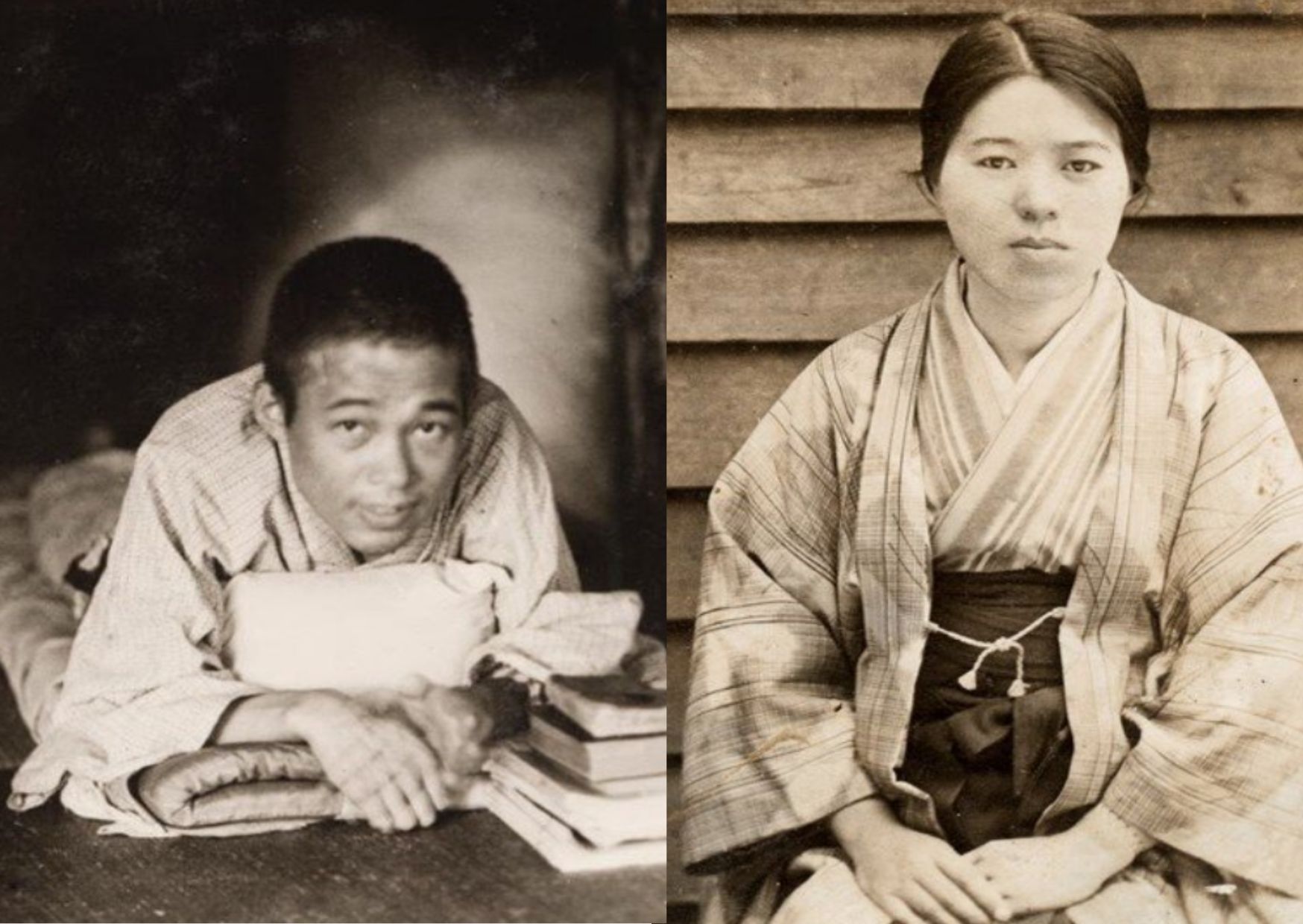
Servant of God Dr. Takashi Nagai (1908-1951) and wife Midori Moriyama Nagai (1908-1945). Image: https://images.squarespace-cdn.com/content/v1/602e278c0b8c3e5483f1dd2a/0c24daec-cbe9-492b-9496-04591c63d2c9/SPOSI+NAGAI.png

Dr Nagai was born in Japan in 1908, of a samurai family. He was one of the world’s first radiologists and an expert in X rays.

In 1928 Nagai entered the Nagasaki Medical College. There he rented rooming space with the Moriyama family, who for seven generations had been hereditary leaders of the Hidden Christians or Kakuri Kirishitan. The Kakuri Kirishitan had gone underground, keeping their faith for hundreds of years between 1614 and 1873, without contact with the Church hierarchy. When the hidden Christians were allowed to return to the mainland, they reconnected with Church emissaries and joined the rest of the Catholic Church.

In 1932, he attended Christmas mass with the Moriyamas and was deeply moved by the faith and piety he saw. He read Blaise Pascal. His faith took a big turn when he read the words of Pascal: “There is enough light for those who only desire to see, and enough obscurity for those who don’t want to.” I guess he was attracted to Pascal because they were both men of science. He studied the Catechism as thoroughly as he studied science.

Nagai was baptized on June 9, 1934, choosing the first name Paul, and married Midori Moriyama, his landlord’s daughter.

In 1937 war broke out between Japan and China and Dr. Nagai was sent to China as a surgeon. There, he treated both Chinese and Japanese soldiers and civilians. He created a small conduit of relief aid that served Chinese families and orphans. He was also a decorated soldier, but his faith in Japanese culture was severely shaken by the brutality he witnessed.

He returned to Japan in 1940 and got his doctorate in 1944. In June 1945, he was diagnosed with leukemia and given three years to live. At this time people were not aware of the dangers of X rays. He told Midori about it, who said in reply: “Whether you live or die, it is for God’s glory.”

On 9 August 1945, the atomic bomb struck Nagasaki. Dr. Nagai was working in the Nagasaki Medical College Hospital. He received a serious injury but joined the rest of the surviving medical staff in dedicating themselves to treating the atomic bomb victims. Returning to his house 2 days later, he found it destroyed and his wife dead. In her hands was a melted object: Midori had been praying the rosary. Months later, Nagai’s injury worsened. According to him, he heard a voice urging him to pray to the priest Maximilian Kolbe, who died in Auschwitz in 1941. St Maximilian Kolbe lived in Nagasaki between 1930 and 1936, and Dr. Nagai was almost certainly his radiologist.

In the following years, Dr. Nagai, seriously ill, spent his life in a small hut, in prayer, contemplation, and work. He continued teaching and wrote books, including the bestseller The Bells of Nagasaki about the bombing. Referring to the Nagasaki Cathedral, he wrote: “These are the bells that did not ring for weeks or months after the disaster. May there never be a time when they do not ring! May they ring out this message of peace until the morning of the day on which the world ends.”

In July 1946 he collapsed and henceforth remained bedridden. He continued to write. He received a visit from Helen Keller in October 1948 and from Emperor Hirohito in 1949. He died in 1951. Some 20,000 attended the funeral. The city of Nagasaki observed one minute of silence while the bells of all the religious buildings rang.

What can we learn from the life of Takashi Nagai?

We learn that Christ goes to find us where we are on the road of life and death. What we call a life of faith is when we decide to walk with Him.

I remember this cartoon. It shows a man kneeling in prayer. And then a rock strikes him from behind. He immediately complains “Jesus, why did you let that rock hit me?”. Then he looks behind and he sees Jesus, standing, with arms outstretched, with hundreds of rocks hitting Him from behind. Jesus tells the man, “Sorry, that one got through.”

Christ is there when we must deal with a loss of millions in our business, when we must discipline our teenage children. He is there when we are diagnosed with cancer. Jesus is there to celebrate with us when our youngest kid graduates college, when you are promoted, when you are able to visit family abroad.

He is there even when you think you don’t want Him to. Or when you think He has abandoned you. Dr. Nagai’s atheism, his wounds, the horror of war, the loss of all his property, the death of his wife, the terrifying effects of radiation—God was present there.

Silent, perhaps. But Dr. Nagai was in the habit of listening, and if it seemed he was not listening, he was doing good, which is also prayer. And so he heard God.

If that sounds familiar to you, it’s because you heard God’s voice. In quiet, you heard His voice. Whatever good deed you may be doing, such as attending a talk, or driving, eating, fulfilling your tasks as a husband or father or friend, all are God’s chances to get through to you.

We can hear Him better. By making an act of the will. Tell God at the beginning of your day “Oh Jesus, through the Immaculate Heart of Mary, I offer You all my prayers, works, sufferings, and joys of this day for all the intentions of Your Most Sacred Heart, in union with the Holy Sacrifice of the Mass throughout the world, in reparation for my sins, for the intentions of all our associates, and in particular, for the intentions of the Pope.”

Each time you say these words, you lift your work to God.

You could fill your day with such words. Or even without words. When we see a beautiful sunset we might say, “Wow, Lord, what a beautiful sunset!”. But sometimes, you just watch the sunset without saying a word. That sunset today might be your wife, your children, or the contract you just drafted that inspires you to say “Thank you Lord.”

I understand that having God in my life does not mean my life will have zero problems. But I know those problems will be opportunities. However, I heard the same from my management consultant. So what difference does it make?

A lot. When you work with Jesus Himself, it’s as if He does the work Himself, and so the work has unimaginable effects.

Like what effects? Merits. One way to understand how merits work is by comparing them to bank accounts and real estate. Merits are what you put in the bank account in heaven that Jesus opened for you when you got baptized. When you do good, you deposit. When you do bad, you withdraw. When you die, the balance determines your real estate in heaven.

Now what does that mean, real estate? There’s no real way of putting in words what no man has ever seen, but I’m quite sure that the smallest property you can own in heaven is at least the size of a galaxy. If you had more merit you would own and operate thousands of that. But it’s no cause for jealousy. I have another analogy for that. In heaven, the least of the saints has a small cup filled to the brim, while the greatest saint has a gigantic cup filled also to the brim. Both are immeasurably happy.

What happens to that account when you are on earth? You deposit and withdraw, but the amount you deposit depends on two things: the love for God with which you do things, and whether you’re in the state of grace, a state of friendship with Him. The deposits and the interest are massive when you love God and when you are in the state of grace. We’ll get to that later.

But first, what happens when you’re NOT in the state of grace? First, of all this state disappears when we commit a grave sin for which we are not sorry. When that happens, we are keeping our distance from the bank. When you’re not in the state of grace, your account probably still grows by small amounts whenever you do good, but you can’t touch your assets. When you die without repentance, you can’t touch the real estate that should be yours.

Instead, you go to Hell. It is a place where nothing has value: one has no freedom of movement, one can’t grow, one can’t be happy. It’s a place where everyone just hates everyone else. We traditionally describe it as a place of fire, because really, the misery of what I tried to describe is impossible to picture otherwise.

But God doesn’t want you to go to Hell. He wants you, all of us, in heaven with as big an account as possible. He won’t force you, though. What He does is to whisper, and when we quiet down, we get to hear Him.

And He stands ready for our return. He has made it easy to get back that state of grace, and restore access to our account, through the Sacrament of Confession.

He also makes it super easy for our account to grow. Many small things we do have great value in the eyes of God. You think your act of kindness is worthy of a million likes on Youtube? That’s nothing to Him; to God, you get a galaxy. And not because of you, but because Jesus is your friend. Recall, when you work with Jesus, it’s as if He was the one earning that value, then accrues it to your account. Every good work, every prayer, with or without words, increases your assets. The value is so big that it can be the start of the conversion of even the toughest souls.

Dr. Haywood Robinson and Blessed Bartolo Longo (1841-1926) are two men who were very far from God once. Dr. Robinson is a Pro-life advocate. After performing hundreds of abortions, he and his wife had a conversion, ending their practice. Blessed Bartolo Longo was an Italian lawyer, and a former satanist priest who, after his conversion, spent the rest of his life promoting the Holy Rosary.

But are merits any good on earth? Yes. Jesus said “Blessed are the poor in spirit, for theirs is the kingdom of heaven,” as the introduction to the Beatitudes in Matthew 5. He said “theirs IS”, meaning, love God and you will be rewarded right NOW. This reward comes with an even greater reward: the chance to suffer with Jesus. Hence, the Beatitudes end with “Blessed are you when people insult you, persecute you and falsely say all kinds of evil against you because of me. Rejoice and be glad, because great is your reward in heaven, for in the same way they persecuted the prophets who were before you.”

So, the more good work you do, the more good work you CAN do. You may not know it, but the patience you showed in traffic today might have brought about the conversion of a criminal.

Imagine what it would be like: you are changing the world and the people around you without you realizing it. You are also changing yourself. When doing good becomes a habit, chances are God will find you doing good at the moment of your death. Death itself becomes a good work, even a prayer.

Living in faith means being afraid of nothing, not even death. Let me correct that. We are afraid of things, we are afraid of death. But a man of faith faces his fears in peace.

The Blessed Virgin’s merits are exceedingly enormous. So enormous that we can think of Her as heaven’s top banker for being the saint closest to God. She can distribute her richesse to anyone, snatching sinners from the gates of hell at the very last minute. The merits of children, of old people, and of the sick are also very large, and this makes it wise to ask them to pray for us.

It is clearly in our interest to do good and to earn grace. Since we work all the time, the opportunities to do good are superabundant. Can I grow and grace and merit by, say, sitting in my car? Yes, if offered up to God. It’s not easy sitting in the car waiting for someone who is late. It’s a passive good work.

If I could grow in grace working my own stuff, why should I pray? Well, God still wants to spend time to converse with you one-on-one. These exclusive face-to-face times with God are what we normally understand as prayer. Here we can praise God, ask for forgiveness, thank God, ask for things, without any other thing on our mind.

We also express our love for God in community, as a family. God wants us to participate in what we call the liturgy, such as the Mass. He wants us to model our lives on the cycle of Jesus’ life. A cycle that goes from birth (Christmas), to suffering and death (Lent), and redemption and resurrection (Easter).

These moments of exclusive time with God are necessary to stay in friendship with God. The Mass and the Eucharist, in particular, are so necessary that the Church requires all Catholics to go to Mass on Sundays and to receive the Holy Eucharist at least once a year, at Easter time. The Church also requires that the faithful confess their sins at least once a year, during Easter time.

Other face-to-face prayers include the Rosary, the Angelus, prayer at meals, making the Sign of the Cross when you pass by a church, making a reverent bow of the head whenever you see an image of the Blessed Virgin or Our Lord. You might also have devotions to a saint like Fr. Pio or Mother Teresa of Calcutta. It’s good to have few of them, as long as they are constant.

Now the catch: What do I have to give up in order to live a life of faith? What do I give up?

St. John the Baptist answered that question: He must increase, and I must decrease (John 3:30). Jesus provides a more graphic description of what it actually means to live a life of faith. He equates it with the Beatitudes, meaning, a life of happiness. And this is what it looks like:

Blessed are the poor in spirit, for theirs is the kingdom of heaven.

Blessed are they who mourn, for they will be comforted.

Blessed are the meek, for they will inherit the land.

Blessed are they who hunger and thirst for righteousness, for they will be satisfied.

Blessed are the merciful, for they will be shown mercy.

Blessed are the clean in heart, for they will see God.

Blessed are the peacemakers, for they will be called children of God.

Blessed are they who are persecuted for the sake of righteousness, for theirs is the kingdom of heaven.

Matthew 5: 1-10

Now, get a Bible and look it up Matthew 5: 1-10.

Let’s illustrate how we might practice reflecting on these words. Again, let’s take the first, Blessed are the poor in spirit, for theirs is the kingdom.

First, begin by understanding the meaning of the words, in their literal sense, and in their extended sense. Poor in spirit could mean a spirit that is not attached to earthly things. It can mean not attached to ideas, or to people, or to ego. Theirs is the Kingdom of Heaven. For people on earth, heaven is not a place. Instead, it is a state of being in the presence of God.

Second, ask What does it mean to YOU right now? God might be telling me that if I detach myself from my wealth or my pride or my projects I will give Him a chance to take greater possession of my soul. We know how much pain pride can bring.

Realize also that closeness to God does not mean one will never suffer temptations. Also, poor in spirit and possessing the kingdom of heaven here on earth does not shield me from hardships, from the possible loss of all my wealth, from my personal humiliation. But, the life of faith gives you the key to facing temptations and hardships with joy and peace. Faith teaches me to detach myself so that I can be attached to God. The reward will be the peace and joy of knowing I have done God’s will, and that He has my back.

Third, make a resolution to do something. I therefore resolve to be detached from my wealth, my pride, my achievements. As an immediate resolution I will be generous with my time and money, spend more time with my family and with God, and give more alms to the poor and to the Church. And if I want to give more, then it’s just natural that I will want to earn more. Material wealth is not incompatible with faith.

Certain consistent practices of prayer keep the faith alive. Mental prayer is one. There are many other signs, such as regular acts of piety. I’ve often heard it said that a common sign is that a person is more cheerful and more peaceful. Often, the person becomes a better worker, a better friend, a better father. Yet another sign is the you bring others the Good News.

So, let’s wrap it all up. A life of faith is a life lived walking with Jesus Christ. It is shown through thinking, feeling, and acting like Jesus Christ, in whatever profession or situation you find yourself. It has consequences, especially joy and peace. A life of faith on earth will be a life of suffering and joy, shadow and color, a chiaroscuro worthy of the best artists.

And one day God, we will see God himself. And this vision and presence will be without end.

(Calamba, 230717)

We are not our thoughts but our actions

So, it’s been raining hard lately. If I wear a raincoat can I make the rain stop?

But that’s what happens when people think they can address their issues through worry, guilt, and anxiety. Nothing you do can make problems disappear except to action. Worry, guilt, and anxiety immobilize. Furthermore, to meet the challenges better one must have one’s wits together. An brain in the grip of emotion is not logical.

You can choose to wear anything you want as none will change the weather anyway. But though you may not stop the rain by wearing a raincoat, you sure have more option than with a suit. You can choose what is “appropriate” or “comfortable”. It’s the same with thoughts.

The question then is: “Is my current thought more comfortable? Am I happier with it? Does it allow me to see the bigger picture?” If “yes”, then that’s the appropriate thought to adopt.

I can think, for example, of a situation where a guy gets dumped by his girlfriend. The employee can either accept that judgment as truth, then pity himself like we’ve seen happen to some of our friends. Or, he can replay that memory but replacing the girlfriend’s voice with a Chipmunk voice. As I said, you can think anything you want. I bet the Chipmunk voice can be funny, which puts our friend in a more calm position where he might see that the girlfriend may just be emotional, or possibly insane.

Strong negative emotions can cause tunnel vision. This prepares us to channel our resources to meet a threat. When you get leg cramps while swimming in the sea, when your tire bursts while driving, or when you’re held up by an armed robber you will not want to be distracted from taking right action.

But most daily threats are not like that. Yet when like our friend you get dumped, your world can get dark sometimes for days. I’ve heard of at least one case of suicide. A calm thought, however, will remove tunnel vision. You will see the bigger picture, you will see the facts. You can take more productive action.

Calm thoughts also allow you to ignore fears, like whether or decisions are going to work out, or fear of “hurting”.

For example, I tell my younger friends “If your girlfriend dumps you, I mean dumps you, just tell her ‘OK, I wish you the best,’ and move on. To my older friends dumped by their equally old girlfriends, I say “It gets harder for them to replace you than it is for you to replace them. Move on.” Some of the best decisions can also be the harshest. But a reason and common sense allow you to make that call with confidence. And you’re not stuck with overthinking and paralysis.

How do you get into a calmer state of mind? Recognize that you’re under the grip of an emotion; name that emotion, experiencing it fully. I would even say enjoy it. Two things happen. First, naming an emotion is rational, and rationality and emotion cannot occupy the mind at the same time for long. Second, emotions are tiring: even a strong one will have to subside, about 2.5 min on the average, before going back on line.

For more chronic cases of worry, anxiety, guilt, fear, depression, and others, the practice of mindfulness and meditation bring many benefits.

Some people object that mindfulness and meditation are a form of escapism or surrender. Not necessarily. From the above, we see that they are ways to get back control. I like to imagine how the samurai do it.

Before a battle samurai would strategize and plan. But at the point of fighting they think about…nothing. They certainly don’t think that their opponents will come running to them with their tails between their legs. They don’t think about winning, losing, living, or dying. They don’t expect anything, and they accept everything. They only think about aiming and firing and swinging the sword. They only think of their job, not the outcome. They win? Fine. They lose? Fine. Things take longer than expected? Fine.

No illusion, no disillusion.

Image: https://rlv.zcache.co.uk/yu_courage_bushido_virtue_samurai_kanji_6_cm_round_badge-rf08e7dd0de4e4b0091b1774dbdb4bbc5_k94rf_630.jpg?rlvnet=1&view_padding=%5B285%2C0%2C285%2C0%5D

One of the 8 virtues of the samurai is “Yu”, bravery and courage, revealed by decisive action. Talking about courage, thinking about courage, but not doing it — that is not courage. Once you perceive what is right, do it, without hesitation.

“Those who hesitated at the moment of trial, who did not act with clarity and determination when the moments of crisis were upon them, deserved the limitations to which their fears committed them.”

Robert Ludlum, author

We prefer to wear certain clothes under certain weather conditions, we also may be comfortable with certain thought patterns. Some are naturally impulsive, some naturally neurotic. But the actual thought at the moment of crisis has to be appropriate, not “preferred”. I agree that the ability to lay down a preference in favor of something more appropriate is trained. Some people never get beyond their childhood patterns because they lack training or they don’t learn from experience.

And authenticity in this context is not a virtue.

Sometimes, it is. It may be good to have pessimists in one’s TEAM. Good for you, good for them. They bring you down to earth, you bring them to where they are functional. It may be good to have all kinds of people on your team AS LONG AS THEY CONTRIBUTE MORE THAN THEY TAKE AWAY. Freeloaders contribute nothing. Constant complainers and gossips create more damage that what they put in. Have nothing to do with them.

Interestingly, psychopathic personalities may be quite useful. They don’t care about how people feel or what they say about them; and so they can make tough calls that the rest of us are too scared or sensitive to make. There is a cost to dealing with psychotics, and sometimes the cost may be too much, but as long as the benefits significantly outweigh these costs, fine.

By your fruits you will know them.

Understand that everyone is acting mainly, even always, for their own self interest. Even when they go emotional, seem to act psychotic, or dump you — this ONE THING is common to all of us. Personally, I have made better calls assuming self-interest more than any other motive. Even when I ask people to be generous, I always emphasize it’s good for them. And that is true.

We’re all defective, we all have our tendencies. Fine. We’re not our thoughts, but our actions.

(Q.C. 230716)

The crafting of the soul

This is an essay on work. I will stress only parts of it. Work as Service, Work as Failure, and then we end with a Parable. It’s a very short talk, so stay awake.

The first part was inspired by a talk given by Dr. Paul Dumol years ago, where he talked about how words we use shape how we work. The word hanap-buhay highlights income. Trabajo, Spanish actually, highlights tedium. And the word gawain highlights activity. Altogether, in the filipino language work means a tedious activity that earns income. Figure out for yourself the implications of that.

But what do the Japanese use? They use the word shigoto. Literally, shigoto means a service done to others. The concept is profoundly spiritual. Hence, Japanese are proud if their work contributes to someone else’s, and ashamed if it doesn’t. You are familiar with that photo of a Japanese train conductor bowing deeply to passengers to apologize because the train was 2 minutes late. It matters little what the work is: Japanese street sweepers love their craft as executives do. This mentality has been changing, with the lifting of lifetime employment and the prevalence of hikikomori — young Japanese who refuse to work — but the basic value is still shigoto. And we still see it in the high quality of Japanese products.

Now, for the second part, Work as Failure.

Failure is really two things. First, failure in the mind. You expected your career to be wonderful, but it’s not. You expected rapid promotion, you’re still stuck. You’re tired, harassed. You’re afraid of making mistakes. You made a big mistake. Now everyone thinks you’re incompetent. You wanna quit.

So far, so good.

Then you quit. Ah, now you REALLY failed. That’s failure in act.

We all fail in the mind sometimes. You think a guy like Elon Musk is mostly positive? Even the best of us feel down, stupid, discouraged, we feel like imposters, and we can feel this hundreds of times a day.

But what makes some people great is that they stand up and deliver regardless of how they feel. Great work is rare not because genius is rare, but because relentlessness is rare.

So then your thoughts don’t define you; only your actions do. And action is the key to changing thought. So, guys, be relentless. Do what you have to do in spite your dark thoughts, your blunders, and the chaos in your world. Be relentless when the only thing you have left is relentlessness.

These verses were nailed on a ship’s mast:

If you can force your heart and nerve and sinew
To serve their turn long after they are gone,
And so hold on when there is nothing in you
Except the Will which says to them: ‘Hold on!’

If you can fill the unforgiving minute
With sixty seconds’ worth of distance run,
Yours is the world and everything that’s in it,
And—what’s more—you’ll be a Man, my son!

Rudyard Kipling (1865-1936), “If”

If you don’t download this poem that I just cited
One of the best to be penned by Rudyard Kipling
You’re screwed.

Finally, a parable.

Image: https://journals.sagepub.com/cms/10.1177/07475284231164466/asset/images/large/10.1177_07475284231164466-img1.jpeg

Once upon a time in Florence there lived an old sculptor and his young apprentice. Their days were filled with a sacred rhythm of rituals, a dance between man and marble, chisel and hammer. Even if they were sleepy, dawn always saw them preparing their blocks, examining each for hidden faults and grains, followed by the sharpening of their tools, a process as meticulous as the act of carving itself.

The studio was littered with remnants of their toil. Discarded blocks with flawed faces and malformed limbs lay strewn. But the sculptor taught his student that mistakes were stepping stones on the path of mastery, showing the way by not being the way.

One day, after months of labor and a myriad of shattered blocks, a beautiful statue stood in the corner of the studio. It was the statue of a horse, his face radiant with divine grace, his mane flowing like a gentle river. The student sighed in admiration, “Master, it’s beautiful. Our work is complete.”

The old sculptor, a smile on his face, nodded, his gaze shifting from the statue to his apprentice and back to the shards scattered across the floor. “Yes, it’s beautiful,” he agreed, “but it is not the only work that’s complete.”

The student, confused, looked at his master. Who, understanding, elaborated, “We may have made this statue, yes, but it’s just an echo of our journey, not the destination.”

“Look at these discarded blocks,” sweeping his gaze across the littered floor. “Each is a moment we learned, an occasion we improved, a time we grew. See that one there? Remember I forced you to make it because you were so discouraged? See how it turned out? These discarded prototypes are the building blocks of who we are now.”

The student looked again at the littered workspace. And felt the beginnings of mastery.

“Every time we strike the hammer and chisel, we make a choice. Choices carve a habit. Habit, a virtue. Virtue, a character. Character, a destiny. The greatest work of art that comes out of this studio,” the sculptor said, “is our soul.”

(Q.C. 230712)

Ethics class on conscience

I asked my students in Ethics this semester to write a short story on the theme “You may escape the law, you may escape the ethics committee, but you can’t escape your conscience.”

Image: https://www.scienceabc.com/wp-content/uploads/ext-www.scienceabc.com/wp-content/uploads/2022/10/Moral-decision-Being-torn-between-angel-and-devil-Hatched-vector-drawing.jpg-.jpg

Their stories highlighted a number of points.

1. Sin is a terrible thing. From the young scientist who fabricated the results of a drug test that killed people, to the guy who patched organ parts in a demented attempt to recreate his daughter, sin is all the more ugly because it is chosen. On the other side, one must choose to repair it, then one might finally be set at peace. Otherwise, conscience will scream. Not a few wrote about the suicide of the protagonists.

2. We think we are kings and queens. But, in fact, there are limits. Look at any playground: if you don’t follow the rules no one will play with you. You can twist those rules, play your own game, but in the end you will have to apologize or the other kids won’t play.

3. Principles are better guides than rules. Legally, one can obtain a patent if the person one stole the idea from has no proof he was the originator. Laws define actions and circumstances, but cannot possibly define all the combinations. But the spirit of the law is based on principles of fairness. Conscience judges on principle, and punishes the actor with remorse. An actor might prefer to have his PhD rescinded than to bear the screams of his conscience.

4. Sometimes one will meet a situation that will challenge one’s sense of right and wrong. Maybe one is faced with imminent death and must administer an untested compound at risk. Often, lesser risks are more dangerous because they are easier to run. But then, being based on unethical principles, progressively worse decisions can be made down the line as they were not nipped at the bud. Guarding the conscience is a life’s work.

5. It is wise not to drown the screams of conscience. People on the right side of it recognize the signs of emotion and reason, then muster the courage to bite the pill. Nonetheless, the struggle is real:

• Strong emotions like rage, and strong feelings like agony can trump reason, and the deed may be hard to repair. But some people are able to choose the most uncomfortable outcomes, like the loss of a PhD, in exchange for the knowledge of having done the right thing.

• Often, as with job promotions, the desperate need to be right and to advance blinds one to seeing the immediate consequences of, say, fabricating a photo that someone might not even notice. Of course, we know someone eventually does.

• And then there’s simple cowardice in the face of peer pressure — “what will my boss say if I have no results to show while everyone else does?”

What can one do to stay ethical?

Always, heed the call of conscience, which is harder to ignore the more terrible the sin was. But that voice can be drowned out if our infractions are minor, and that leads to a vicious spiral. But we will hear it. When we do, let’s listen. Conscience can be wrong, its reasoning may be misplaced. But at least by lending it our ear we don’t take the first step in a deadly spiral.

Beware rationalization. This is easy for adults, because by habit we find a reason for doing any thing, even if we have to invent that reason. But you must ask: what do you base your ethical rules on? Do you base them on relativism, i.e., right is what I make it? The most insidious of these rationalization is, I think, relativism. Without a sense of an objective basis for right and wrong, there is no point to even discuss ethics.

Do you base them in law, i.e., if it’s not forbidden it’s allowed? Do you base them on a sense of duty? Do you base them on the nature of the act, or its consequences, on its lack of perfection? Do you base them, heaven forbid, on superstition?

Do you think that the ends justify the means? That pleasure is more important if immediate rather than delayed? Is it enough to look impressive rather than go through the effort of being impressive?

And then, what are your intentions? And how do the circumstances make the sin worse or less bad?

These considerations suggest that ethics should be a part of the curriculum and rigorously discussed and debated.

We will at some point ask the students to make sacrifices. I was moved when one student said “Sir, in this case I think I would rather sacrifice short term credit for long term trust.” I told her she just summarized the whole of ethics class.

The more effective sacrifices will not be in big things. They would be in the little challenges, which represent daily exercises rather than tournament competitions. Most of these small challenges will be anonymous, in areas where we would be ashamed if we were seen. Small challenges are often also in areas where we are afraid, and thus fail to do good when it is clearly in our power to do so.

Finally, it is good to confess our evil deeds. And on the flipside, to forgive. The consequences may be painful even if temporary. But still, the punishment will be a something in a sea of infinite somethings that took place in our past, present, and future.

We got this.

We do wrong. But, I think there’s no better peace than knowing we have been able to right our wrongs.

(Q.C. 230712)