Does matter explain everything?
The driving force behind the idea that faith is not an adequate explanation for reality is rooted in the idea that the only truth is what can be measured — observed, quantified.
The problem, of course, is obvious: that idea, in itself, is a belief. It is an article of “faith”. It is also called “physicalist reductionism”.
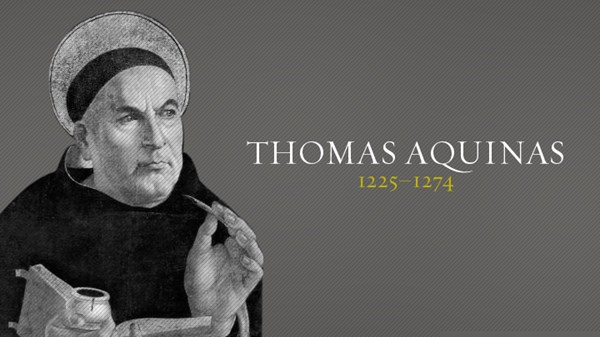
Aristotle and Thomas Aquinas deny that matter with its properties and forces are an adequate explanation of the world. They argue that all the material things of nature are shot through with form; where there is form there is a manifestation of mind – a mind irreducible to one thing or all of them, yet permeating them all and suffusing them with form and working power.
The forms of the things of nature are a manifestation of the mind of God, and matter is formed according to his wisdom, and his wisdom is formulated in the principles and laws of nature.
A material thing is matter organized or configured in some way, where the organization or configuration is dynamic rather than static. That is, the organization of the matter includes causal relations among the material components of the thing as well as such static features as shape and spatial location. This dynamic configuration or organization is what Aquinas calls ‘form’ and what a modern mind might call ‘design’. A thing has the properties it has, including its causal powers, in virtue of having its specific configuration, structure, or design. The thing’s operations and functions derive from its form.
Destroy the form, violate the design, and that material thing is “damaged”, “dysfunctional”, “dead”.
Physicalist reductionism claims that physics explains everything, specifically physics. Does it?
If physicalist reductionism were true, then one science is completely reducible to another. One important challenge to this idea comes from biology: the observation of emergent properties.
Emergent properties, a concept pervasive in various scientific disciplines and not just biology, refer to phenomena that arise in complex systems but cannot be deduced solely from the understanding of their individual components. While emergent properties provide a rich source of inquiry in fields like biology, sociology, and economics, their presence poses a unique challenge within the realm of physics.
Physics, with its reductionist approach, seeks to understand the universe by dissecting it into its fundamental constituents and describing their interactions through mathematical laws. However, emergent properties defy this reductionist paradigm, showcasing that the whole is more than the sum of its parts. The challenge for physics lies in elucidating these emergent phenomena from the microscopic constituents it traditionally studies.
One example of emergent properties is consciousness in neuroscience. The human brain, composed of billions of neurons, exhibits consciousness—an emergent property that cannot be directly explained by understanding individual neurons. The gap in our understanding of how microscopic neural activities give rise to subjective experiences highlights the complexities that emergent properties introduce.
Just how this happens was the subject of a bet between neuroscientist Christof Koch and philosopher David Chalmers. In a 1994 conference Toward a Scientific Basis for Consciousness, Koch asserted that consciousness was scientifically tractable. For example, it can be explained by electrical oscillations that are perceived. Chalmers doubted that strictly physical process could account for WHY perceptions are accompanied by conscious sensations. In 1998 Koch bet Chalmers a case of fine wine that the mechanism by which the brain’s neurons produce consciousness would be discovered by 2023.

But identifying neural correlates of consciousness proved more complex than expected, with crucial aspects like self-awareness overlooked in studies. How brain processes create subjective conscious experience remains unsolved — and will remain that way for a very long time.
On June 25, 2023, during the 26th annual meeting of the Association for the Scientific Study of Consciousness (ASSC) at New York University, Chalmers was declared the winner. During the main event, Koch appeared on stage to present Chalmers with a case of fine wine.
This amusing yet significant wager between the two thinkers are described in the following articles:
https://bigthink.com/neuropsych/consciousness-bet-25-years/
It is challenging for physics to reconcile the macroscopic world with the microscopic laws that govern it. While physics excels at explaining fundamental particles and their interactions, the leap from quantum mechanics to classical mechanics and further to the macroscopic world, where emergent properties manifest may well prove impossible in many areas like neurophysiology. This transition is often described as the measurement problem or the quantum-to-classical transition problem.
Quantum mechanics, the bedrock of microscopic physics, operates with probabilities and uncertainties at its core. Yet, emergent properties, such as consciousness, seemingly defy this inherent quantum uncertainty. Bridging this gap requires a theoretical framework that harmonizes the microscopic and macroscopic realms, a task that remains elusive.
While physics has excelled in understanding the fundamental constituents of the universe, the emergence of complex properties and the elusiveness of reconciling the apparent contradictions between the microscopic and macroscopic realms remain. The pursuit of a unified theory that encompasses both micro and macro scales remains one of the most intriguing and elusive quests in the realm of scientific inquiry. At this point the sciences cannot be reduced to physics.
Some might say such a reduction could be done in principle. But this is circular. It seems reductionism is more of a fantasy. Scientists recognize their science has limited tools and doubt we can reduce it all to one science.
Some argue that there is no better method than measurement. In philosophy, intuitions are evidence. Therefore, by their argument, conclusions arrived at by intuition are not valid — yet the idea that truth is only what can be measured is itself an intuition.
What we actually do in daily life is we reflect on experience, and this reflection leads to truths. We intuit that we are free, have a purpose, can know the truth; the search for God is not pointless. We intuit our inherent dignity, that life is worth living, love is real, and consciousness too. If reductionism is true all this is false, all these are illusions of folk psychology or past.
They say let’s just accept God doesn’t exist, we’re no different from machines, love is just a chemical, relationships are just conveniences. Evidence clashes with philosophical intuitions.
But again, it is NOT science that makes these claims, but are implications of a specific philosophy, which clashes with intuitive evidence. We see that physicalist reductionism is FOR the destruction of human beings; its conclusions make us depressed. Austrian psychiatrist Viktor Frankl (1905-1997), author of Man’s Search for Meaning, attributed mental disease to the propagation of physical reductionism and predicted its prevalence will increase. Many disorders come from an existential void and have become widespread today.
Intuition, philosophy, open us to the idea that we have souls, that our form was made for something. That something is for love, and truth and God. The reasonable thing, therefore, is to reject physicalist reductionism as a false and empty philosophy.
True wisdom is more than science and way more than physics.
(Q.C., 231203)


 jaylazzo
.jpg?w=900)