A proud toast to a student

Good afternoon to all. Especially to the proud parents of J___, to her friends, members of the administration, and members of the community, for inviting us, her team, and most of all for the support you have given to her. Her victory is as much your pride as it is ours.

First, of all, let me tell you about how close we are. [Pointing to my team, four young men huddled at a table just in front of me to my right, who, like me, have just had a first taste of a meal topped by a well crafted Nigerian salad, and now restlessly anticipating the third big event, African dancing.]. We really are seated this close in the lab. D__ sits directly behind J__, N__ to her right, R__ to her left. At this distances, a word that flies from the mouth of one takes a fraction of a fraction of a second to land on the receptive ears of another. And so do viruses, like COVID, and this other virus that infects the floor every year. And so does news. Within minutes, word about a tiny accident we had at the lab spread throughout the school. We spilled a bottle of Congo red, a thick, nasty goo, inside the autoclave; you could say we contaminated the decontaminator. [Laughs]. I did say that one day we would be laughing about this.

Another thing about distances. J__’s dorm is quite far from our Institute. One could compose two chapters of a dissertation walking from there. Or, compose content for a Youtube channel. About two years back, we discovered that J__ had a Youtube channel. We were all amazed, most of all because we found out that J__ sang very well. She took time out to work on her research, but now she’s back, and we’re about to see new posts. Please visit her channel, @ ___.

J__’s claim to fame, as you all know, is that she named a bacteria. In our business, the chance to name a new species is a big thing. I would not have minded if she had named it anything she wanted. She could have named it Lysinibacillus amarachii, or Lysinibacillus kenjilimiensis. I’m so relieved she did not name it Lysinibacillus nimbbiensis; that would’ve been ridiculous. The story of this bacterium began when we discovered it in 2014; ten years later, J__ finished its story. No, she opened a new chapter. It wasn’t easy. Shakespeare asked “What’s in a name?” For J__, it meant five years of tears and fears — you know, during her defense I was probably more nervous than she was, and she defended her work so well.

If there’s one word to describe J__, it would be “works hard”. OK, that’s two words; might as well add a third: relentless. J__ is relentless. In this business we fail a thousand times to succeed once, and when we do, we celebrate, big time. J__’s thesis is this thick [putting up my thumb and forefinger to demonstrate an inch]. But if we had to write about everything that we did, the failed experiments and guesses abandoned, this room wouldn’t fit the volumes that would have to be written. And J__ couldn’t have done it without the support of her team [pointing the spotlight to the four young men]. We couldn’t have done it without the advice of her readers Dr. D__ and Dr. D__ who hosted J__ at her lab for some days. J__ did all this because you supported her, you her family and her friends, especially her friends from Amicos, you who have seen her spiritual battles, which we in the lab were as privileged to observe. All these difficulties, endured, conquered, with friends, team, and family, have sculpted J__’s character into the strong spirit we honor today.

And so, here we are.

The words we use in philosophy, and theology, like substance, being, substantiated being, are imbued with a clarity that makes no mistake as to what they mean. In science, words are coated in a thick layer of uncertainty, of probability, over an extremely thin but sweet blanket of possibility; it is that last one that keeps us going. J__ dug in deep, penetrating, so that now, the name Lysinibacillus zambalensis will forever be connected with her name.

To close. Louis Pasteur said, Dans les champs d’observation, le hasard ne favorise que les esprits préparés. Jean Claude here can tell you this means “Chance favors the prepared mind.” J__ is a very well prepared mind, and with excitement, we look forward to all the awesome things you, J__, will do, moving forward.

Again, a big thank you to all of you. And congratulations to our new doctor, Doctor J__!

(Silang, Cavite, 20 July 2025)

Science and Faith: Physicalist Reductionism

Does matter explain everything?

The driving force behind the idea that faith is not an adequate explanation for reality is rooted in the idea that the only truth is what can be measured — observed, quantified.

The problem, of course, is obvious: that idea, in itself, is a belief. It is an article of “faith”. It is also called “physicalist reductionism”.

Aristotle and Thomas Aquinas deny that matter with its properties and forces are an adequate explanation of the world. They argue that all the material things of nature are shot through with form; where there is form there is a manifestation of mind – a mind irreducible to one thing or all of them, yet permeating them all and suffusing them with form and working power.

The forms of the things of nature are a manifestation of the mind of God, and matter is formed according to his wisdom, and his wisdom is formulated in the principles and laws of nature.

A material thing is matter organized or configured in some way, where the organization or configuration is dynamic rather than static. That is, the organization of the matter includes causal relations among the material components of the thing as well as such static features as shape and spatial location. This dynamic configuration or organization is what Aquinas calls ‘form’ and what a modern mind might call ‘design’. A thing has the properties it has, including its causal powers, in virtue of having its specific configuration, structure, or design. The thing’s operations and functions derive from its form.

Destroy the form, violate the design, and that material thing is “damaged”, “dysfunctional”, “dead”.

Physicalist reductionism claims that physics explains everything, specifically physics. Does it?

If physicalist reductionism were true, then one science is completely reducible to another. One important challenge to this idea comes from biology: the observation of emergent properties.

Emergent properties, a concept pervasive in various scientific disciplines and not just biology, refer to phenomena that arise in complex systems but cannot be deduced solely from the understanding of their individual components. While emergent properties provide a rich source of inquiry in fields like biology, sociology, and economics, their presence poses a unique challenge within the realm of physics.

Physics, with its reductionist approach, seeks to understand the universe by dissecting it into its fundamental constituents and describing their interactions through mathematical laws. However, emergent properties defy this reductionist paradigm, showcasing that the whole is more than the sum of its parts. The challenge for physics lies in elucidating these emergent phenomena from the microscopic constituents it traditionally studies.

One example of emergent properties is consciousness in neuroscience. The human brain, composed of billions of neurons, exhibits consciousness—an emergent property that cannot be directly explained by understanding individual neurons. The gap in our understanding of how microscopic neural activities give rise to subjective experiences highlights the complexities that emergent properties introduce.

Just how this happens was the subject of a bet between neuroscientist Christof Koch and philosopher David Chalmers. In a 1994 conference Toward a Scientific Basis for Consciousness, Koch asserted that consciousness was scientifically tractable. For example, it can be explained by electrical oscillations that are perceived. Chalmers doubted that strictly physical process could account for WHY perceptions are accompanied by conscious sensations. In 1998 Koch bet Chalmers a case of fine wine that the mechanism by which the brain’s neurons produce consciousness would be discovered by 2023.

David Chalmers and Christof Koch. Credit: John Horgan. Image: https://static.scientificamerican.com/sciam/assets/Image/2023/Horgan%20photo2%20IMG_0364%20(1).jpg?w=900

But identifying neural correlates of consciousness proved more complex than expected, with crucial aspects like self-awareness overlooked in studies. How brain processes create subjective conscious experience remains unsolved — and will remain that way for a very long time.

On June 25, 2023, during the 26th annual meeting of the Association for the Scientific Study of Consciousness (ASSC) at New York University, Chalmers was declared the winner. During the main event, Koch appeared on stage to present Chalmers with a case of fine wine.

This amusing yet significant wager between the two thinkers are described in the following articles:

https://www.scientificamerican.com/article/a-25-year-old-bet-about-consciousness-has-finally-been-settled/

https://bigthink.com/neuropsych/consciousness-bet-25-years/

It is challenging for physics to reconcile the macroscopic world with the microscopic laws that govern it. While physics excels at explaining fundamental particles and their interactions, the leap from quantum mechanics to classical mechanics and further to the macroscopic world, where emergent properties manifest may well prove impossible in many areas like neurophysiology. This transition is often described as the measurement problem or the quantum-to-classical transition problem.

Quantum mechanics, the bedrock of microscopic physics, operates with probabilities and uncertainties at its core. Yet, emergent properties, such as consciousness, seemingly defy this inherent quantum uncertainty. Bridging this gap requires a theoretical framework that harmonizes the microscopic and macroscopic realms, a task that remains elusive.

While physics has excelled in understanding the fundamental constituents of the universe, the emergence of complex properties and the elusiveness of reconciling the apparent contradictions between the microscopic and macroscopic realms remain. The pursuit of a unified theory that encompasses both micro and macro scales remains one of the most intriguing and elusive quests in the realm of scientific inquiry. At this point the sciences cannot be reduced to physics.

Some might say such a reduction could be done in principle. But this is circular. It seems reductionism is more of a fantasy. Scientists recognize their science has limited tools and doubt we can reduce it all to one science.

Some argue that there is no better method than measurement. In philosophy, intuitions are evidence. Therefore, by their argument, conclusions arrived at by intuition are not valid — yet the idea that truth is only what can be measured is itself an intuition.

What we actually do in daily life is we reflect on experience, and this reflection leads to truths. We intuit that we are free, have a purpose, can know the truth; the search for God is not pointless. We intuit our inherent dignity, that life is worth living, love is real, and consciousness too. If reductionism is true all this is false, all these are illusions of folk psychology or past.

They say let’s just accept God doesn’t exist, we’re no different from machines, love is just a chemical, relationships are just conveniences. Evidence clashes with philosophical intuitions.

But again, it is NOT science that makes these claims, but are implications of a specific philosophy, which clashes with intuitive evidence. We see that physicalist reductionism is FOR the destruction of human beings; its conclusions make us depressed. Austrian psychiatrist Viktor Frankl (1905-1997), author of Man’s Search for Meaning, attributed mental disease to the propagation of physical reductionism and predicted its prevalence will increase. Many disorders come from an existential void and have become widespread today.

Intuition, philosophy, open us to the idea that we have souls, that our form was made for something. That something is for love, and truth and God. The reasonable thing, therefore, is to reject physicalist reductionism as a false and empty philosophy.

True wisdom is more than science and way more than physics.

(Q.C., 231203)

Science and Faith: Does science explain everything?

No legit scientist ever believes that.

Louis Pasteur (1822-1895), one of the greatest scientists who ever lived, was a devout Catholic. Image: https://encrypted-tbn0.gstatic.com/images?q=tbn:ANd9GcTM9_NNjzgAgjpzB6X8K8TE2PRKuqhK-PgjYw&usqp=CAU

In fact, most people do not really understand the way scientists think. It may, indeed, look like our job is to prove explanations, which we call hypotheses. But, in fact, we work to DISPROVE our hypotheses. When we fail to disprove a hypothesis, we don’t might “Therefore, that’s the way it works,” as a shortcut. What we really mean to say is: “It is probable that’s the way it works.

What else is a probable explanation?” is another thing we think about all the time. Another way of saying all this is that scientific explanations (theories, hypotheses) are falsifiable, i.e., they can be proven wrong. If an explanation cannot be proven wrong, it simply means it is not within our field to study it with our methods.

Can I prove that a picture is beautiful? Can I prove that a sunset is awesome? Can I even explain what awesome is? I once visited the Louvre in Paris with the renowned artist and philosopher Dr. Paul Dumol. We were contemplating a huge mural whose author I forgot. I thought it was beautiful. But then after a few seconds Dr. Dumol just said “It’s decadent,” and walked on. It’s a judgment that did not require an explanation.

Shakespeare was right. “There are more things in heaven and earth, Horatio, than are dreamt of in your philosophy.” And there are more things in heaven and earth than are dreamt of in all of science.

Scientism is an exaggerated understanding of what science is and what it can do for us. Scientism blows science as such all out of proportion, and then aims to organize the world according to the exaggeration. We can say that scientism is the view that science alone explains all things, and science alone is the guide to life.

But it’s fair to ask: Is reason or faith sufficient for life? Many people equate reason with science. They make a jump and conclude the same about truth: truth is anything validated by the methods of science. In other words, truth is what can be measured. This is scientism, an exaggeration of science. It’s a variation of the belief that science alone explains all things.

Science is one thing, Scientism is another. Science is powerful, useful, tremendous benefits and insights. And knows its limits. Scientific methods are designed for specific questions under specific conditions we call experiments. Many things simply lie beyond experiment, such as the decadence in a painting. The attributes of the Infinite Being are clearly beyond these methods, too. Certain attributes that underlie the meaning and the purpose of life, such as income, job satisfaction, and sense of poverty may be measured numerically, but no one really says all life is about income.

Science is also not adequate for settling moral issues. This is what we call in ethics the Should/Is problem: Does the fact that something is so and so mean we should do so and so about it? Science and Ethics are two disciplines precisely because of this problem. I’m not saying science and ethics contradict just because they don’t look at reality in the same way. However, I imply that a rich life involves as appreciation of both sets of concepts and methods.

I do understand, however, that the should/is problem is difficult, just as it is difficult to understand philosophical or scientific concepts over which we have little training to handle. Some, however, take the easy way out, raise their hands in resignation, and say that God, meaning, and morality are totally private matters to many.

Which leads to this ultimate conclusion: truth is what I make it to be. Which in itself is logically untenable.

I viewed this Youtube recently of a man holding up a sign that said “Feminists are smelly.” A woman walks up to him, and angrily accuses him of saying offensive things to women. With a smile, the guy goes, “Oh, are you a woman?” The woman was caught of guard, and could only reply: “Oh, so that’s it. I’m non binary, it doesn’t matter.” He was using woke reasoning, relativistic reasoning, against her. If everything is private, then everything is right, then nothing is wrong, then I should have no qualms selling you the gun that will kill your mother.

Science was never meant to be a compass to life. The proverbs we learned as children are not scientific statements in the sense that no one has done a randomized clinical trial to prove that the early bird gets the worm. But these parables convey truths, which we have verified through experience — imperfect experience, and it’s also true that the early worm gets eaten. More importantly, we know instinctively, we know through common sense that proverbs are true. They’re not just “scientific” truth, meaning, truth is not limited to just what is scientific.

But what underlies the truth of experiment and the truth of common sense is reason. God has given everyone the capacity to reason. In a sense, it reason is a spark of the spiritual because it covers more than just matter. Like sound, we can hear things within a RANGE. Similarly, no science even combined extend through the whole range of reason. Philosophy can go beyond the range of scientific reason, yet can’t go beyond into the reason of contemplation. We experience this reason as conscience, a judgment we make on practical acts. We feel bad when we do something wrong, without necessarily having to go through a complex logical process, and that feeling keeps us from getting into trouble. In some cases, though, our conscience will require a long logical study before it makes a judgment. We’re able to do both simple and complex reasoning, intuition and logic.

Reality is not all science, not all faith. Both enrich our minds, our wills and our emotions.

God created us and gives us the gift of reason, and in a special way, the gift of faith. By reason we come to know God, by faith we come to obey and love Him. And for what purpose? To find, then to be, with Him whom we came to know.

(Q.C., 231121)

Science and Faith: Wisdom

What is the relation between Science and wisdom?

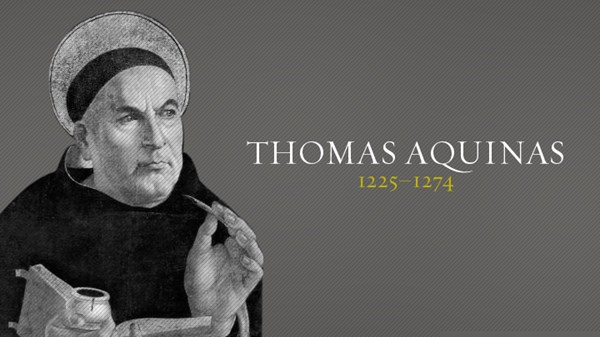
St. Thomas Aquinas (1225-1274), a great philosopher and theologian, advised us that, as we use the light of reason that belongs to human beings by nature, we should also have an open mind to the supernatural: to the possibility that, by grace, a higher light could illuminate our minds.

Thomas Aquinas. Image: https://www-images.christianitytoday.com/images/67498.jpg?h=337&w=600

This supernatural light — the light of faith — does not extinguish the light of reason or undermine the truths discovered by human sciences; rather, it supplements and aids reason, helping us to see more deeply into the truth of reality as a whole, which comes from God and has its ultimate destiny in him.

The idea that what we see is not all there is — I get that. But, for that idea to lead to wisdom one must intuit that there is a purpose in anything that exists. We do not have to know what that purpose is ultimately; perhaps all we can see is an immediate purpose that we neither understand nor approve of.

And this brings us to the idea of miracles. Are they real? Why, for instance, would God resurrect a dead body if the laws of nature, that God also wrote, say that corpses decompose?

Well, God, who wrote the laws of nature, is certainly free to suspend them for a reason, or for no reason. That’s what free will is. But resurrection, or any miracle such as the sudden cure of a cancer, is not in itself unreasonable. The legend of the Phoenix, and the amazing phenomenon of the placebo effect, point to the idea that we do not find such suspensions of the laws of nature offensive to reason.

What we don’t know is the purpose. And we don’t have to. What’s done is done.

The immediate question is: what do we make of it?

For one, I see the arbitrariness of a miracle as evidence of freedom in God. And if God is free, I see not contradiction in the idea that we, too, are free. We can suspend our own laws. We can’t suspend the laws of nature as much as God can, but scientist and engineers have certainly done a great deal in using those laws to — literally fly to the moon, a miracle by any standard.

And what about the first big miracle: Creation? Is there EVIDENCE at all for what we believe, that the world was created? I don’t take the literal 6-day narrative to be a scientific description of anything other than the idea that creation unfolded. This is consistent with physical theories that there were stages in the formation of the universe subsequent to the Big Bang. As to that, modern physics can only go to the fraction of time right after the Big Bang. Our physics do not go beyond matter and energy, and so if there was anything before that — by definition, what came before the Big Bang — our laws wouldn’t grasp them.

But what’s done is done. The universe is here. What do we make of it?

We make of it what we choose to. Believe. Or not believe. One cannot say “I believe in science, and I do NOT believe in science.” That would be offensive tor reason. But it’s possible to believe both faith and science, because they are not contradictory ideas.

They do explore different subjects. Science investigates observable nature, using specific tools depending on what science we’re talking about. A biologist does not work with exactly the same tools as a theoretical physicist. We use those tools following the general rules of reason, such as hypothetical reasoning, deduction, induction, abstraction.

Theologians and philosophers also follow general rules of reason and have their own tools.

So, when we step back we find that it’s possible to see all things with a perspective that includes whatever knowledge ALL of these different fields contribute. I know it’s difficult, especially today, since knowledge is so vast. But it’s possible for a biologist like myself to learn a little of what the metaphysicist or the psychologist does. Their perspective elevates me for a while from my focus, and I get to see more of the world, and I appreciate the greater reality that has to into my grasp.

And then, looking at all this, I might see beauty, order, harmony. And then I ask myself: there must be something that unites all of this. Or else everything would just be contradicting each other. Not only is there a purpose in every little thing, but a purpose itself in the fact that I can know them.

That purpose, I have come to conclude, is for us to acknowledge Reason as the source of all this order in the physical and non-physical worlds. And if Reason puts order, it is for a purpose. I can intuit what that purpose is: for the mind to recognize the Creator, thank the Creator, and give our minds and hearts to the Creator.

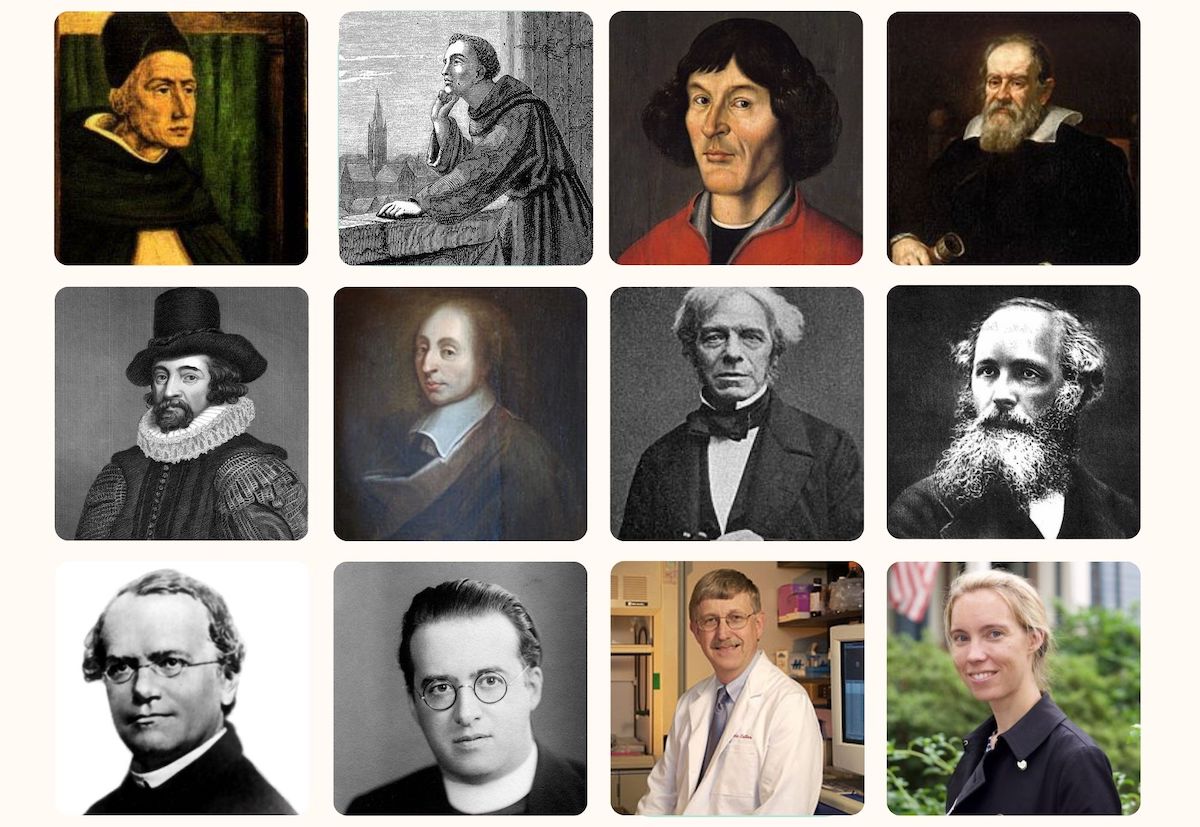
As many a scientist in history has done.

I did not reach that conclusion in an instant. Perhaps, the normal thing is for a person to discover perspective, ultimate perspective, over the course of his or her life. Perhaps some will not reach a completely satisfactory answer. But if God created minds to search for answers, He will perhaps not allow that they do not reach the end of that purpose. If they do not find the answers in this life, then they must find it in the next. Immortality, therefore, must be true.

And that’s the ultimate destiny of minds: of people.

(Q.C., 231117)

Science and Faith: Introduction

Is there a conflict between science and faith? Is one a lower kind of knowledge than the other? Has science debunked faith? Does evolution debunk faith? Or quantum theory? Does God exist?

No, there’s no conflict.

I get asked these questions sometimes, and they’re not difficult to answer. I know that my scope of knowledge and technique as a scientist are rather limited, and I don’t think I’m arrogant enough to think that I’m better than any non-scientist. On the contrary, the more I know and discover the more I realize how little I actually know, and the more I realize how much of nature is beyond the grasp of my tools.

Yet, the fact that my tools allow me to draw conclusions from experiments indicate that nature is reasonable, i.e., understood. With a little leap of intuition, I grasp that the reasonableness of nature is a reflection of a Reason that governs it. This sentiment I share with many fellow scientists.

Image: https://www.magiscenter.com/hubfs/scientists%20who%20believe%20in%20god%20magis%20center.jpg

On the other hand, I’m not naive that I don’t get it why people don’t see things the way we do. Most fellow scientists I work with are not atheists, but we do know some very good ones who are. I understand this. I understand that experience, feelings, intuitions are equally tools of reason, and like the tools of science they can be inadequate and lead to wrong conclusions. I therefore think that although tools are normally used in a certain correct way, not everyone will use them so.

But the basic substrate of all we experience is Reality. And this Reality is internally consistent. If science and faith deal with reality, then there should be no conflict. They might look at the same thing from different perspectives. Disagreements arise from differences in perspectives and in my experience are almost always reconcilable.

These different perspectives represent different instruments in an orchestra. Each player doesn’t have to play on their own. But when they do, the result is beautiful.

I researched these series of essays to prepare for a talk that I eventually delivered before an audience from varying professions. And I began that talk in the same way with which began this introduction:

Conflict is an illusion.

(Q.C., 231117)

Science and Magic

When talking about science and magic — or, mystery, to be more precise –, we’re actually talking about two sides of the same coin. I mean, what’s the big difference? Both of them deal with the mysterious parts of nature, right? Science tries to explain the inexplicable, while magic is just another name for the unexplained. So, let’s dive into this mind-blowing connection between the two.

First off, let’s talk about how science has its roots in magic. Back in the day, people used to think that the forces of nature were magical. Lightning? That’s Zeus tossing thunderbolts. Earthquakes? It’s the Earth god getting all mad and stuff. So, it’s no wonder that early scientists were like magicians in their own right. They were trying to understand the mysteries of the world around them, and even though they didn’t always get it right, they were onto something.

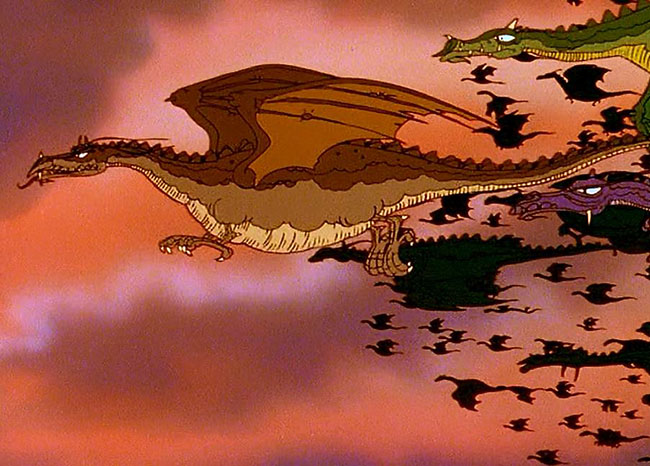
One of my favorite movies growing up was Flight of Dragons (1982). A medieval, magical world is threatened with extinction by the rise of science. Its keepers, wizards, propose to hide a tiny part of this world behind an invisibility shield to protect it. “A foolish retirement village,” scoffs the evil wizard Ommadon, who offers instead to corrupt mankind, causing humans to use their science to destroy themselves. Carolinus, a good wizard, summons Peter Dickinson, a science nerd and dragon geek from the real world of the future, and transports him into this other world and accidentally puts him in the body of a dragon. As Peter and his friends face epic battles, he realizes that his science becomes his secret weapon.

For all its power, magic cannot trump what is real.

At their climactic face-off, Ommadon dares Peter to deny all magic. To do away with the evils of imagination – lies, superstition, deceit – Peter must also admit that the pleasures of it are equally insubstantial.

“SAY IT!”, says Ommadon.

Peter after some thought, replies with conviction: “I deny all magic!” Then he defeats Ommadon with incantations of his own: “algebra, anatomy, astronomy, biology”, etc. until the evil wizard sublimates. But having denied magic, he must return to the real world and forever leave Carolinus and his friends, including the beautiful Princess Melisande.

The movie and especially the book of the same title, explained a lot to a kid. Why and how did dragons fly and breathe fire? Both were the result of an evolutionary specialization to fly like a blimp. Dragons were balloons. Hydrochloric acid, what we have in our stomachs, reacted with calcium carbonate from either limestone or renewable bone to produce hydrogen, which lifted the dragon, its wings more like fins for maneuvering or propelling rather than for lifting as with birds and bats. The acid is the highly noxious “dragon’s blood” of legend, and the reason there are no dragon fossils. The dragon at rest produced gas in smaller amounts. Whether it burped gas to land, or released excess gas at rest, it had to ignite it, probably with chemicals like the bombardier beetles, because unburned hydrogen is toxic especially if it accumulates in the dragon’s lair: caves. Fire later became a weapon and a form of display. Since dragons ignite gas in their sleep, they hoard gold as bedding material because it is soft, acid resistant, and non-flammable.

So, even in this mystical world, rational questions aren’t out of place, and there is a reason behind the workings of these fantastical creatures. Ah.

Now, adult, think about how science has evolved over time, in the real world. We’ve figured out a ton of stuff that used to be considered magical. Electricity? We got that down. Flight? No problem. And though we’ve come a long way, there’s still so much we don’t understand. Dark matter and dark energy make up like 95% of the universe, but we barely know anything about it. It’s like we’re still chasing after those magical mysteries, and every time we learn something new, it feels like we’re pulling back the curtain on a magic trick.

Now here’s the kicker: the more we learn about the universe, the more magical it seems. Quantum mechanics is just straight-up bizarre. Particles can be in two places at once, and they can change their behavior just by being observed? It’s like nature is saying, “Hey, I’ll let you in on some of my secrets, but there’s always gonna be more magic waiting for you.”

And so, back in 20th century Boston at the end of the movie, Peter is selling a magic flute and shield to a pawnbroker when Melisande enters the shop as a normal Bostonian girl, carrying Ommadon’s power crown, and the two embrace.

What’s the moral of the story? Science and magic are like best friends forever, and they’re always going to be linked. We’ve come a long way since the days of ancient myths, but we’re still chasing after those mysteries. And as long as there’s something left to explore, we’ll never lose that magical sense of wonder.

Two peas in a pod. Both try to explain the mysterious parts of nature. As we learn more about the world around us, we can’t help but see the magic in it. We stay curious as children.

(Q.C. 230420)