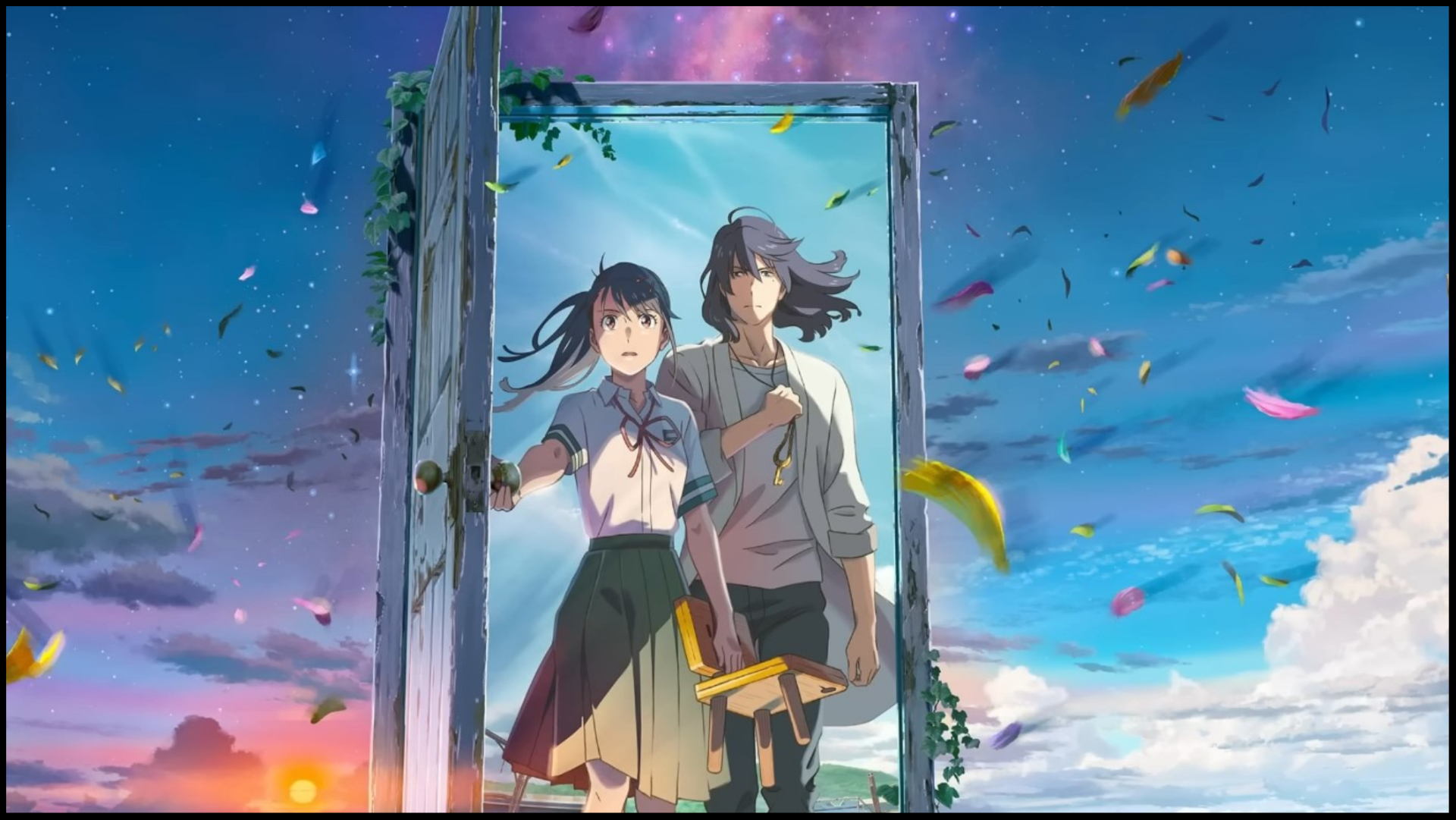
These two films are worth entering into the Japanese canon: Suzume (2022) and The Last Recipe (2017).
Suzume (Suzume no Tojimari) is a 2022 Japanese animated coming-of-age fantasy adventure film written and directed by Makoto Shinkai. The film follows 17-year-old high school girl who teams up with a young stranger to prevent a series of disasters across Japan by sealing doors from the colossal, supernatural worm that causes earthquakes after being released.

Suzume, a girl from Kyushu, meets a young man, Souta Munakata, who is searching for special doors that lead to an otherworldly realm. After an incident at an abandoned resort, Suzume learns that Souta is a “Closer” who locks these doors to prevent a supernatural “worm” from causing earthquakes. During their journey to secure these doors, Souta becomes trapped in the Ever-After, a place where souls reside after death, due to the actions of a “keystone” cat named Daijin, whose job it is to guard the doors.
In her quest to rescue Souta, Suzume discovers she has a connection to the Ever-After because of a traumatic event during her childhood in the Tōhoku region. With the help of various allies, including her aunt Tamaki and Souta’s friend Serizawa, Suzume finds the door she needs to enter the Ever-After in the ruins of her childhood home. Inside, they manage to save Souta, but at the cost of Daijin’s sacrifice.
In a twist, Suzume meets her younger self and provides comfort, altering her past and giving her strength to face her future. The story concludes with Suzume and Souta reuniting in Kyushu, hinting at new beginnings.
What I think the story is about. Suzume represents a reversal of the traditional Japanese hero-cult, where the hero is a kamikaze who is either killed or kills himself. In this movie, Souta unwillingly takes on the role of the “killed” hero and acquires glory as an immobile but basically dead guardian of the Ever-After. But Suzume “rescues” him from that role, which is taken over by Daijin whose job it was in the first place to be guardian. Daijin temporarily left his job to enjoy life. But after a short vacation that put various cities at serious risk of earthquakes, he takes on his job again. Heroism, therefore, is not about killing or getting killed, but doing one’s job faithfully. Although temporary breaks are not bad.
“The Last Recipe” (Kirin no Shita no Kioku) is a 2017 Japanese live action film film directed by Yojiro Takita. It’s based on the novel “Kirin no Shita wo Motsu Otoko” by Keiichi Tanaka.

The story revolves around Mitsuru Sasaki, a talented chef who possesses an exceptional talent: the ability to remember every taste he has ever experienced. However, his own restaurant goes bankrupt because he pays too much attention to the taste rather than the profitability of his dishes. To earn a living after the bankruptcy, he starts to recreate dishes from restaurants, old recipes, and even personal memories if given the ingredients and basic information about the dish.
However, his unique talent comes at a cost. Every time he uses his memory to recreate these tastes, he loses a piece of his own passion.
Sasaki is then approached with a unique request. A wealthy client wants him to recreate a royal feast dating back to the 1930s Imperial Japan, which was made by the legendary chef Naotaro Yamagata in Manchuria. As Sasaki delves deep into the mystery of Yamagata and the royal feast, he embarks on a journey that takes him through the tumultuous history of Japan and the intricacies of Japanese cuisine. The culinary journey, perseverance, experience of loss, and the healing power of food reignite his passion.
What I think the story is about. The Last Recipe is built around a progression: from craft, to art, to sacrament. Mitsuru is an expert craftsman with talent and technique to prove it. He is famous for his creativity. But his obsession for perfection and inability to be pleased by anything less alienated his closest friends (save for one) and sapped his soul. His journey involved his reliving in his mind the creation of the mystery dishes as if he were making them himself. He gradually learns that the recipes were more than a technique: they incarnated the experiences, the feelings, and the relationships joyful and tragic, of all those who were involved. At this point art became sacrament, and he found his soul.
“Suzume” and “The Last Recipe” are masterworks of visual storytelling. Suzume’s animation represents the best of what animators can do. The Last Recipe is a visually stunning film with its detailed culinary creations. I know food shots are extremely difficult to do well.
Both films are heartwarming stories that transcend time and borders.
(Q.C. 230807)
 jaylazzo